


[!tip] Author’s Note:
This piece is part of a curated series to help you experience Portugal like you actually know somebody here (me).
View the complete visitor’s guide for my personal advice and a few free lessons that will teach you enough Portuguese to order your food and navigate your way around more confidently.
Most American visitors fly into Lisbon, spend a few days, maybe pop up to Porto, and head home.
That’s a great trip. But Portugal is small (about the size of Indiana), and the country opens up significantly once you get out of the two big cities.
Each region has its own food, its own pace, its own kind of person who lives or vacations there. This is a quick overview to help you figure out what fits your style.
[!tip] Looking for immediate Lisbon day trips?
If you plan to visit spots just outside the capital like Sintra, Cascais, or Costa da Caparica, check out my Lisbon Orientation Guide. The guide below focuses on the larger regions across the rest of the country.
Coimbra
Coimbra is Portugal’s third largest city and home to one of the oldest universities in Europe, founded in 1290. The old university buildings sit at the top of a hill overlooking the Mondego river, and the historic library inside is one of the most beautiful in the world.
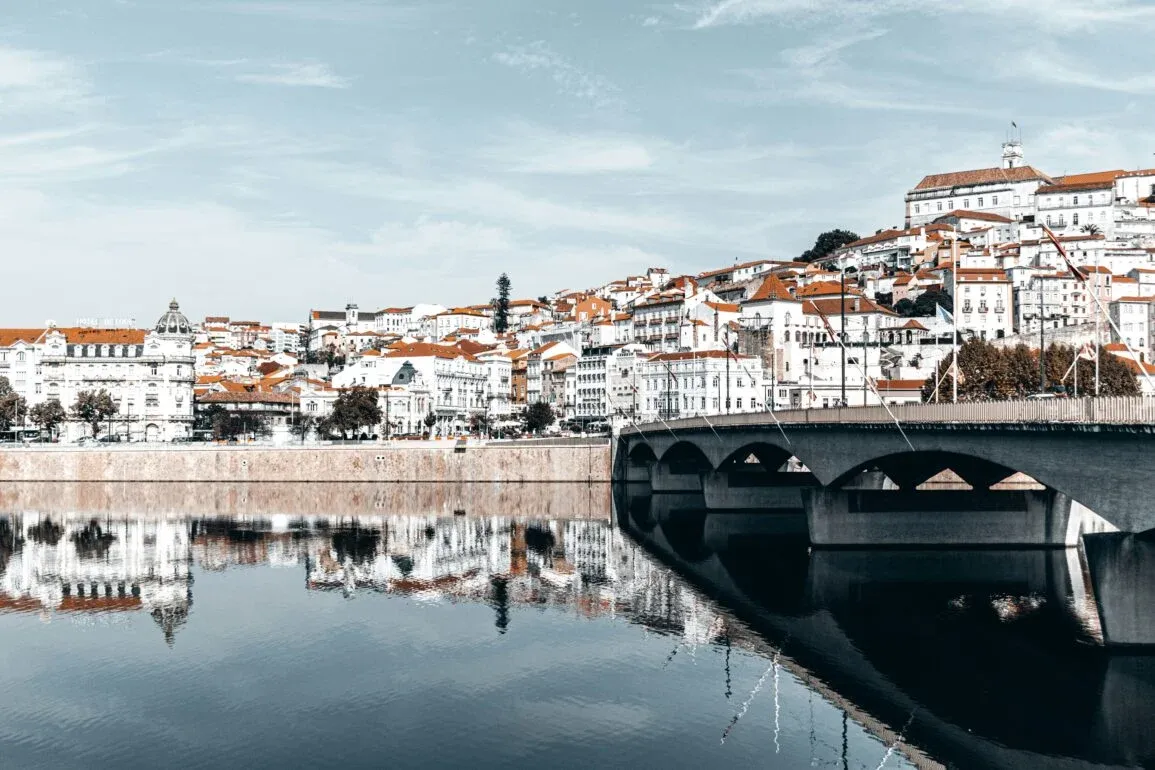
The city itself is walkable, has a nice riverfront, and a good local craft brewery scene (the brewpub Praxis is well-regarded if you’re into beer). It’s small enough to cover in a day but interesting enough that some people use it as a base for a longer stay in central Portugal.
The regional specialty dish here is called “leitão” (suckling pig), roasted whole and served in thin slices with crispy skin, garlic, pepper, and orange slices to cut through the richness.
A special spot for this dish specifically is called Rui dos Leitões and is about a 9 minute drive/Uber from Coimbra city center. We’ve been here three times and each time has been special.
Truly a foodie? A local will tell you the “best” spots to get this are in Mealhada, a small town about 25 minutes north on the highway, where places like Pedro dos Leitões and Rei dos Leitões have been doing this one dish for generations. If you’re serious about trying leitão and have a way of getting there, the detour is supposedly worth it (never tried these latter two myself but please let me know if you do!).
[!tip] Use Coimbra as a midpoint Coimbra sits roughly halfway between Lisbon and Porto on the main highway. If you’re driving between the two cities and don’t want to do it in one shot, Coimbra is the perfect lunch stop or full-day break. Leitão for lunch, walk the university, hit the road.
Óbidos
Óbidos is a perfectly preserved medieval walled town about an hour north of Lisbon, and it’s one of the easiest day trips you can do from the capital. The entire town sits inside intact 14th-century walls that you can walk on top of, with whitewashed houses trimmed in blue and yellow, narrow cobblestone streets, and a castle at one end (now a state-run pousada hotel).
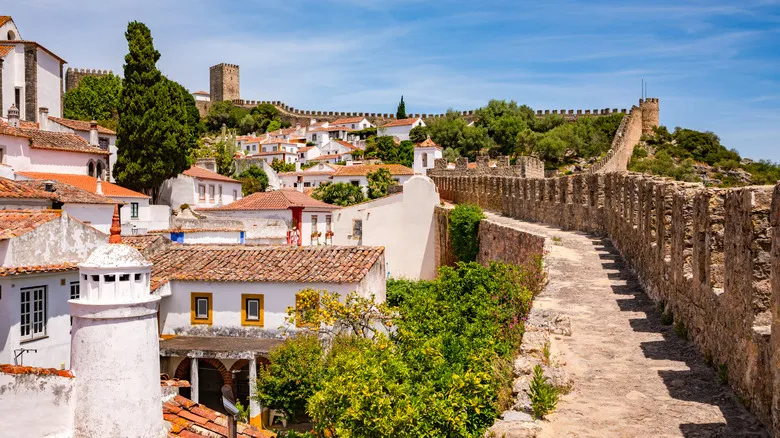
The crowd is heavy with tour buses during the day in high season, so the move is to either go early or stay the night. Óbidos has a few small hotels and guesthouses inside the walls, and the town empties out completely after the day-trippers leave.
Walking the streets at night with no one around is the version most people miss.
The local specialty is ginjinha, a sweet cherry liqueur made from sour Morello cherries. In Óbidos, it’s traditionally served in small edible chocolate cups. You knock back the shot, then eat the cup. There are kiosks selling it on practically every corner inside the walls. A few cups will run you €5 and it’s part of the experience.
Óbidos also hosts a famous Medieval Festival every July, with full medieval-themed reenactments, costumes, food stalls, and music. If your trip lines up with it, worth planning around. There’s also a Christmas village called “Vila Natal” every December that’s supposed to be quite lovely.
The Alentejo
The Alentejo is the big rural region between Lisbon and the Algarve, and it’s where Portugal slows all the way down. Rolling plains, cork oak trees, whitewashed villages, fields of wheat, and a pace of life that hasn’t changed much in centuries.
The crowd here is mostly Portuguese, on weekend escapes from Lisbon or wine pilgrimages to the local quintas. You’ll see fewer Americans than almost anywhere else in the country, which is part of the appeal.
The food is heavier and the wines are bigger. The regional specialty is porco preto (black Iberian pork) from acorn-fed pigs, served in a hundred ways but always rich. Pair it with the local red wines, which run heavier and more tannic than what you’ll get elsewhere in Portugal.
Évora
The must-visit town in the Alentejo is Évora, a UNESCO World Heritage city about 90 minutes east of Lisbon by car. The historic center is small enough to walk in half a day, but worth lingering in.
The headline sights:
The Roman Temple of Évora (sometimes called the Temple of Diana) sits in the middle of the old town, mostly intact, dramatically lit at night. It’s nearly 2,000 years old. Free to view from the square.
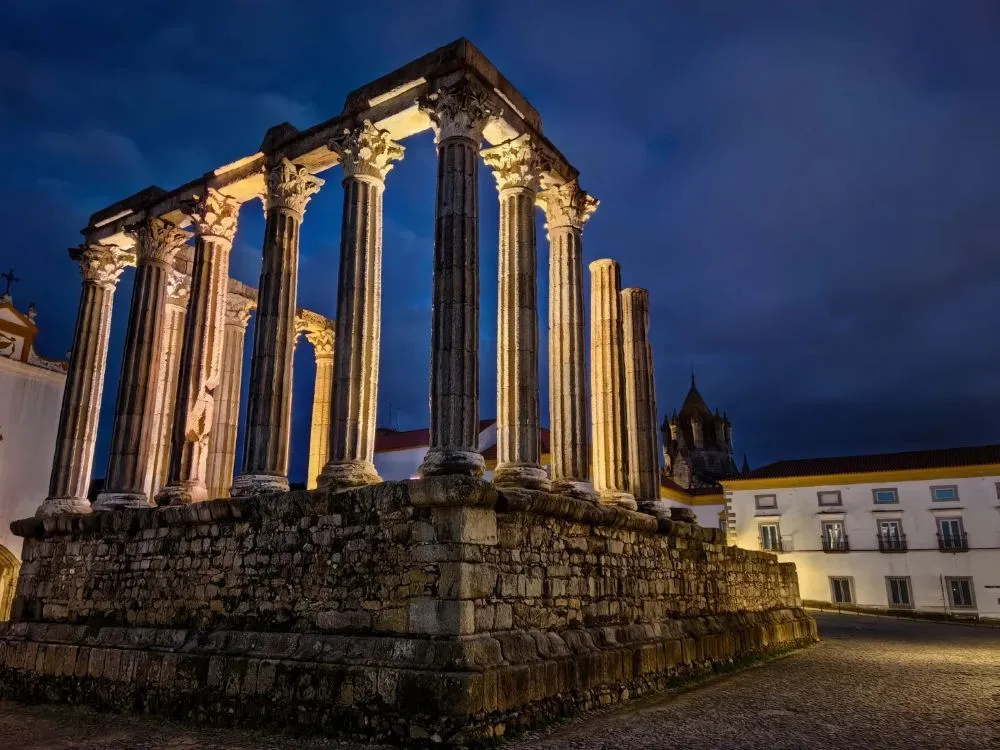 The ancient Roman Temple of Évora
The Capela dos Ossos (Chapel of Bones) is a small chapel where the walls are lined with the skulls and bones of about 5,000 monks. The inscription above the entrance translates to “We bones that are here, for yours we wait.” It’s not as macabre as it sounds in practice. Small fee to enter.
The Sé de Évora is the city’s cathedral, the largest medieval cathedral in Portugal. You can climb to the roof for views over the old town.
Évora also has a great food scene built around “Alentejano” classic cuisine (my favorite dish is called Carne de Porco à Alentejana, which is a hearty dish with pork, clams and potatoes).
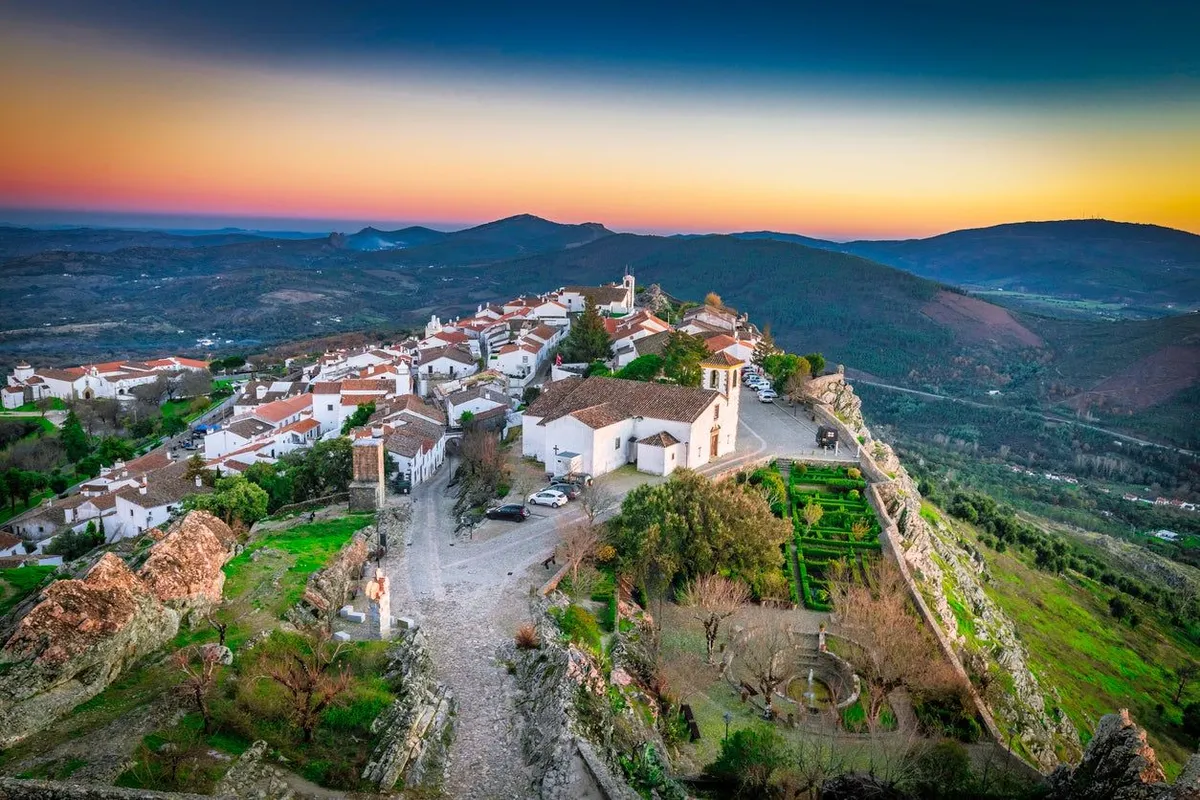 The charming village of Marvão in the Alentejo
Beyond Évora, the smaller towns of Monsaraz, Estremoz, and Marvão are all worth a stop if you have time for a multi-day Alentejo loop.
The Algarve
The Algarve is the entire southern coastline of Portugal, stretching from the Spanish border in the east to the southwestern tip of the country. It’s the part of Portugal most Americans have heard of even if they don’t know the name.
The whole region is built around sun, beaches, and dramatic Atlantic cliffs. The geography is genuinely stunning, especially around Lagos, Sagres, and the western Algarve, where orange cliffs drop into turquoise water and hidden sea caves are accessible by boat.
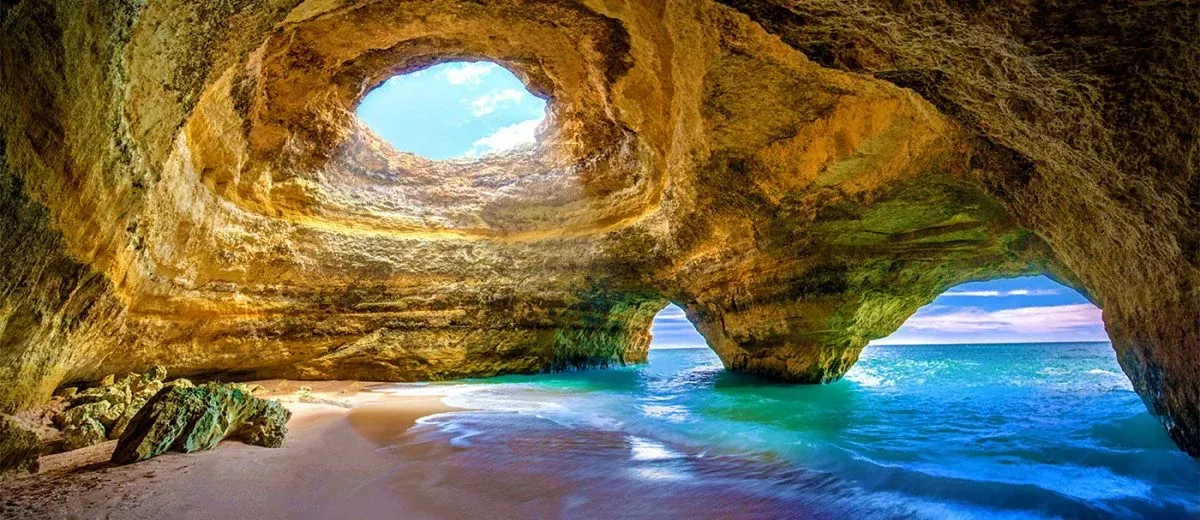
Faro Airport is the main entry point, and United Airlines runs a seasonal direct flight from Newark from roughly mid-May through September. If you’re planning a beach-focused trip, flying directly into Faro can save you a connection through Lisbon.
The crowd here is distinct. You’ll see a lot of British retirees (the Algarve has been a British holiday destination for decades), families on resort vacations, golfers, and a growing American immigrant population around Lagos, Albufeira and Portimão.
It’s the most internationally touristed part of Portugal, which has pros (English is spoken everywhere, lots of infrastructure) and cons (many towns feel less Portuguese, more expensive during peak season).
Things worth doing:
- Do the “7 Hanging Valleys Hiking Trail” along breathtaking seafront cliffs. Get started early, bring a hat and lots of sunscreen as you’re likely to get a LOT of sun doing this, but the views are 100% worth it.
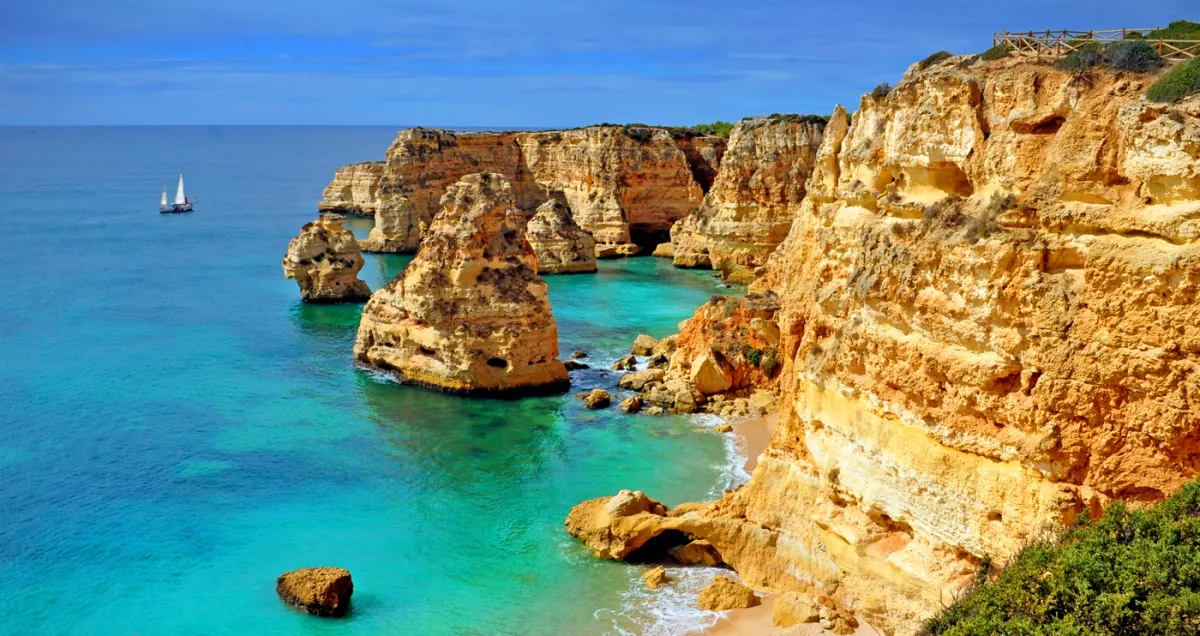 A common view along the 7 hanging valleys hiking trail
-
Book a boat tour of the sea caves out of Lagos, Albufeira, or Benagil. The Benagil Cave is the famous one (photographed above), with the open ceiling and the small beach inside, and you can only reach it by water. Go early in the day to beat the crowds and the wind. You might even get lucky and ride alongside dolphins (we did!)
-
Eat a cataplana, the traditional southern Portuguese seafood stew cooked in a copper clam-shaped pot. It’s the regional dish and it’s incredible.
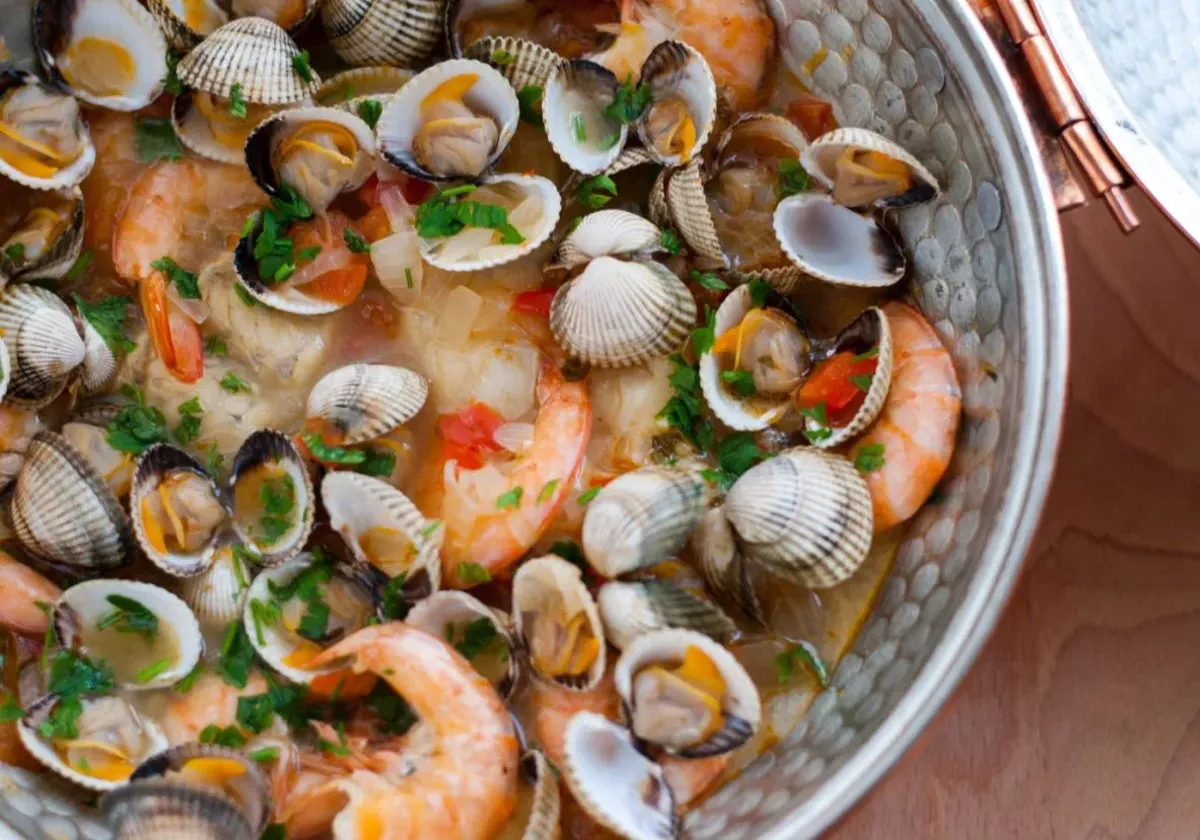 Cataplana de Mariscos, an Algarve specialty
- Drive west to Sagres and Cabo de São Vicente, the southwestern tip of mainland Europe. The cliffs and the lighthouse at the edge of the world feel appropriately dramatic.
The Silver Coast
The “Silver Coast” (Costa de Prata) is the central Atlantic coastline north of Lisbon, running up to roughly the Aveiro region. It’s a region of small fishing villages, rugged surf beaches, and far fewer tourists than the Algarve.
The crowd here is a mix of surfers (particularly around Peniche and Ericeira), history buffs visiting the medieval towns, and a growing population of European and American immigrants who’ve moved out of Lisbon for quieter lifestyles and more affordable coastal living.
Nazaré is a working fishing town that became globally famous for having the largest surfable waves in the world. From October through March, waves of 60, 80, even 100 feet form just offshore at Praia do Norte.
During the winter months, watching surfers tow into these things from the lighthouse at the top of the cliff is one of the most surreal experiences you can have in Portugal. Even outside of big-wave season, Nazaré has a beautiful beach, a beautiful, walkable promenade, and great seafood.

Peniche and Ericeira are the main surf towns, both within an hour of Lisbon.
Ericeira in particular, while beautiful, has become a hub for surfers and digital nomads. Some people love its “eat pray love” vibe, it makes me a bit uncomfortable, personally. While the city may aesthetically look like Portugal, you’ll quickly realizing half the town are white, Native English speakers.
The Schist Villages
Inland from the coast, in the mountain ranges of central Portugal (Serra da Lousã and Serra do Açor), there’s a network of 27 ancient villages called the “Aldeias do Xisto” (Schist Villages). They’re tiny medieval settlements built almost entirely from schist, a dark gray metamorphic stone that’s plentiful in these local mountains. The houses, the walls, the streets, all of it is the same dark stone, which makes the villages look like they’ve grown organically out of the hillsides.
Most of these villages were nearly abandoned in the second half of the 20th century before a regional preservation project in the 1990s restored them and converted many of the houses into small guesthouses. Today you can stay in a 600-year-old schist house with modern plumbing and Wi-Fi for a few nights and feel like you’re in another century.
Piódão
The most famous and most photogenic of these shist villages is Piódão, in the Serra do Açor. It sits in an amphitheater shape on a steep slope, with all the houses cascading down the hillside in dark schist with bright blue painted doors and windows. The whole village is sometimes compared to a nativity scene, especially when it’s lit up at night or fogged in.
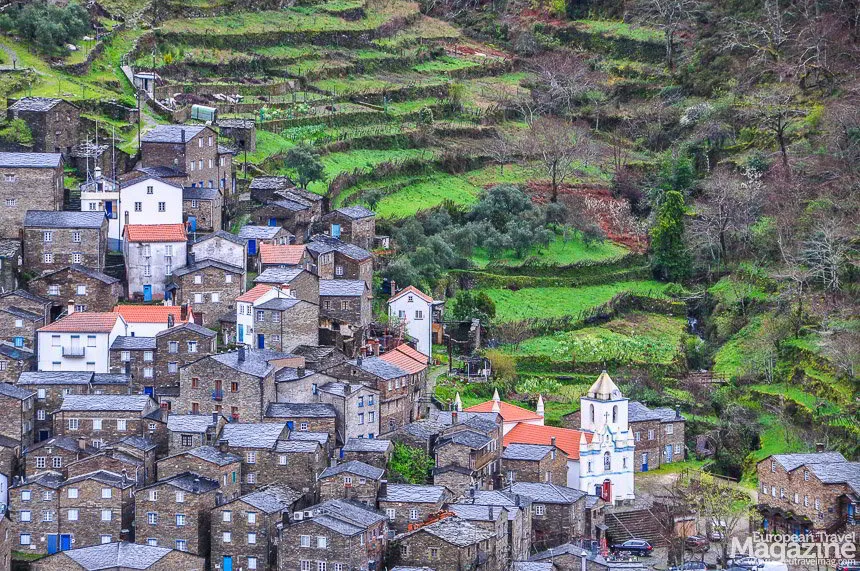
Piódão is genuinely remote. Until the 1970s, the only way to get there was on foot or by horseback. Even today, the drive in involves winding mountain roads. It’s about 2.5 hours from Lisbon, 2 hours from Porto, or about 90 minutes from Coimbra. Plan accordingly.
The village itself is small. You can walk the whole thing in an hour. The real value is staying overnight, eating chanfana (the regional dish of slow-cooked goat in red wine) at one of the small restaurants, walking the trails into the surrounding mountains, and seeing the night sky. The area has some of the darkest skies in Portugal.
A few other schist villages worth knowing about:
-
Talasnal in the Serra da Lousã is more accessible (about 40 minutes from Coimbra) and is one of the better-preserved villages.
-
Cerdeira has become a small artist and craft community with regular workshops and residencies.
-
Foz d’Égua, about 10 minutes from Piódão, isn’t technically a village but a tiny river-beach hamlet with two suspension bridges over crystal-clear water. Worth the short detour.
River Beaches
Speaking of river beaches… this deserves its own mention because it’s something most international visitors have no idea about. Portugal has “praias fluviais” (river beaches) all over the central and northern interior, and they’re one of the great pleasures of a Portuguese summer.
A praia fluvial is exactly what it sounds like, a stretch of river that’s been turned into a swimming spot, usually with a small dam to create a deeper pool, a sandy or pebbly bank, a kiosk for drinks and snacks, and sometimes lifeguards in peak season. The water comes off the mountains and stays cold even in August, which is exactly what you want when it’s 100°F outside and you’re a two-hour drive from the nearest ocean.
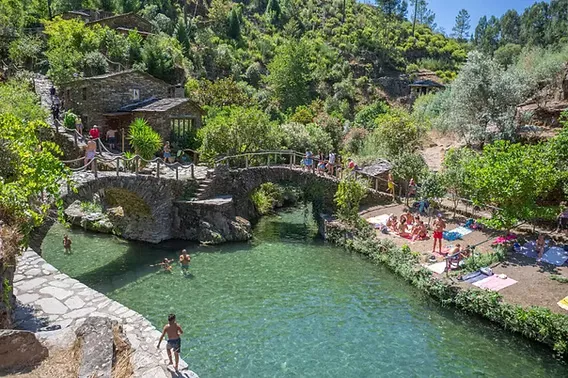
The schist villages region has dozens of them, including the Praia Fluvial de Piódão right at the edge of the village. Other well-known ones include Praia Fluvial do Pego Fundo near Alcafozes, the river beaches around Loriga in the Serra da Estrela, and Fragas de São Simão near Figueiró dos Vinhos, which has dramatic schist cliffs around the swimming area.
If you’re traveling in July or August and finding inland Portugal too hot, a river beach afternoon is the answer. It’s also a super neat, local experience. You’ll be surrounded by Portuguese families on weekend trips and very few tourists.
Braga
Braga is in the far north of Portugal, about 50 minutes inland from Porto, and it’s a unique kind of city. It’s one of the oldest cities in the country and a deeply religious one, sometimes called the “Portuguese Rome”.
But it’s also home to the University of Minho, which means the historic streets are full of young students. The combination of medieval cathedrals and college-town energy makes it feel different from anywhere else in Portugal.
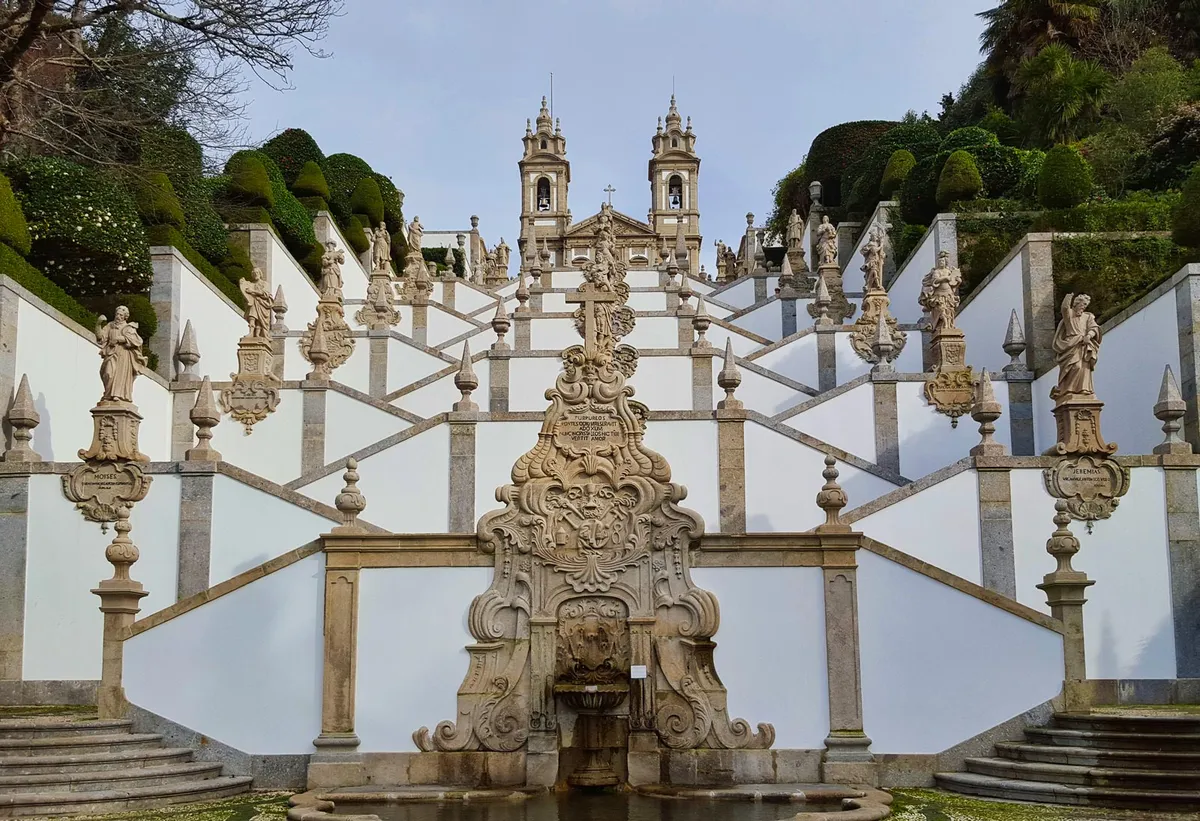
The headline attraction is Bom Jesus do Monte, a sanctuary on a hillside just outside the city. It’s famous for its monumental Baroque staircase, which zigzags up the hill in symbolic stages representing the Stations of the Cross. You can walk up the stairs (a workout) or take a 19th-century funicular powered by water counterweights. The views from the top are great.
In the city itself, the Sé de Braga (cathedral) is one of the oldest in Portugal, and the historic center is small enough to walk in a few hours.
For food, try Pudim Abade de Priscos, the regional dessert. It’s a rich, dark egg-yolk pudding made with port wine, bacon fat, and lemon. Sounds strange, tastes incredible.
Setúbal and Comporta
Just south of Lisbon, across the Tagus river, the Setúbal peninsula has two very different scenes within a 45-minute drive of each other.
Setúbal is a working-class fishing port and Portugal’s third-largest harbor city. It’s gritty, authentic, and beloved by Lisbon foodies who make the trip specifically to eat choco frito (fried cuttlefish), the regional specialty. The cuttlefish is breaded, deep-fried, and served with rice and salad. It’s simple and delicious. Spots like Casa Santiago and Xtoria are the local institutions.
Setúbal is also the launch point for boat trips to see dolphins in the Sado Estuary and for ferries to the Tróia peninsula, a long sandy spit across the bay.
Comporta, about 45 minutes south of Setúbal, is something else entirely.
It’s a string of small beach villages on the Atlantic side of the Tróia peninsula that has become one of the most fashionable beach destinations in Europe over the past decade.
Long sandy beaches, pine forests, rice paddies, and a deliberately understated “boho luxury” aesthetic. The crowd skews wealthy, international, and quietly famous. Madonna has a house here. Christian Louboutin too.
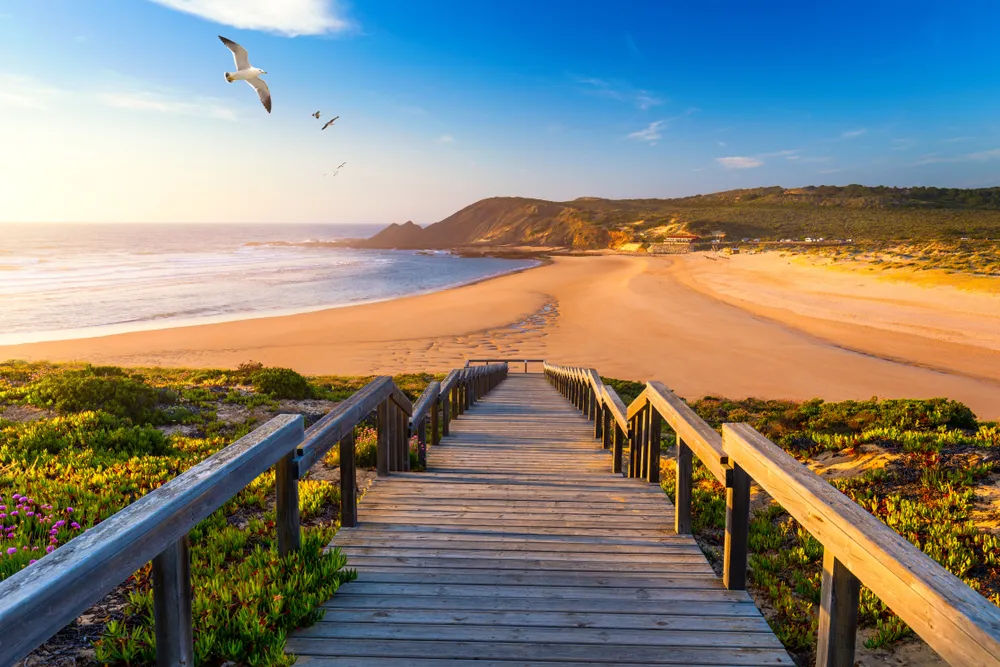
The contrast between Setúbal and Comporta is worth discussing. You can eat fried cuttlefish standing at a counter in a working port for lunch, then drive 45 minutes south and have a €25 cocktail watching the sun set over the dunes. Both are worth experiencing.
Portugal is small enough that you can sample several of these regions on a two-week trip if you’re willing to drive. A common loop people do: fly into Lisbon, spend a few days, head south to the Alentejo for a night in Évora, continue down to the Algarve for a few days, drive back up via the Silver Coast and Óbidos, swing through Coimbra and the schist villages for a couple of nights, and finish in Porto with Braga as a day trip.
Or just pick one region and stay put. The country rewards both approaches.
[!question] Hungry for more? If you want to know exactly what to order when you sit down at a local restaurant, read my Guide to My Favorite Portuguese Dishes.
Boa viagem!
