


For a long time, I tried to say things like “I gave the book to him” as Eu dei o livro… para ele. It felt clunky. I knew it sounded like a bad translation, but I had no other way of saying it.
Then I started noticing how my Portuguese friends said the same thing. I never heard para ele. Instead, they used a tiny, quick sound that seemed to be the secret ingredient.
(I couldn’t really catch it at first, but I eventually figured out what they were doing.)
“lhe.”
“lhes.”
It sounds strange coming out of a non-Portuguese mouth at first, but it makes your sentences a lot smoother once you get the hang of it.
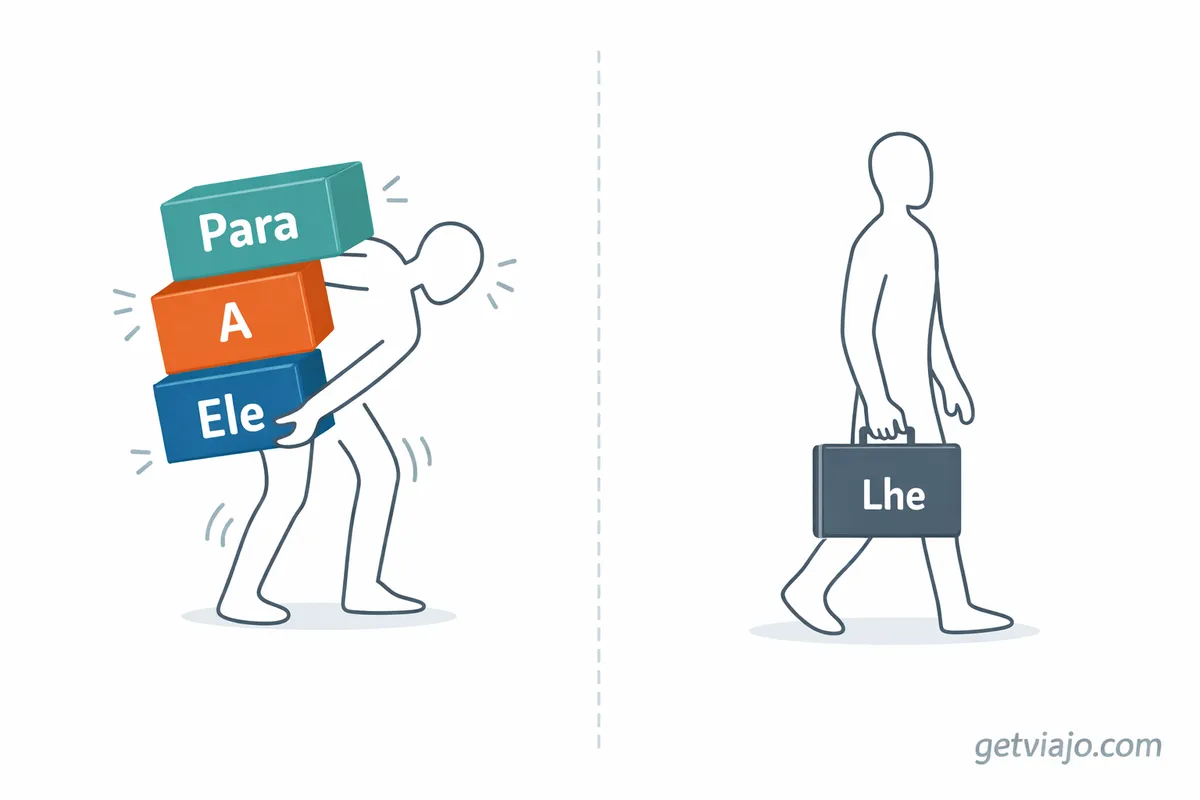
Lhe as a Compression Tool
I think of lhe less as a grammar rule and more as a compression tool.
In English, we use two words (“to him” or “to her”). In Portuguese, you compress that idea into a single sound, lhe. It makes your sentences faster and lighter.
If the sheer number of pronouns feels overwhelming, I have a wider map in my guide to making sense of Portuguese pronouns. Today we are sticking with the “receiver.”
The Pizza Test
Before we get to the table, you need to make sure you are using lhe for the right person. Pass the Pizza Test first.
Picture yourself giving a pizza to your friend João.
- The pizza is the thing being moved (direct object).
- João is the person receiving the pizza (indirect object).
“Lhe” is ONLY for João.
You can never use lhe for the pizza itself. You can’t lhe a pizza. You can only lhe the person receiving it.
The Logic Map
The rules are simpler than they look. Here is the conversion chart.
| The Estrangeiro Way | The Smart Fix |
|---|---|
To me (-me)O João deu a caneta a mim. (João gave the pen to me.) | O João deu-me a caneta. (João gave me the pen.) |
To you (-te)Ele pediu um favor a ti. (He asked a favor of you.) | Ele pediu-te um favor. (He asked you a favor.) |
To him / her (-lhe)Mandei uma mensagem ao João. (I sent a message to João.) | Mandei-lhe uma mensagem. (I sent him a message.) |
To them (-lhes)Ele telefonou às amigas. (He phoned [to] the friends.) | Ele telefonou-lhes. (He phoned them.) |
Notice how the smart version cuts the preposition a (“to”) entirely. You do not send to him, you send him. It works the same way in English.
[!tip] Pro Tip Get in the habit of dropping the Eu, Tu, Você, etc., and let the conjugations speak for themselves.
Instead of Eu mandei-lhe, just say Mandei-lhe. It is faster and sounds more native.
[!warning] A Note on “Você” In conjugation charts, Você sits in the same row as Ele/Ela. So if you are being polite to a stranger or a boss, you would use lhe.
That said, while “Você” is the grammatical category, be careful about saying the actual word “você” to someone’s face. I’ve been told that in many parts of Portugal, it can sound aggressive or crudely direct. Dropping it is usually the safer move (and sounds more native anyway).
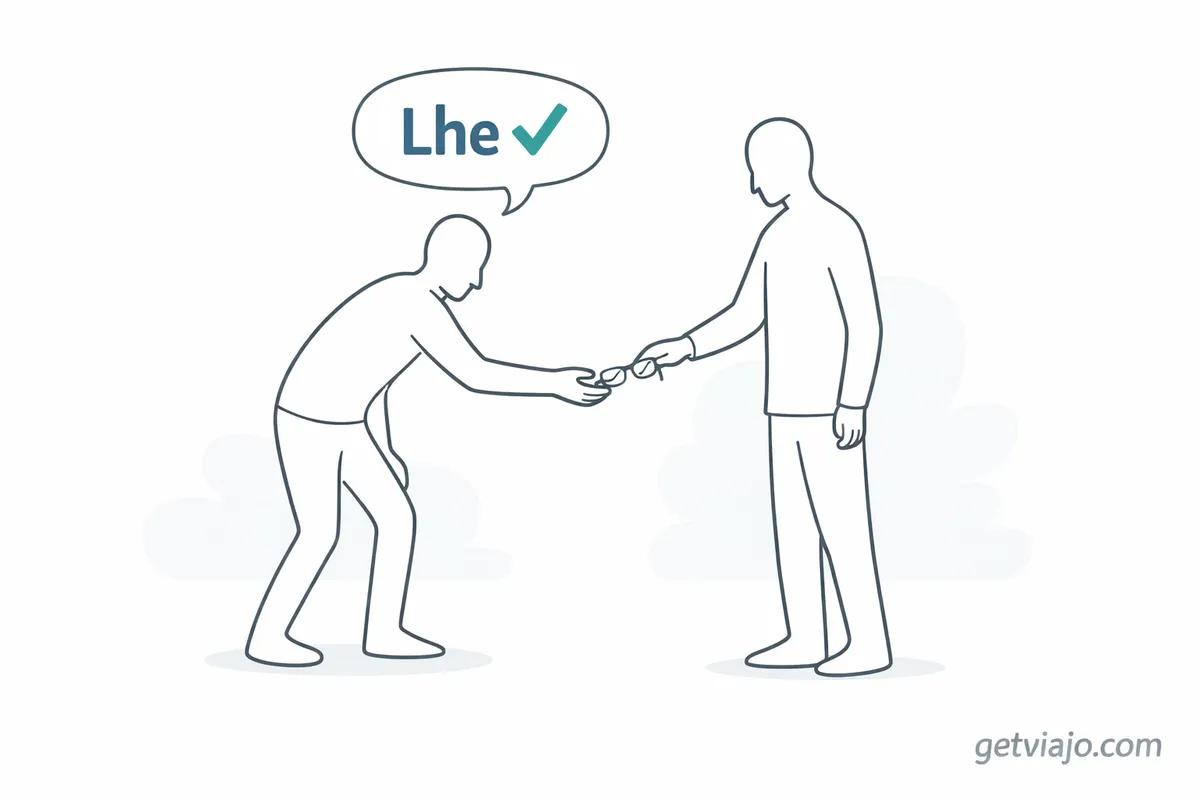 Using ‘lhe’ is the safest bet for polite interactions.
Five Verbs Where Lhe Shows Up Often
You will need this for many things over time, but I’ve been told that lhe tends to cluster around these five verbs:
- Dar (to give)
- Dei-lhe o dinheiro. (I gave him the money.)
- Dizer (to say / tell)
- Disse-lhe a verdade. (I told him the truth.)
- Pedir (to ask for / request)
- Ele pediu-lhe um favor. (He asked him for a favor.)
- Perguntar (to ask a question)
- Podes perguntar-lhe quando é que ele vem? (Can you ask him when he is coming?)
- Telefonar (to call)
- Ela nunca lhes telefona. (She never calls them.)
Audio lessons and PDF study guides to accompany every lesson
Get In on the Ground Floor!
This is a new website!
As such, I'm starting the price for premium at just $2.99/mo, increasing to $11.99/mo after my first 100 members.
Where to Put It
I’ll be honest, this is the part I still trip over.
In standard European Portuguese, the pronoun usually goes after the verb, connected by a hyphen.
- Dei-lhe a chave. (I gave him the key.)
But certain words act like magnets. They pull the pronoun from the end of the verb to the front. Miss this and you are immediately outed.
The three biggest magnets are negatives, questions, and adverbs.
| Type | Portuguese Example (Why) |
|---|---|
| Standard | Dei-lhe a chave. (Normal placement, after the verb.) |
| Negative | Não lhe dei a chave. (“Não” pulls “lhe” to the front.) |
| Question | Quando é que lhe deste a chave? (“Quando” pulls “lhe” to the front.) |
| Adverb | Já lhe dei a chave. (“Já” (already) pulls “lhe” to the front.) |
[!note] Other Adverbs Watch out for words like ainda (still), sempre (always), and talvez (maybe). They are all magnetic.
- Eu sempre lhe disse isso. (I always told him that.)
One more thing. When the pronoun comes after, you include the hyphen (dei-lhe, dar-me, and so on).
When the magnet pulls the pronoun in front, the hyphen disappears too (não lhe dei, já lhe dei).
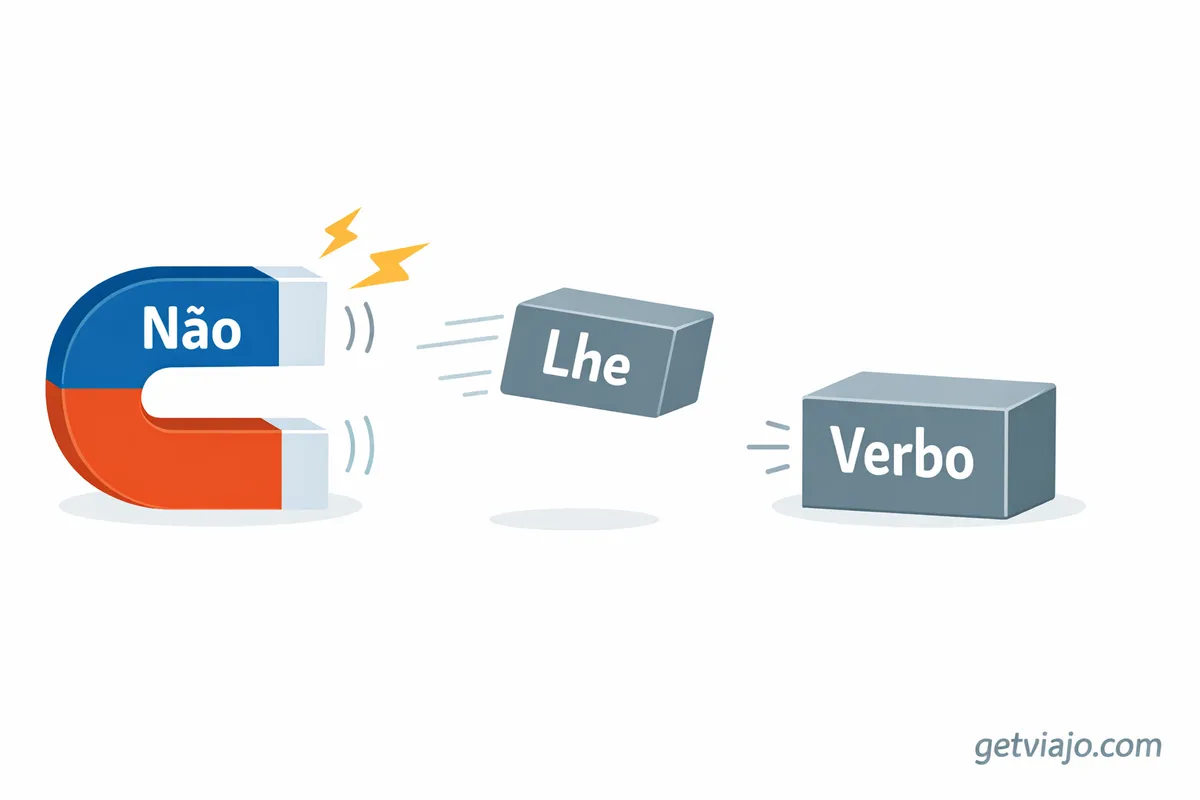 Negative words, questions, and adverbs are magnetic. They pull the pronoun to the front and remove the hyphen.
The Plural Trap
Don’t get lazy with the plural. If you are talking about “Eles” (them) or “Vocês” (you all), you have to use lhes.
- Ele telefonou às amigas. (He called his friends.)
- Ele telefonou-lhes. (He called them.)
Forget the ‘s’ and you are suddenly talking about a single person. The story gets confusing fast.
Next time you want to say Vou dar o livro ao meu pai, stop yourself and compress it.
Vou dar-lhe o livro.
It saves breath, and it makes you sound like you actually live here.
Frequently Asked Questions
[!faq]- Can I use “para ele” instead of “lhe”? You will be understood, but it isn’t quite right. “Para” indicates movement or direction (Vou para Lisboa). When you give something to someone, the preposition is “a” (Dei o livro a ele).
I believe “para ele” is more common in Brazilian Portuguese, but in Portugal, stick to “a ele” or the better shortcut, lhe.
[!faq]- Does “lhe” change for gender? No, this is the best part. “Lhe” works for “him,” “her,” and “you” (formal). You don’t have to match the gender of the person you are talking to. Context handles it.
[!faq]- What if I have two pronouns, like “give it to him”? When you combine a direct object (o/a) with an indirect object (lhe), they fuse. Lhe + o becomes lho. For example, Dei-lho (I gave it to him). Don’t worry about that yet. It’s coming in a future article. Master “lhe” first.
[!faq]- Why do I sometimes see “dar-lhe” and sometimes “lhe dar”? Dar-lhe is standard European Portuguese. Lhe dar is Brazilian usage. As mentioned above, if there is a magnet word like não, que, or já before the verb, European Portuguese also puts the pronoun first (Não lhe dou).
