


The first 30 seconds of a Portuguese dinner party often involves cheek kisses, coat-taking, and overlapping greetings.
I recently wrote about the broader rules of expected behavior in my article on navigating social etiquette in a new country. However, in THIS guide, I want to focus on helping you walk through the front door smoothly.
I used to hover awkwardly with my hand frequently half-extended, feeling silly, trying to listen and remember what I was supposed to say. The solution is simple. You basically just need a good hello and goodbye script.
This article is meant to help you memorize a handful of useful lines for the first five minutes and the last five minutes of the gathering.
 The anxiety of the arrival is universal, but the solution is scripted.
The Arrival Script
The initial arrival usually includes a physical greeting and the interaction depends on who you are meeting. Traditionally, this involves os beijinhos, which consists of two kisses, right cheek to right cheek first.
I have noticed a few cultural nuances regarding this practice.
Men greeting men usually stick to a handshake unless they are family. In professional settings, a man and woman meeting for the first time generally use a handshake.
Among younger crowds, I’ve been told that the double-kiss is becoming less common, especially if they are greeting a large group of people at once.
Here are the three scripts I use to get through the doorway smoothly.
Olá Tudo Bem
You can use this greeting most of the time with almost anyone, from your neighbor to your doctor.
| English | Portuguese |
|---|---|
| Hi, how are you? | Olá, tudo bem? |
| Everything is good. | Tudo bem. |
It is simple, expected, and polite. It’s almost rude not to say go through this sequence with everyone.
Group Greetings
When you walk into a room with many people, greeting every single person individually takes time. I often offer a general greeting to the group.
| English | Portuguese |
|---|---|
| How are you all? | Como estão? |
| Everything good? | Tudo bem? |
Nodding to the room while saying “Tudo bem?” while waving your hand and making eye contact with people from a distance is also an acceptable way to acknowledge everyone. People get it when there’s a large group and won’t think you’re being rude.
”Boas”
I have noticed many people using this casual greeting. “Boas!”
It is common among friends, younger crowds, and colleagues.
| English | Portuguese |
|---|---|
| Hey! | Boas! |
This expression signals that you are relaxed and already know each other well.
[!warning] Casual Settings Boas is efficient. Traditional Portuguese people can sometimes view it as overly casual in formal contexts. Only use it if you are well-acquainted with someone in a relaxed atmosphere. Otherwise, use “Olá, tudo bem?” to be safe.
Use “Boas” in casual settings, but switch to “Olá” for formal greetings.
The Men’s Greeting
I’ve observed that men greeting other men typically start with a handshake unless they are family or close friends.
After you become friends, the handshake often evolves into O Abraço (The Hug). It functions as a quick, warm greeting. I’m sure many of you have seen men do this, but it’s often this kind of masculine… shake right hands firmly > lean in > pat the other person on the back with your left hand.
Just extend your hand. If they pull you in, pat them back. It signals a shift toward friendship. Don’t overthink the ritual.
Settling In
Let’s say you are inside the hallway. Guests typically hand over the wine or food they brought, take off coats, and engage in initial chatter before reaching the living room.
Handing Over the Gift
When handing over whatever you brought, the goal, I’ve observed, is to be humble and slightly diminish the value of the gift.
| English | Portuguese |
|---|---|
| I brought a little thing for you guys. | Trouxe uma coisinha para vocês. |
| I brought a small souvenir. | Trouxe uma pequena lembrança. |
Calling it a coisinha (little thing) sounds much more natural and local than simply saying “here is a gift.” Expect the host to reply with the mandatory refusal script: “Ah, não era preciso!” (Oh, it wasn’t necessary!).
Sounds like I’m kidding, but in almost every Portuguese gathering I’ve gone to, I’ve seen some form of this exact ritual take place.
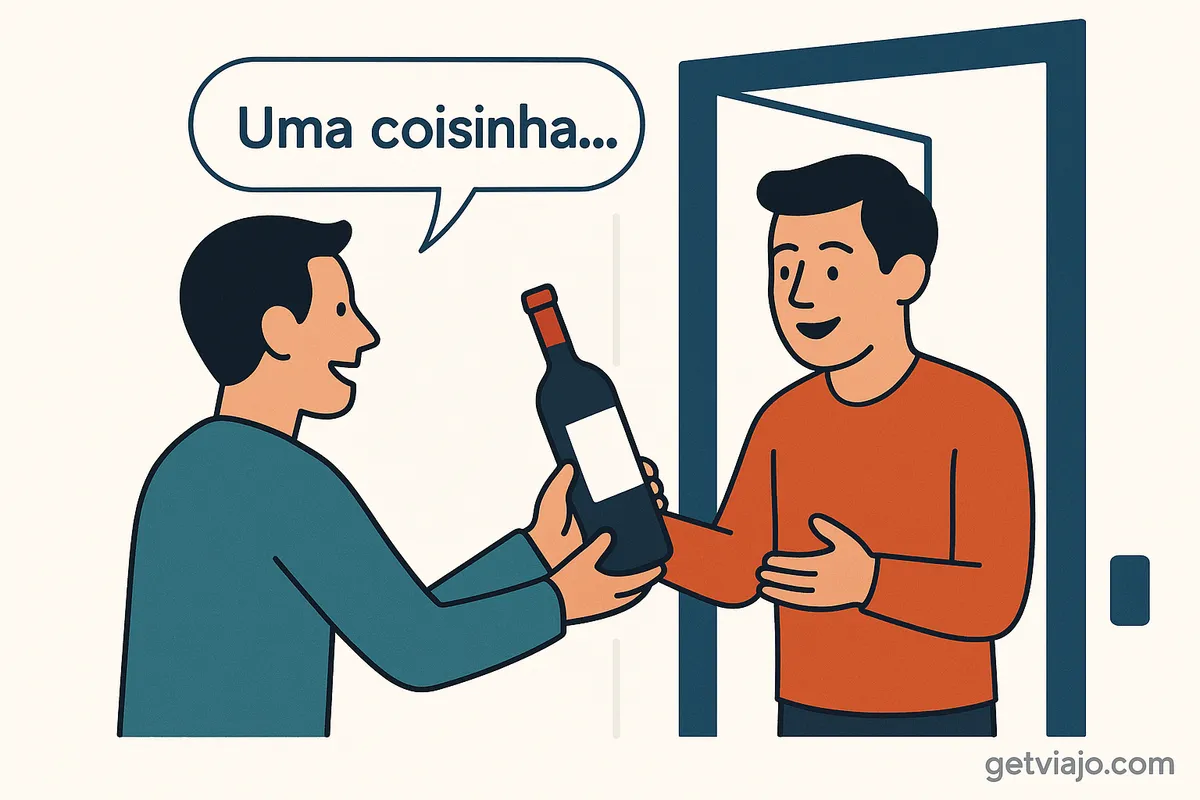 Calling your gift a “coisinha” adds a layer of warmth and humility that simply saying “gift” lacks.
The Arrival Check-In
As you step inside, the host frequently asks if your journey was okay. In these cases, they’ll use the Simple Past (Pretérito Perfeito) because your arrival is a completed action.
| English | Portuguese |
|---|---|
| Did you arrive well? | Chegaste bem? |
| Did you guys arrive well? | Chegaram bem? |
| Yes, everything went well. | Sim, correu tudo bem. |
If you need a conversational filler, complaining about traffic is a national pastime. Saying “O trânsito estava horrível” (The traffic was horrible) creates an instant bonding moment.
Audio lessons and PDF study guides to accompany every lesson
Get In on the Ground Floor!
This is a new website!
As such, I'm starting the price for premium at just $2.99/mo, increasing to $11.99/mo after my first 100 members.
Complimenting the House
If it is your first time visiting, you need to compliment the space. Avoid the textbook word acolhedora (cozy), as it sounds like a real estate listing.
| English | Portuguese |
|---|---|
| The house is very cool/cute! | ”A casa é muito gira!” |
| The house is very beautiful. (Classic & respectful) | “A casa é muito bonita.” |
| The house is spectacular! | ”A casa é espetacular!” |
The Exit Strategy
In Portugal, leaving a gathering is a process that happens in stages. Making a polite exit is expected and you might be seen as rude if you don’t go through the whole song and dance.
The Signal
You need to announce your intention physically before standing up. What I personally end up doing is slapping my hands on your knees and sighing, kinda like a “oh my creaky old knees are barkin’, that must mean it’s time for me to stand up and go.”
“Bem…”
(Well…)
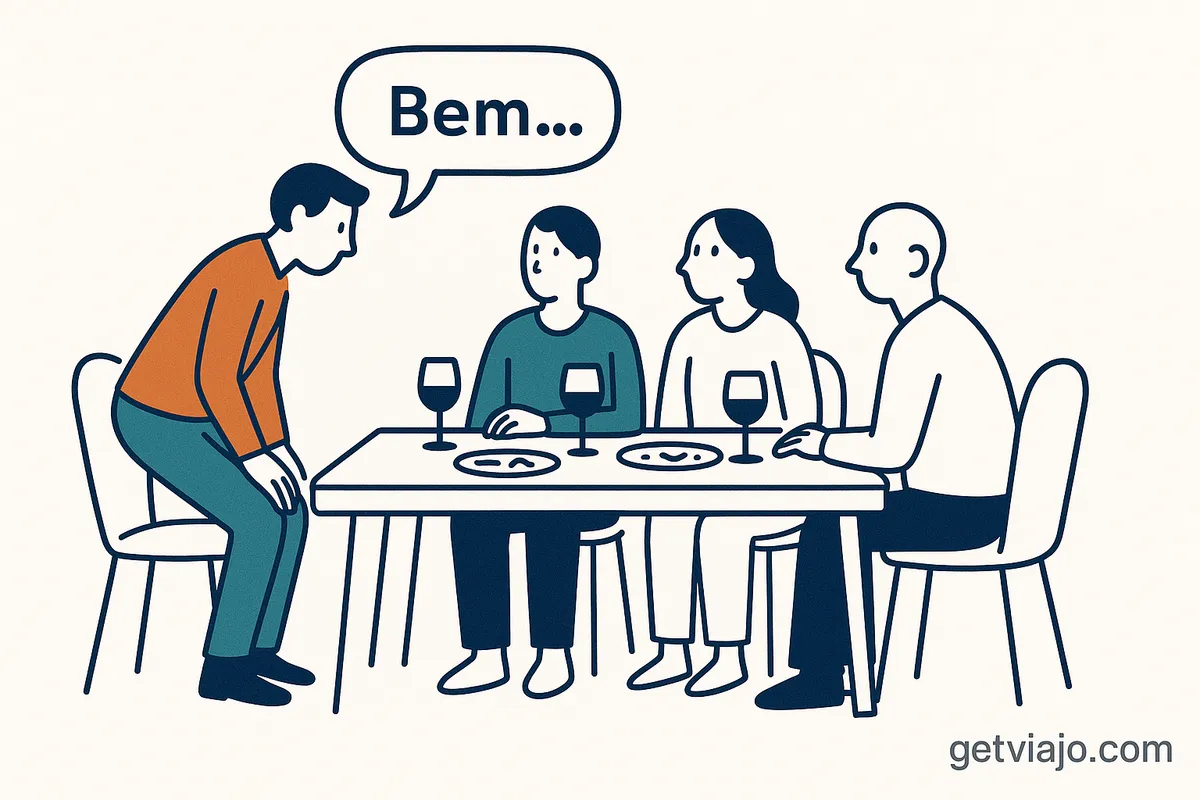 The knee slap is a non-verbal signal that the night is concluding.
The Departure Phrase
Once you have everyone’s attention, use a phrase to signal your departure. The phrase “Vou-me embora” can sound harsh, almost as if you are upset. Choose softer phrases.
| English | Portuguese |
|---|---|
| I’m getting going. (Soft Exit) | “Vou andando.” |
| I have to go. (Natural) | “Tenho de ir.” |
| It’s my time. (Polite) | “Está na minha hora.” |
[!warning] Grammar Alert: The Forbidden Gerund “Vou andando” is an idiomatic exception in European Portuguese. In Portugal, they typically avoid the gerund (-ando), preferring “estou a + infinitive”. However, “Vou andando” is a fixed expression. Don’t apply this gerund pattern to other verbs, or you will sound Brazilian!
The Protest
Another thing I’ve observed is that the host often will protests your departure, even if it’s just to be polite.
| English | Portuguese |
|---|---|
| Ah, but it is still early! | Ah, mas ainda é cedo! |
| Stay a little bit longer! | Fica mais um bocadinho! |
Treat this as a politeness ritual. Provide a reason to gently bypass the protest.
| English | Portuguese |
|---|---|
| Tomorrow I work early. | Amanhã trabalho cedo. |
| Tomorrow I have a busy day. | Amanhã tenho um dia cheio. |
| Bye, kisses to everyone! | Tchau, beijinhos a todos! |
Summary
When you walk in, stick to “Olá, tudo bem?” For a room full of people, use a general “Como estão?” or “Tudo bem?” with a nod. Men greeting men often use the handshake and back-pat combination.
When you hand over a gift, call it “uma coisinha.”
When you leave, use “Vou andando” or “Tenho de ir” and offer a reason like “Amanhã preciso de acordar cedo.” (I need to get up early)
Once the “bookends” of the evening are secure, you can focus on the conversation in the middle. If you need help with that, check out my guide on how to make small talk in Portugal.
Boa sorte!
Frequently Asked Questions
[!faq]- Do I really have to kiss people I don’t know? In social settings, yes, it is the standard greeting for women (to everyone) and men (to women). The “air kiss” (cheeks touching, making a sound but no lip contact) is the standard move. In very formal settings, a handshake is safer for a first meeting between a man and a woman.
[!faq]- Which cheek goes first? In Portugal, the standard is right cheek to right cheek first. You lean to your left. Always lead with your right cheek to avoid an awkward nose-bump!
[!faq]- Is “Boas” rude to say to my boss? It depends on the culture. In a young tech startup, it’s likely fine. For a traditional boss or a stranger, stick to “Olá” or “Bom dia/Boa tarde.”
[!faq]- What if I arrive late to the party? If the group is already eating, do not go around the table kissing everyone. Give a general wave, say “Desculpem o atraso” (Sorry for the delay), and “Bom apetite” to the room.
[!faq]- Do I take my shoes off at the door? Taking off shoes varies by household. Look at the host’s feet. If they are wearing shoes, keep yours on. If you see a pile of shoes in the hallway, take yours off. Every household is different!
