


A few months after my wife and I moved here, I was at my local Continente paying for groceries. The cashier finished scanning, looked up, and said something to me in Portuguese. I had no idea what she’d asked. I just handed her my card, awkwardly avoided her question and said “obrigado” when she gave it back, then walked out.
It was probably a “tem cartão Continente?” (do you have a Continente card?) or something simple like that, but I’d been so focused on getting through the bom dia and the obrigado that anything off script broke me.
That’s the trap a lot of us get stuck in. We can do the transactional stuff fine, but the moment someone tries to actually talk to us about the weather or their weekend, we freeze.
This article is about leaning in instead of pulling back, and the handful of phrases I lean on to make that easier.
Talking About the Weather
 Even a simple conversation about the weather can go a long way towards building a relationship with someone.
The weather is a safe topic almost anywhere. It works the same way here.
My neighbor and I have a running joke at my expense. Nearly every time we pass each other, I’ll just say “Que calor!” (How hot!) or “Que frio!”, and she’ll chuckle and reply, “Pois é” (Indeed).
That’s the whole interaction. She knows I’m just an estrangeiro being silly, but it’s enough to acknowledge each other and move on.
Here’s a few tips to expand your weather vocabulary beyond “hot” and “cold.”
| English | Portuguese |
|---|---|
| Today is very humid | Hoje está muito húmido |
| It’s foggy | Está nevoeiro |
| Tomorrow will be cloudy | Amanhã vai estar nublado |
| It’s really windy | Está muito vento |
| It’s been so windy lately! | Tem estado tanto vento ultimamente! |
| It should be nice this weekend | Vai fazer bom tempo no fim de semana |
| The sun is coming out | O sol está a aparecer |
| It looks like rain | Parece que vai chover |
[!tip]
In my observation, using “better” words like húmido (humid) and nublado (cloudy), or phrases like está nevoeiro (it’s foggy), shows that you’re genuinely trying to learn and improve rather than just going through the motions.
You’ll often see people seeming impressed when you try.
The Café Counter
Another common part of life here is getting coffee, or a tea, a snack, etc. The balcão (counter) is where a lot of people’s daily interactions happen.
In these situations, skip “Eu gostaria de…” (I would like…). It sounds a bit like a textbook. Most people, I’ve noticed, are much more simple and direct.
| English | Portuguese |
|---|---|
| I wanted a coffee, please. | ”Queria um café, se faz favor.” |
| Have you had lunch yet? | ”Já almoçou?” |
| It was just this, thanks. | ”Era só isto, obrigado.” |
| I wanted the bill, please. | ”Queria a conta, se faz favor.” |
When ordering or asking for the bill, using the imperfect past tense “queria” softens the request.
If it is around lunchtime, the person at the counter might ask “já almoçou?” as a greeting.
When you receive your items, saying “era só isto” signals that your order is complete. To ask for the bill, you can also just make eye contact with the server and make a small scribbling motion in the air.
Complaining Together
I say this with love, and as someone with Portuguese blood myself… the Portuguese like to complain. Bonding over bad weather is a pretty common move here. Saying “it’s nice out” is fine, sure, but joining in on the suffering often builds a little more rapport.
Try these to get someone to chuckle and agree with you:
| English | Portuguese |
|---|---|
| What heat! No one can stand it! | Que calor! Não se aguenta! |
| (the weather) Today is terrible. | Isto hoje está terrível. |
| It is like ice! | Está um gelo! |
You can use “que calor, não se aguenta!” when the summer sun is at its peak. “Isto hoje está terrível” is highly versatile and works perfectly for rain, wind, or even things like heavy traffic, packed transit cars, etc.
On very cold mornings, complaining that “está um gelo!” will fit the mood perfectly.
Weekend Plans
 Weekend plans are a great conversation starter and an easy way to connect with your neighbors and community.
Weekend plans are another useful topic.
Asking about the weekend is an easy way to talk with neighbors, the people at the gym, or the person working at the pastelarias you visit often.
[!tip]
If these interactions makes you sweat, check out this article to brush up on your cafe and restaurant phrases.
A simple “Já tem planos para o fim de semana?” (Do you have plans for the weekend?) could be all you need.
We use “tem” here, the formal version, which is safer for someone you don’t know well.
When they ask you the same question back, just be sure you have something prepared.
I frequently lean on either:
- “Ainda não sei” (I don’t know yet), or
- “Eu e a minha mulher provavelmente vamos à praia” (my wife and I are probably going to the beach)
I like this one because you might actually get some great ideas for something to do!
Audio lessons and PDF study guides to accompany every lesson
Get In on the Ground Floor!
This is a new website!
As such, I'm starting the price for premium at just $2.99/mo, increasing to $11.99/mo after my first 100 members.
Common Small Talk Questions
I hear these questions constantly, personally.
| English Question | Portuguese Question |
|---|---|
| Where are you from? | De onde é? |
| I’m from the US. | Sou dos Estados Unidos. |
| How long have you been here? | Há quanto tempo é que está cá? |
| I’ve been here for three years. | Estou cá há três anos. |
| What do you do for work? | O que é que faz? |
| I work in tech. | Trabalho em tecnologia. |
| Do you work for a Portuguese company? | Trabalha numa empresa portuguesa? |
| No, I work remotely. | Não, trabalho à distância. |
You might be tired of answering these types of things, but they are natural questions for people to want to ask.
Sure, they could just be nosy (I’m nosy, too), but you are a foreigner here. What else would you expect them to be asking you right away?
You can take it as a way for people to show they are genuinely interested in you and want to connect.
[!tip] Use “você” (but be careful)
You’ll notice the questions in the table above use the formal “you”, for example, “De onde é?”. This is the safest and most respectful way to address strangers, shopkeepers, or older individuals.
However, calling someone “você” explicitly can be considered blunt or rude. Just omit the pronoun entirely and let the third-person verb conjugation do the work.
The informal “you” (tu) is reserved for friends, family, children, and people who have explicitly told you it’s okay. They might say, “Pode tratar-me por tu.” (You can address me with tu.)
Until that happens, sticking with the formal você verb conjugations is always the best choice.
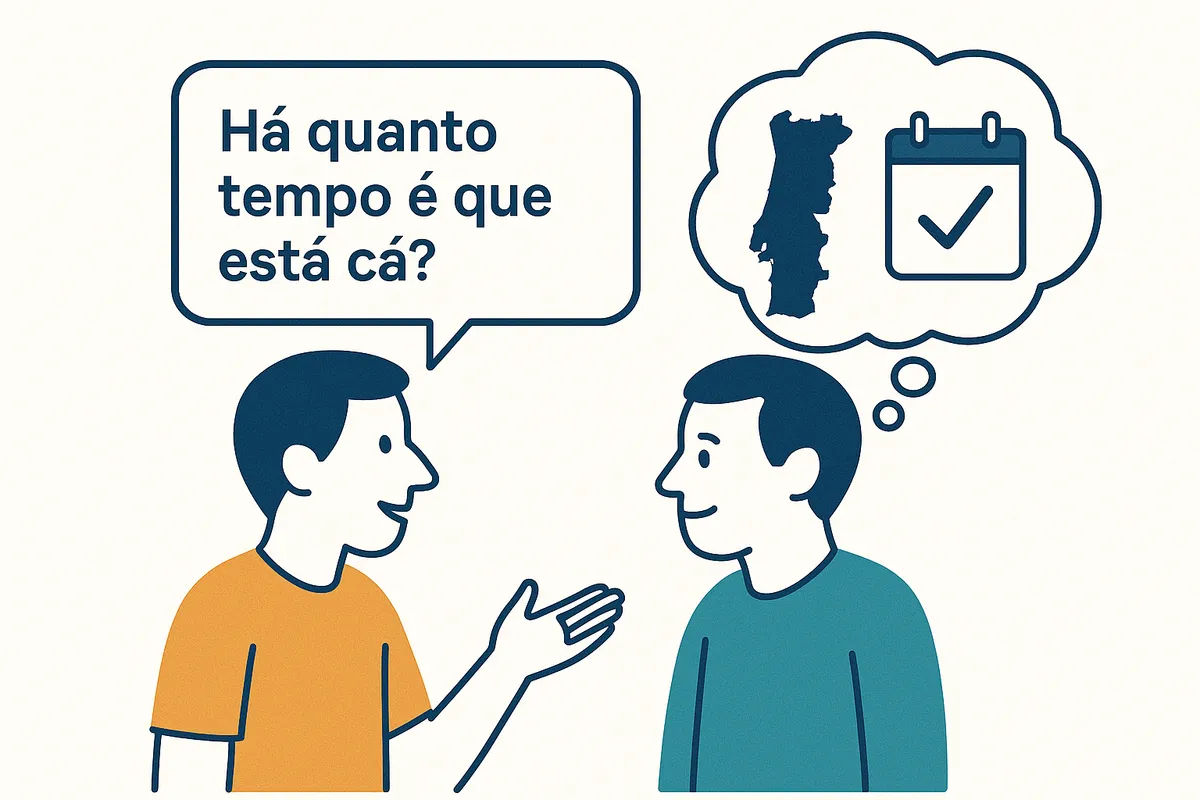 People in Portugal will be curious about where you’re from. It’s a great opportunity to connect and make a good impression.
Navigating Holiday and Weekend Talk
August is a big holiday month here, so knowing how to ask about it helps.
I used to hear that people would be leaving on holidays soon and I felt unsure of how to lean into the conversation. Now I ask, “Vai de férias?” (Going on vacation?) to get the ball rolling.
When they say yes, I use a few easy follow-ups:
| English | Portuguese |
|---|---|
| That’s great! | Que bom! |
| How lucky! | Que sorte! |
| Where to? | Para onde? |
| It should be fun! | Deve ser giro! |
| That’ll feel good! | Vai saber bem! |
| I’ve never been there. | Nunca estive lá. |
| Nice weather? | Bom tempo? |
| Have a great holiday! | Boas férias! |
And hey, they’re probably going to ask you, too.
I try to have my own rehearsed holiday plans ready to share (even if I’m just saying that I work on American hours and don’t get these beautiful European luxuries).
But just like having phrases ready for before people leave, here’s a few useful ones for when they eventually return.
| English | Portuguese |
|---|---|
| Welcome back! | Bem-vindo de volta! |
| How was it? | Como foi? |
| Did you enjoy it? | Gostou? |
| Was the weather good? | Esteve bom tempo? |
| Did you rest? | Descansou? |
| Did you go to the beach? | Foi à praia? |
| Was the food good? | A comida era boa? |
| That sounds amazing! | Que maravilha! |
| Bet that felt good! | Aposto que soube bem! |
These types of interactions help to build a connection, even if it is just a little bit at a time.
Active Listening
So, you asked a question, and they responded. What next? You have to show you’re actually listening. The goal is to move beyond a simple “yes” or “no” answer and show you’re invested in the conversation.
I try to use little phrases like these:
| English | Portuguese |
|---|---|
| Really? | A sério? |
| What a shame. | Que pena. |
| I didn’t know that. | Não sabia. |
| Right. | Pois. |
| Exactly. | Exatamente. |
| Of course. | Claro. |
| That’s funny. | Que engraçado. |
| How nice! | Que giro! |
| Wow! | Uau! |
Using these phrases signals to the other person that you’re paying attention.
And here’s my favorite go-to’s for follow-ups:
| English | Portuguese |
|---|---|
| And did you like it? | E gostou? |
| What was it like? | Como foi? |
| Was it cool? | Foi fixe? |
| I’d like to try it someday. | Gostava de experimentar um dia. |
| Was it worth it? | Valeu a pena? |
| What did you like the most? | Do que é que gostou mais? |
They’re just a few simple questions, but it shows genuine interest and encourages them to share more.
Using Pois
If you forget every other word in this article, remember pois.
It is incredibly versatile. You can conduct a long conversation using only this word just by changing your intonation.
| English | Portuguese |
|---|---|
| I agree. Right. | Pois. |
| That is correct! You are totally right! | Pois! |
| Really? Is that so? | Pois? |
| I know… life is hard. What can we do? | Pois… |
| Yeah, right. I doubt it. | Pois, pois. |
A short, flat delivery signals simple agreement. Saying it with an excited tone means you completely agree with the other person. A rising, questioning tone turns the word into a way of asking for confirmation.
Dragging it out with a slow, falling tone expresses sympathy for a difficult situation. Doubling it up with a sarcastic tone shows polite disbelief.
The Three Big Football Clubs
People in Portugal are often very passionate about their club. From what I can tell, if someone asks if you like football, saying “I like Benfica” or “I like Sporting” can sound a bit unenthusiastic.
| English | Portuguese |
|---|---|
| I like Benfica. | Eu gosto do Benfica. |
| I support Sporting. | Eu sou do Sporting. |
| I like to watch the National Team. | Gosto de ver a Seleção. |
Translating directly and saying “eu gosto do Benfica” is understood. Sounding more like a “true supporter” requires saying “eu sou do Benfica”. If you prefer a neutral option, simply say “gosto de ver a Seleção”.
In my experience, you can also just jokingly yell “Ronaldo!” and give someone a high five. That usually gets some laughs.
Leaving a Conversation
Knowing how to end a conversation helps and will feel a lot better than just walking away awkwardly.
The best way is to signal that you are about to leave with a word like “Bem…” (“Well…”) or “Então…” (“So then…”)
If you are at a social event, there is actually a whole specific ritual for this (including a well-understood “knee slap”).
I break down exactly how to handle those group departures in my guide on how to enter and exit social gatherings.
From there, you can choose a closing that fits the situation:
| English | Portuguese |
|---|---|
| See you later. | Até logo. |
| See you tomorrow. | Até amanhã. |
| Have a good day. | Tenha um bom dia. |
| Have a good holiday! | Boas férias! |
| Take care. | Fica bem. |
| See you soon. | Até breve. |
| It was nice to see you! | Foi bom ver-te! |
| Bye, have a good weekend. | Tchau, bom fim de semana. |
Say you’re talking to your colleague, Senhor Silva, just say, “Então, obrigado/a, Senhor Silva, até breve!”, then give them a handshake, pat them on the arm, smile and turn away. You’ll have just handled the situation like a pro.
From Robot to Real Person
I’ve always enjoyed small talk, and I admit that once I moved somewhere I struggled to speak the language, I suddenly became a different person, much more quiet and reserved.
Leaning on the tips above has helped me to feel much more “myself.”
So, the next time you’re at the checkout, at a social event, or even just waiting for the bus, try one of these simple phrases.
You might just find that you’re not only improving your language skills but also building the kind of relationships that makes immigrant life a little less lonely.
Frequently Asked Questions
[!faq]- Should I always use formal language (Senhor/Senhora) when talking to strangers? In many parts of Portugal, especially with older individuals or in more formal settings, using titles like o Senhor or a Senhora is a sign of respect. When in doubt, it’s always safer to start with the more formal approach.
As you get to know someone better and they invite you to use their first name, or say “podes tratar-me por tu” (you can speak to me in the ‘tu’ form) you can switch to informal language.
[!faq]- How do I handle a conversation if I don’t understand the reply? I used to say “sorry” constantly when I did not catch something. I learned pretty quickly to avoid saying “Desculpe.”
I just cup my hand behind my ear and say “Diga?” (literally meaning “Say?” or “Tell me?”).
This is polite and completely normal. If you are entirely lost, you can use the sorry line, “Desculpe, não percebi.” (Sorry, I did not understand). Using percebi instead of entendi sounds more European.
[!faq]- Is it appropriate to ask about family in small talk? Yes, asking about family is very common and shows genuine interest. You can ask simple questions like, “A sua família está bem?” (Is your family doing well?) or “Tem filhos?” (Do you have children?). These questions are usually received well and can help you build a stronger connection.
[!faq]- What are some other simple topics for small talk? Besides the weather and weekend plans, food is the safest bet.
Asking, “Conhece algum bom restaurante por aqui?” (Do you know a good restaurant around here?) or talking about the last festa (local festival) you went to can be great conversation starters.
[!faq]- How can I practice this if I’m shy about speaking in public? Start small! Try using these phrases with people you see every day, like the person at the local café or your neighbor. They’ll get to know you, and the pressure will be off.
You can also try saying these phrases out loud to yourself while you’re at home, just to get your mouth used to saying them.
