


Years before my wife and I ever dreamed of moving here, we came to Lisbon for our honeymoon. I’d been studying Portuguese for a few months and was eager to show off what I’d been learning. We sat down at a cute, tile-covered tasca in Alfama, and I felt like I was handling things like a pro.
A few moments later the server brought a basket of crusty bread, a small dish of olives, and some local cheese. My wife exclaimed, “Oh, that’s so nice of them”. I confidently mansplained, with worldly confidence, “It’s the couvert”. “A little welcome snack they give you.”
Then the bill came.
My confidence evaporated. That “welcome snack” that had just cost us five euros. I was both embarrassed and confused. More importantly, I had no idea what to say or how to even ask about it without sounding like a dummy. It wasn’t a lot, of course, just a few euros… but I still felt silly.
I learned a lesson that day. And I’ve since eaten at hundreds of Portuguese restaurants, and have been living here since 2022… so things on my end have improved remarkably.
The point of this article is to share what I’ve learned, and walk you through how to navigate a Portuguese restaurant so you can avoid any mistakes, know what to expect, and feel like you know what you’re doing.
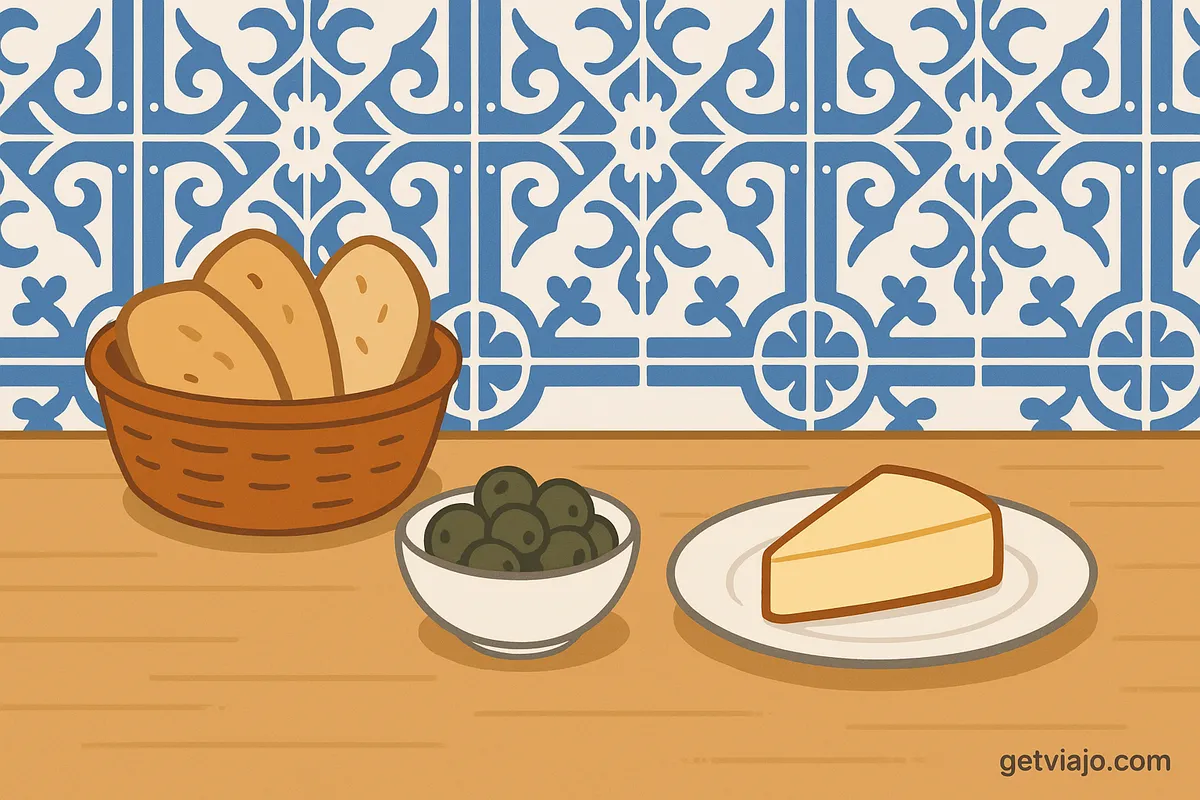 The couvert. It’s not free, but you can politely refuse it.
[!tip] Hear It in Action I’ve created a free companion audio lesson for this guide (and a few others) so you can practice your pronunciation for every key phrase we cover.
Arriving and Getting Seated
Getting a Table
At traditional restaurants here, there’s not often a dedicated host. It’s the servers who manage the seating directly while carrying food and drinks and doing everything else non-cooking related.
Just step straight into the dining room, locate someone who looks like they’re working, and try to catch their eye, or just wait near the entrance for them to approach.
| English | Portuguese |
|---|---|
| Mesa para dois, por favor | Table for two, please |
Once they give you a quick nod of approval, you sit down.
How to Request Outdoor Seating
When the sun is out, sitting on an esplanada (terrace) is a national pastime here. There’s no way you’re eating inside.
Here’s the magic phrase:
| English | Portuguese |
|---|---|
| Can we sit outside, please? | Podemos sentar-nos lá fora, por favor? |
Realistically, even if you just point outside and say “Lá fora?” with a charming smile, they’ll get it. But using the reflexive “sentar-nos” (seat ourselves) will score you points for grammatical accuracy.
The word for “inside” is dentro, just FYI.
Common Server Responses
You’ll probably hear one of two things back:
- Claro, venham comigo. (Of course, come with me.)
- Lamento, mas a esplanada está cheia. (I’m sorry, but the terrace is full.)
 On a sunny day, there’s no better place to sit.
If they’re full outside, don’t sweat it. A simple smile and a nod are all you need. The staff here are (generally) super helpful, and they will likely appreciate you trying to speak their language.
The Initial Server Interaction
In busy restaurants here, the staff frequently share tables. A server approaching your table needs to establish your status before taking your order. You will likely hear one of these questions.
| English | Portuguese |
|---|---|
| Have you (all) been served? | Já foram atendidos? |
| Have you (all) ordered? | Já pediram? |
The English mental model relies on complete sentences like “Yes, someone already took our order.” The Portuguese logic hinges entirely on the word já (already).
To sound natural, you just mirror that exact word.
| English | Portuguese |
|---|---|
| Already, thank you. | Já, obrigado/a. |
| Not yet. | Ainda não. |
If you are dining alone or your companion stepped away, another server might try to take your order again. Trying to explain the situation by translating “I gave my order to another server” might translate literally but sounds awkward and weird.
Just use these instead.
| English | Portuguese |
|---|---|
| I already ordered. | Já pedi. |
| We already ordered. | Já pedimos. |
State the completed action and the server will move on to their next task.
Ordering with Confidence
Asking About Dishes
Okay, you’ve got the menu (the “ementa”). It’ll likely be filled with delicious-sounding things you (if you’re a beginner) won’t be able to decipher (many of which will likely be irregular past participles like frito or grelhado).
It’s natural you might have questions. Asking is way better than just pointing, grunting and hoping for the best.
Here are a few good questions:
| English | Portuguese |
|---|---|
| Are the potatoes fried or boiled? | As batatas são fritas ou cozidas? |
| What is the dish of the day? | Qual é o prato do dia? |
| Does this dish have shellfish? | Este prato leva marisco? |
[!tip] Pro Tip Not sure about what to look for on a Portuguese menu? I actually wrote an article all about my favorite Portuguese dishes here.
Using “Queria” To Say “I Would Like”
Before we talk about modifications, we need to fix one common mistake: saying “Eu quero” (I want).
In English, “I want the steak” sounds direct. In Portuguese, “Eu quero” sounds demanding, even if you say “por favor” (please) at the end.
The secret to sounding polite and local is to use the imperfect past tense: Queria (I wanted). It implies, “I wanted this… if it’s not too much trouble.”
| English | Portuguese |
|---|---|
| I would like the steak, please. | Queria o bitoque, se faz favor. |
| I would like a glass of white wine. | Queria um copo de vinho branco. |
It feels weird to use the past tense for something you want now, but saying something in the past tense is just how Portuguese speakers make themselves sound polite rather than demanding.
(If you want to really understand the logic behind this, check out my guide on how to make polite requests.)
[!warning] Get Ready for This Joke Because queria is technically the past tense, you will absolutely run into a server with a sense of humor who replies: “Queria? Já não quer?” (You wanted it? You don’t want it anymore?). It’s a classic Portuguese dad joke.
The perfect, confident response is to smile and say, “Ainda quero, sim!” (I still want it, yes!). You’ll probably get a laugh and some respect for knowing the expected comeback.
Requesting Modifications
Now for a tip that took me ages to learn. This is neither good nor bad, just one of those things that makes it obvious you’re still learning.
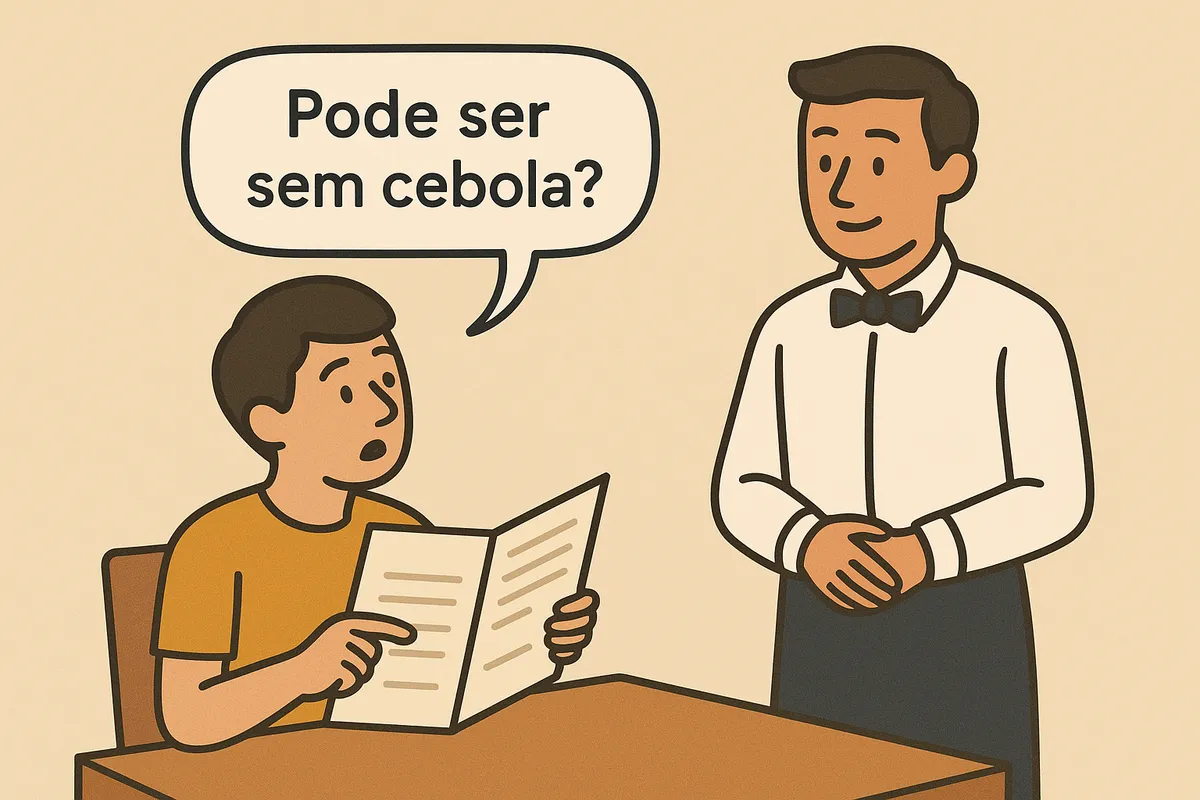
For a long time, I translated “Can I have…” directly to “Posso ter…”.
It’s grammatically correct (posso = can I + ter = have), but it’s also a dead giveaway that you’re an estrangeiro translating from English.
A local friend, when eating together, finally taught me me that native speakers almost never say “posso ter?” when requesting things (with anything, not just food).
So, what’s the secret? Use “Pode ser…?” (“Can it be…?”) instead. It’s softer, more natural, and will instantly make you sound more fluent.
Watch how it works…
❌ The Foreigner Way: Posso ter o prato sem cebolas? (Can I have the dish without onions?)
✅ The Local Way: Pode ser sem cebola? (Can it be without onion?)
Here’s a few more examples:
| English | Portuguese |
|---|---|
| Can I have salad instead of fries? | Pode ser com salada em vez de batatas fritas? |
| Can I have the sauce on the side? | Pode ser o molho à parte? |
Once you get the hang of this, it’ll go a long way in sounding less like a textbook and more like a human.
Handling Server Questions
Servers will usually ask a few standard follow-up questions depending on what you order. Being prepared for the following will help you feel a lot more capable.
Ordering Water
Water is a weird thing here for Americans. Back home we just say “water” and that means a cold glass of tap water, free of charge. Here, there’s a lot more to just ordering water.
| English | Portuguese |
|---|---|
| Água fresca | Cold water |
| Água natural | Room temperature |
| Com gás | With gas (Sparkling) |
| Sem gás | Without gas (Still) |
| Água da torneira | Tap water (the only free option) |
Tap water is completely safe to drink. You can request either a cup (um copo) or a pitcher (um jarro) of tap water depending on what you need.
| English | Portuguese |
|---|---|
| Can you bring a glass of tap water? | Pode trazer um copo de água da torneira? |
| Can you bring a pitcher of tap water? | Pode trazer um jarro de água da torneira? |
(Of course, just be sure you say “por favor” at the end to sound polite)
Ordering Beer
If you ask for a beer, the server might ask if you want it from the tap or a bottle.
| English | Portuguese |
|---|---|
| Draft or bottle? | Pressão ou garrafa? |
In the north, a small draft beer is called “um fino”, and in Lisbon and south, a small draft beer is called “um imperial”. A large draft beer is called “uma caneca” (which translates to ‘mug’).
[!tip] A note on beer genders
Fino is masculine. Caneca is feminine. Um fino, dois finos. Uma caneca. Duas canecas.
BUT, in lisbon and the south, “imperial” is feminine just like caneca is. Uma imperial. Duas imperiais. I made this mistake for like 3+ years.
To make things easier on yourself, you can always get away with simply saying “cerveja pequena” or “cerveja grande”. Just be sure to say “por favor” at the end to avoid bluntness.
| English | Portuguese |
|---|---|
| A draft beer | Uma cerveja a pressão |
| A bottled beer | Uma garrafa de cerveja |
| A small draft beer | Um fino (North of Lisbon) / Uma imperial (Lisbon + south) |
| A large draft beer | Uma caneca |
| A large beer | Uma cerveja grande |
| A small beer | Uma cerveja pequena |
[!tip]
Keep in mind that “fino” and “imperial” are informal terms meant for a casual restaurant or a relaxed outdoor terrace. Use standard terms like “cerveja a pressão” in formal situations or whenever you’d feel inclined to say “draft beer” in English
Ordering Wine
When ordering wine, the terminology is straightforward. A glass of wine is “um copo”, and a bottle of wine is a “uma garrafa”. A pitcher is a “um jarro”. The math is simple. One glass is “um copo” and two glasses is “dois copos”.
You can always ask for “vinho da casa”, which is generally the simplest way of saying you want the cheapest house option. Just be sure you specify branco (white wine), verde (green wine), or tinto (red wine).
To politely ask about seeing the wine menu, you can ask if they have a “carta de vinhos” they can bring you.
| English | Portuguese |
|---|---|
| Do you have the wine menu? | Vocês têm a carta de vinhos? |
| I’d like a glass of red house wine | Queria um copo de vinho da casa tinto |
| A bottle of green wine | Uma garrafa de vinho verde |
How to Order Meat
If you order a steak (a “bife”) or a hamburger, etc., they are likely to follow up with a specific question about how you’d like it cooked. In my experience, they often ask something along these lines.
| English | Portuguese |
|---|---|
| How do you want the meat? | Como quer a carne? |
The possible responses are:
- Mal passado (Rare)
- Ao ponto (Medium)
- Bem passado (Well done)
Asking About Dessert
Servers have a variety of ways to ask if you want dessert (“a sobremesa”). You might hear a few different phrases like these:
| English | Portuguese |
|---|---|
| Will there be dessert? | Vai haver sobremesa? |
| Will you want dessert? | Vão querer sobremesa? |
| Do you want dessert? | Quer sobremesa? |
If you want to see the options, it is totally fine to ask to see the menu.
| English | Portuguese |
|---|---|
| Can I see the menu? | Posso ver a ementa? |
| What do you have? | O que é que tem? |
Navigating Allergies
If you have dietary restrictions, you need to be specific. Portuguese staff are generally very helpful, but vague descriptions can get lost in translation.
Use the word “alérgico” (allergic) to make sure the kitchen takes it seriously.
| English | Portuguese |
|---|---|
| I am allergic to peanuts. | Sou alérgico a amendoins. |
| Does this dish have gluten? | Este prato tem glúten? |
| Do you have gluten-free options? | Tem opções sem glúten? |
Audio lessons and PDF study guides to accompany every lesson
Get In on the Ground Floor!
This is a new website!
As such, I'm starting the price for premium at just $2.99/mo, increasing to $11.99/mo after my first 100 members.
Mid-Meal Interactions
Complimenting the Food
Say the food arrives and it’s incredible. If you take a bite of that perfectly grilled fish and you want to tell them it’s the best thing you’ve ever eaten, do it!
| English | Portuguese |
|---|---|
| The food is delicious! | A comida está ótima! |
A little compliment goes a long way.
Food is life, and telling the staff you love it is one of the easiest ways to get a genuine smile in return.
Asking for Additional Items
Okay, so say your plate of bacalhau à brás is amazing, but you’ve already devoured all the bread for mopping up the deliciousness. We’ve all been there.
Just remember our rule from before. Instead of “Posso ter…”, you’ll want to ask the server to bring you something.
| English | Portuguese |
|---|---|
| Could you bring more bread, please? | Pode trazer mais pão, por favor? |
| Could you bring us some more napkins? | Pode trazer-nos mais guardanapos? |
| Could you bring us another bottle of wine? | Pode trazer-nos outra garrafa de vinho? |
The Bathroom Question
Nature calls. Here’s how to find the toilet:
| English | Portuguese |
|---|---|
| Where is the bathroom? | Onde fica a casa de banho? |
Ending the Meal / The Coffee Ritual
You can’t write a guide to Portuguese dining without mentioning coffee. It is the punctuation mark at the end of every meal, even late at night (somehow.)
But be warned: if you just order “a coffee,” you likely won’t get what you expect.
| English | Portuguese | What you get |
|---|---|---|
| A coffee | Um café | An espresso. (Also called uma bica in Lisbon). |
| An Americano | Um abatanado | An espresso diluted with hot water. It’s not filter coffee, but it’s the closest to an American-style black coffee. |
| Espresso with a drop of milk | Um pingo / Um café pingado | An espresso with just enough milk to cut the bitterness. |
| Decaf | Descafeinado | A decaf espresso. |
Paying the Bill
Asking for the Bill
You’re full, you’re happy, and it’s time to go. Unlike back home, the bill won’t magically appear. You have to ask for it.
The most common and direct way is to simply catch the server’s eye and say:
| English | Portuguese |
|---|---|
| The bill, please. | A conta, por favor. |
[!tip] Pro Tip
You don’t even really need words for this. If you catch the server’s eye and make that universal “scribbling motion” in the air (like you are signing a check), they will know exactly what you mean.
Alternatively, you can use your new favorite structure discussed above:
| English | Portuguese |
|---|---|
| Can you bring the bill, please? | Pode trazer a conta, por favor? |
Reviewing the Bill (And What to Do If It’s Wrong)
This is the part I wish I’d known during that honeymoon dinner.
When the bill arrives, actually look at it. Mistakes happen. Sometimes they charge you for the wrong wine, or that couvert you politely sent away still shows up.
 Mistakes happen. Knowing how to politely point them out is a key skill.
It’s almost never malicious, and it’s easy to fix if you know what to say.
First, get your server’s attention with a polite:
“Desculpe!” (Excuse me!)
Once they’re at your table, simply point to the line item on the bill. You don’t need a long explanation.
| English | Portuguese |
|---|---|
| We didn’t order this. | Não pedimos isto. |
| Can you take it off, please? | Pode tirar, por favor? |
They’ll usually just apologize, take the bill, and bring back a corrected one. No drama, no confusion. Easy.
Asking About Payment Methods
Now for the moment of truth. Before you try to tap your fancy foreign credit card, it’s a good idea to check.
| English | Portuguese |
|---|---|
| Do you accept credit card? | Aceitam multibanco? |
| It’s a foreign card | Está um cartão estrangeiro |
“Multibanco” is the Portuguese debit card system and the word is used synonymously with “all credit cards”. Just accept that it’s a catch all for “if you swipe a little piece of plastic, we call it multibanco”.
Also, while most “newer” places in cities take credit cards, a lot of traditional restaurants are often cash-only. If they say no, your next question is vital:
| English | Portuguese |
|---|---|
| Where is the nearest ATM? | Onde fica o multibanco mais próximo? |
Knowing this little sequence can save you from a very awkward “I can’t pay” situation.
Embracing Traditional Portuguese Dining
Use these phrases as your key to unlocking great experiences. Don’t just stick to the tourist traps that make it easy to speak in English; instead, gather your courage, find a place bustling with locals and give it a shot.
If you want to know exactly how to spot the authentic ones, check out my guide on demystifying tascas.
That’s where the best food and the best memories are.
[!tip] My personal favorite part of the Portuguese food scene is the concept of the marisqueira (seafood restaurant). For me, it’s one of the best things about living here.
Think, giant platters of fresh crabs, shrimp, and clams all while drinking wine and beer with your friends. It’s a loud, fun, and uniquely Portuguese experience, but it comes with its own specific vocabulary.
To help you navigate it like a pro, I’ve also put together a dedicated guide to essential marisqueira vocabulary.
Conclusion
By learning these phrases, you’ll be getting a lot closer to having a great time, feeling more and more capable in everyday life here in Portugal. You’ll go from feeling like an awkward outsider to someone who can confidently order, enjoy, and pay for a meal entirely in Portuguese.
Maybe even making a new friend with your server you’ve just impressed so much. 💪
You’ve got this. It takes practice, and you might still mess up (I still do!), but every effort is appreciated. Now go out there and order something delicious.
Frequently Asked Questions
[!faq]- What’s the rule for tipping in Portugal? Tipping is not obligatory, but it is appreciated for good service. Unlike in some countries, there’s no set percentage. For a typical meal, rounding up the bill or leaving a few extra euros is a common way to show appreciation. For exceptional service at a nicer restaurant, a tip of 5-10% is considered generous.
[!faq]- So what’s the deal with the couvert? Can I refuse it? Absolutely. The couvert (bread, olives, butter, pâté, etc.) is not free. By law, you only have to pay for what you consume. When the server brings it, if you don’t want it, you can simply say, “Não, obrigado/obrigada” (No, thank you), and they will take it away with no issue. If you eat any part of it, you will be charged for it.
[!faq]- How do I get a server’s attention when it’s busy? A simple and polite “Desculpe!” (Excuse me!) when they are nearby is the best way. You can also try to make eye contact and give a slight nod or raise your hand discreetly. Avoid shouting or snapping your fingers, as this is considered rude.
[!faq]- Is it rude to ask for a takeaway box? Not at all anymore. While it wasn’t traditionally common, asking to take leftovers home has become perfectly acceptable, especially in cities. You can ask, “Pode pôr isto numa caixa para levar, por favor?” (Can you put this in a box to take away, please?).
[!faq]- What are some common non-alcoholic drinks to order besides water or soda? Portugal has some great options. You can ask for an “ice tea” (in English), which often comes in lemon (limão), peach (pêssego), or mango (manga) flavors, a “sumo de laranja natural” (freshly squeezed orange juice), or a “refrigerante” (soda) like Sumol (a lightly carbonated fruit drink).
