


In my main guide, I cover the rules for forming Portuguese past participles. Knowing the grammar is only half the battle. The other half is memorizing the common, everyday verbs that simply don’t follow those rules.
This article is your cheat sheet for those words.
It’s the practical vocabulary list that accompanies the grammar lesson. I’ve compiled the irregular participles I find myself using most often, organized by the situations where they tend to come up. Bookmark this page and come back to it whenever you get stuck.
 Getting small words like ‘aberta’ right makes a big difference in sounding natural.
The Daily Workhorses
These are the irregulars you’ll reach for constantly. A short list, but the payoff is huge, since they show up in almost every conversation, describing a delivered package, mentioning a movie you’ve seen, talking about a door left open.
[!tip] Masculine vs. Feminine These participles often act like adjectives, so they need to agree in gender with the noun they’re describing. I’ll include both the masculine (-o) and feminine (-a) forms.
| English | Portuguese |
|---|---|
| Opened | Aberto / Aberta |
| Covered | Coberto / Coberta |
| Said | Dito / Dita |
| Written | Escrito / Escrita |
| Done / Made | Feito / Feita |
| Put / Placed | Posto / Posta |
| Seen / Viewed | Visto / Vista |
| Come | Vindo / Vinda |
| Born | Nascido / Nascida |
| Dead | Morto / Morta |
| Saved | Salvo / Salva |
| Welcome | Bem-vindo / Bem-vinda |
The Two-for-One Verbs
Here’s where it gets tricky, even for native speakers. Some verbs have two past participles, a longer, regular one (ending in -ado/-ido) and a shorter, irregular one.
The simple rule I use to keep things straight:
- Use the long, regular form (e.g., salvado) with
terorhaver. This builds active voice tenses, like “Eu tenho salvado os documentos” (I have been saving the documents). - Use the short, irregular form (e.g., salvo) with
serorestar. This is for the passive voice or using the participle as an adjective, like “O documento está salvo” (The document is saved).
In most daily situations, you’ll be using the short, irregular one (e.g., Está entregue, “It is delivered”). Still, it helps to know the other one exists so you aren’t thrown off when you see it.
| English | Portuguese (Irregular / Regular) |
|---|---|
| Accepted | Aceite / Aceitado |
| Lit / Turned on | Aceso / Acendido |
| Delivered | Entregue / Entregado |
| Won / Earned | Ganho / Ganhado |
| Spent / Worn out | Gasto / Gastado |
| Printed | Impresso / Imprimido |
| Cleaned | Limpo / Limpado |
| Saved | Salvo / Salvado |
Audio lessons and PDF study guides to accompany every lesson
Get In on the Ground Floor!
This is a new website!
As such, I'm starting the price for premium at just $2.99/mo, increasing to $11.99/mo after my first 100 members.
Kitchen and Food Irregulars
Anyone reading Portuguese recipes or menus runs into these constantly. The difference between frito and cozido is the difference between a fried potato and a boiled one, a detail that very much matters if you want the dish to turn out right.
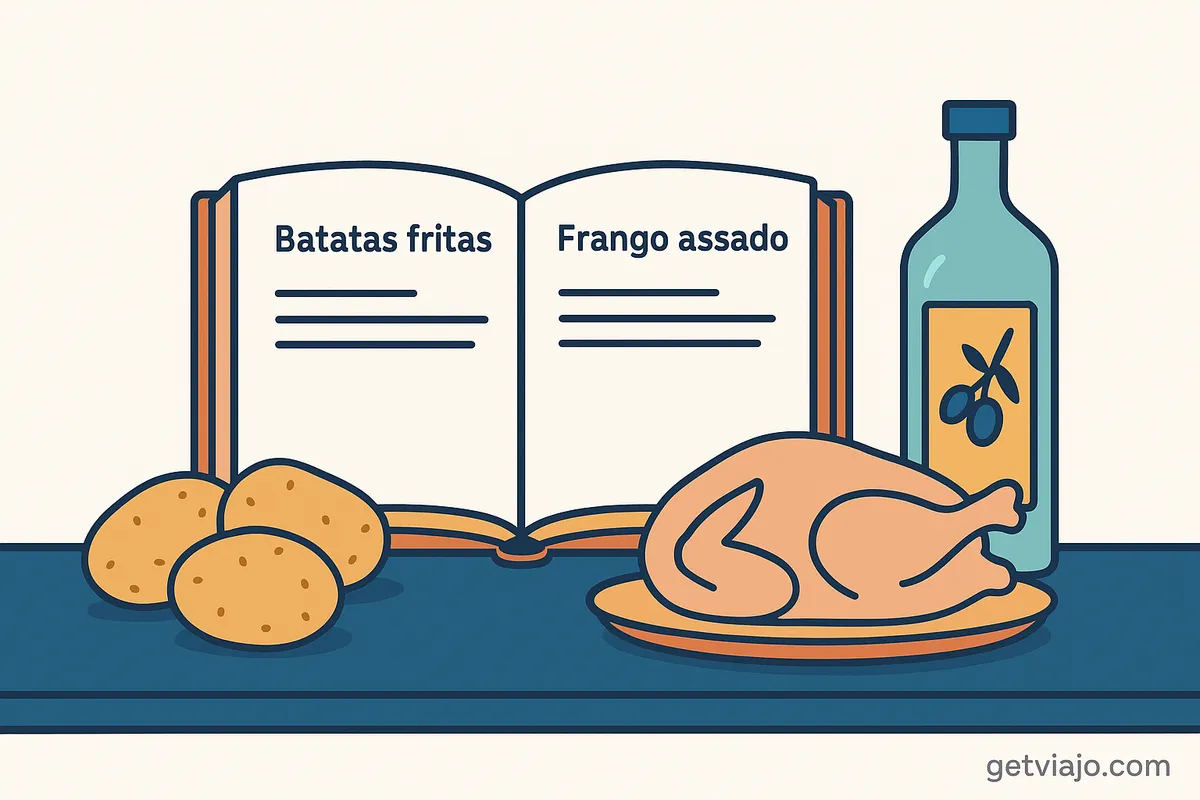 You’ll find these participles all over Portuguese recipes and menus.
| English | Portuguese |
|---|---|
| Roasted | Assado / Assada |
| Cooked / Boiled | Cozido / Cozida |
| Fried | Frito / Frita |
| Grilled | Grelhado / Grelhada |
| Ground | Moído / Moída |
| Sautéed | Refogado / Refogada |
| Filled | Recheado / Recheada |
| Dried | Seco / Seca |
| Broken | Partido / Partida |
| Made | Feito / Feita |
Business and Formal Irregulars
These are the words that help you sound put-together when you need to. Dealing with Finanças, signing a rental contract, reading an official email, the right participle goes a long way in these situations.
[!tip] A Bureaucracy Tip Worth Knowing The word deferido means “approved” or “granted.” It sounds like the English “deferred,” which makes it easy to misread as a rejection. When an official letter says o seu pedido foi deferido, that’s good news.
| English | Portuguese |
|---|---|
| Signed | Assinado / Assinada |
| Accepted | Aceite |
| Received | Recebido / Recebida |
| Paid | Pago / Paga |
| Included | Incluído / Incluída |
| Resolved | Resolvido / Resolvida |
| Expressed | Expresso / Expressa |
| Printed | Impresso / Impressa |
| Suspended | Suspenso / Suspensa |
| Delivered | Entregue |
| Approved / Granted | Deferido / Deferida |
You’ve Got This
Nobody masters these overnight. You’ll pick the wrong one from time to time, and that’s fine. Even native speakers get tripped up by the two-for-one verbs and will pause mid-sentence wondering whether it should be salvo or salvado. Progress is the goal, not perfection.
Every time you reach for aberto and resist the temptation to invent a word like abrido, you’re building the right reflex. Small choices like that add up.
Memorizing these words is one piece of the puzzle. To see how to put them to use telling stories about the past, check out my master guide on Portuguese Verb Tenses.
Frequently Asked Questions
[!faq]- Why can’t I just add “-ado” or “-ido” to every verb to make the past participle? That’s the standard rule for regular verbs, but Portuguese, like English, has many common verbs that are irregular. Verbs like fazer (to do/make) and ver (to see) have been used so frequently over the centuries that they’ve developed their own short forms (feito, visto) that you just have to memorize.
[!faq]- What’s the most common mistake foreigners make with these? Besides inventing a form like abrida, the most common slip is with the double-participle verbs. Many learners use the short, irregular form (like pago) with ter, saying Eu tenho pago when the more grammatically correct form is Eu tenho pagado. You’ll usually be understood (and some of these forms are so rare even natives question them), but using the textbook form shows a higher level of polish.
[!faq]- For the double participle verbs, which one should I default to if I panic? When in doubt, use the short, irregular form (e.g., pago, aceite, entregue). It’s far more common in everyday speech because it’s used as an adjective (“the bill is paid,” “the package was delivered”), which is a very frequent construction.
[!faq]- How important is my pronunciation of these words? It matters, but don’t let it intimidate you. With feito, aim for the “ei” sound (like the “ay” in “say”). With posto, the “o” is a closed sound. Listening to native speakers is the best way to improve, and you can try a few free lessons to hear how I approach it. There’s no free lesson on these past participles specifically, but the ones available will sharpen your pronunciation overall.
[!faq]- Is there a list of all the irregular participles? Comprehensive lists exist online, but they can be overwhelming. The better approach, in my experience, is to learn them in context based on frequency. The lists in this article cover the essentials, and you can browse the blog archive for more articles on specific grammar points as you need them.
