


Past participles are one of those grammar points that feels manageable until an irregular verb shows up and trips you. You drill the regular pattern, build some confidence, and then a word like fazer refuses to play along.
I’ve made my share of these mistakes. Once, trying to ask a barista if the pastries on the tray were baked in-house, I reached for fazido instead of feito. He understood me and answered politely, but the word in my head was wrong. I had drilled the regular -ER pattern (comer → comido) so hard that I forgot fazer is one of the irregular ones.
That’s the real challenge with past participles. There isn’t one rule. There’s a base pattern, a list of rebels, and a few verbs that wear two faces depending on which helper verb they’re standing next to.
This guide walks through all of it. The regular pattern, the irregulars worth memorizing, the double-form verbs, and the agreement rule that tends to give English speakers the most trouble.
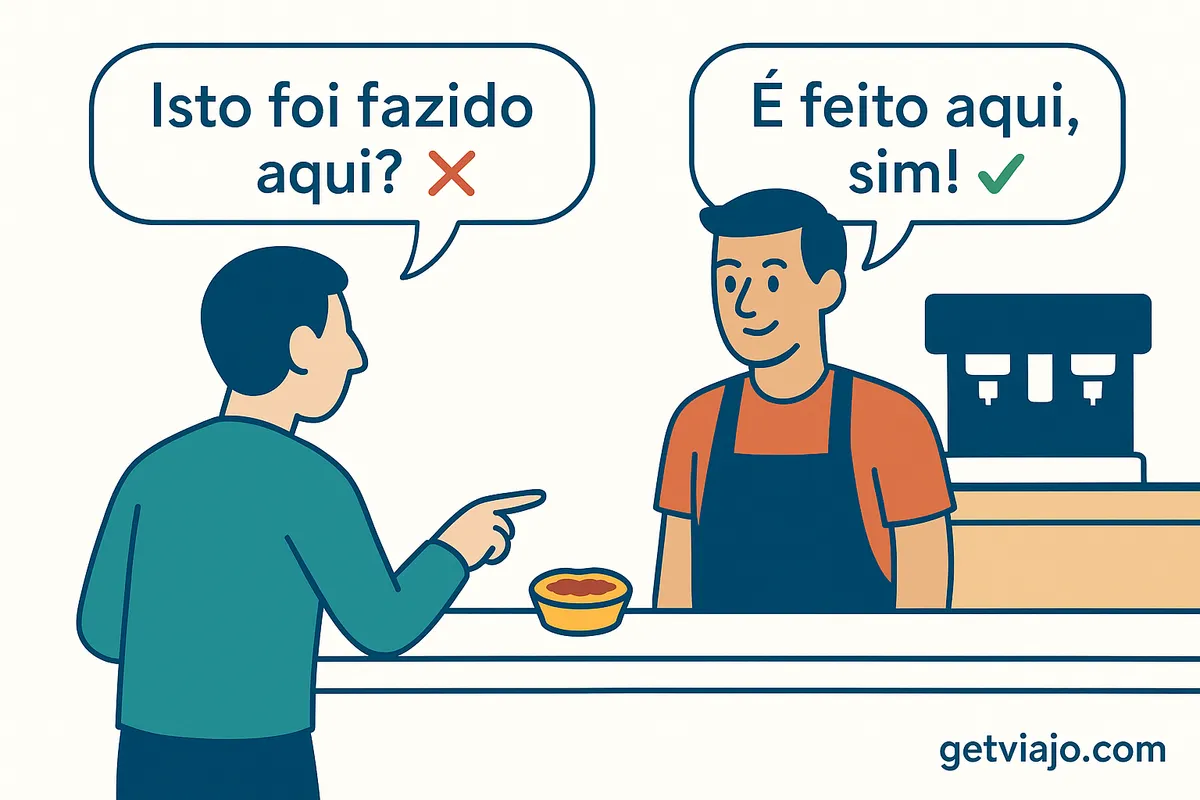 Irregular conjugations are always a bit weird. Past participles are no exception.
What a Past Participle Actually Is
A past participle is a verb form that also does the job of an adjective. You already use them constantly in English without thinking about it. You can read a quick refresher on what a past participle is in English if you want the formal explanation, but the short version is this. A “broken” window, “I have eaten,” the song has been “sung.” They often end in “-ed” or “-en.”
Portuguese past participles do the same job. They pair with helper verbs to build different tenses, and they describe nouns. They’re a building block for almost any sentence about something that already happened.
Regular Past Participles
Most Portuguese verbs follow a predictable pattern. Once you have it, you’ve covered the majority of cases. The ending depends on the verb’s infinitive ending.
| English | Portuguese |
|---|---|
| -AR verbs, drop -ar, add -ado | falar → falado (spoken) |
| -ER verbs, drop -er, add -ido | comer → comido (eaten) |
| -IR verbs, drop -ir, add -ido | partir → partido (left) |
If you know nadar (to swim), the participle is nadado. If you know vender (to sell), it’s vendido. The pattern carries you a long way.
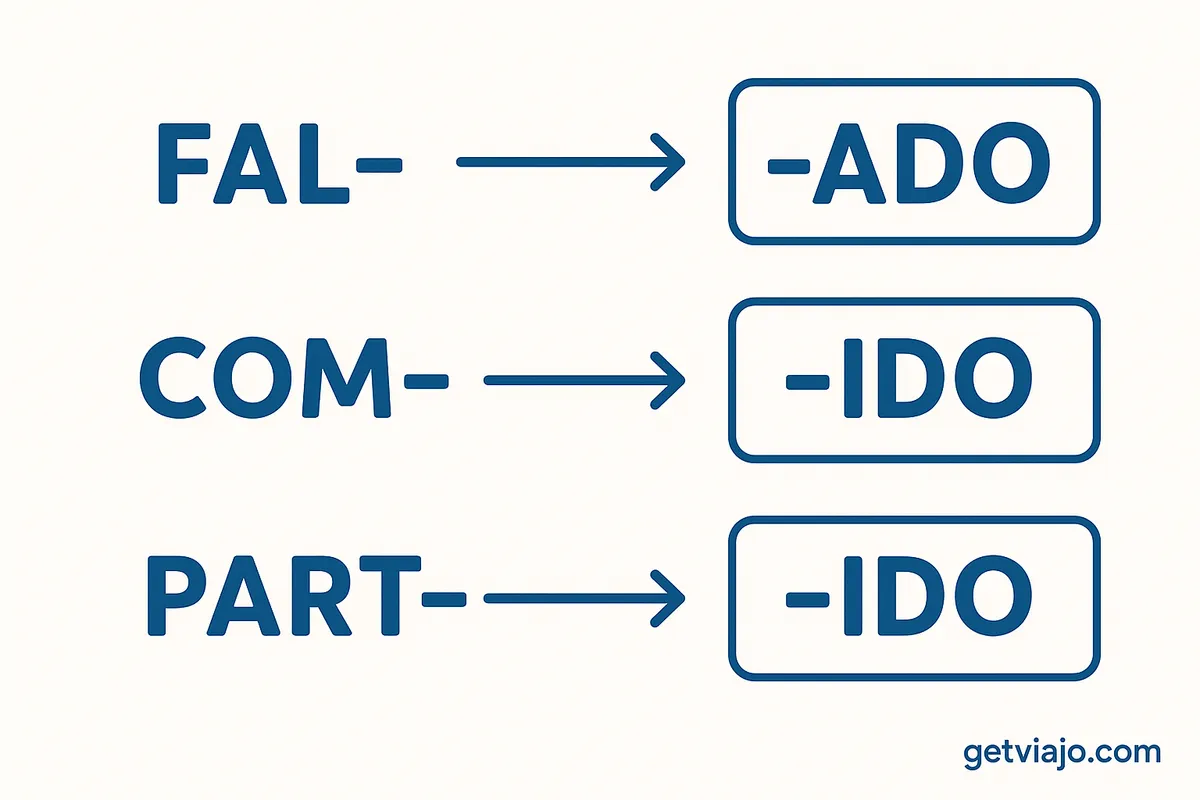 For most verbs, the pattern is your best friend.
Irregular Past Participles
Some verbs don’t follow the pattern, and there’s no shortcut. They have to be memorized. Here are a few of the common ones:
| English | Portuguese |
|---|---|
| done / made (fazer) | feito |
| seen (ver) | visto |
| written (escrever) | escrito |
| said (dizer) | dito |
| opened (abrir) | aberto |
| put (pôr) | posto |
[!tip] 🧠 Cheat sheet for the irregular ones The grammar rule only gets you halfway. You still need to memorize the words that refuse to follow it.
For a longer list of the ones that come up in daily errands, see 40+ Irregular Participles for Daily Life.
I still slip on these. Telling a friend about a movie I had finally watched, I started with “já tinha… vido?” The pause that followed told me everything. It’s visto. These three (feito, visto, escrito) are the ones I hear most often, so they’re a good place to start.
Verbs With Two Participle Forms
A handful of verbs have two participle forms, the regular long form (-ado/-ido) and a shorter irregular one. The short form usually drops the -ado or -ido ending entirely.
| English | Forms |
|---|---|
| paid (pagar) | long: pagado / short: pago |
| won (ganhar) | long: ganhado / short: ganho |
| accepted (aceitar) | long: aceitado / short: aceite |
| lit (acender) | long: acendido / short: aceso |
| delivered (entregar) | long: entregado / short: entregue |
The short form shows up often after ser and estar because those verbs carry passive or descriptive meaning, which fits the adjective-like short form.
- A conta está paga. (The bill is paid.)
- O prémio já foi ganho. (The prize has already been won.)
[!tip] A working rule of thumb
- Use the long, regular form (pagado, ganhado) with the helper verb ter (to have).
- Use the short, irregular form (pago, ganho) with the helper verbs ser or estar (to be).
Compare:
- Eu tenho pagado a tempo. (I have been paying on time.)
- A conta está paga. (The bill is paid.)
This one trips up native speakers too. Pick it up verb by verb as you meet them.
The Helper Verbs
Past participles almost always travel with a helper verb. The three you’ll see most often are ter (to have), ser (to be), and estar (to be). The helper changes the meaning of the sentence.
| English | Portuguese |
|---|---|
| I have spoken | Eu tenho falado |
| The castle was built | O castelo foi construído |
| The door is open | A porta está aberta |
The wrong helper changes the meaning of the sentence, or breaks it entirely.
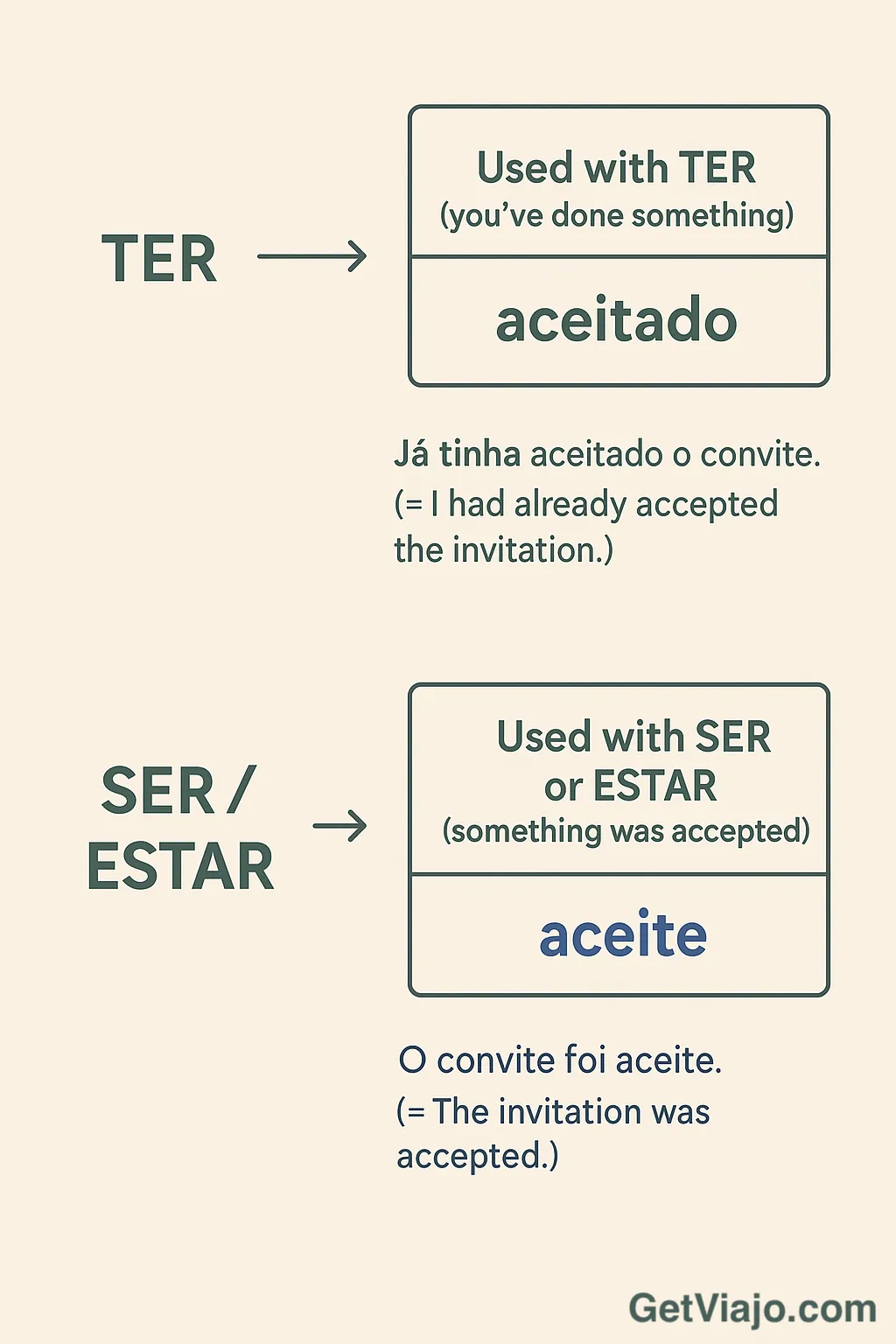 A simple rule for a tricky situation. ‘ter’ takes the long form, ‘ser/estar’ takes the short one.
The Agreement Rule
This is the rule that separates the people who have practiced from the people who haven’t. I still forget it sometimes.
When a past participle follows ser, estar, or ficar, it has to agree in gender and number with the noun it describes. It behaves like an adjective.
| Portuguese | English |
|---|---|
| A casa foi pintada | The house was painted (feminine singular) |
| Os carros foram vendidos | The cars were sold (masculine plural) |
| As portas estão abertas | The doors are open (feminine plural) |
| O livro foi escrito | The book was written (masculine singular) |
The exception with ter
Ter doesn’t play this game. With ter (and also haver, which is rare in spoken Portuguese), the participle stays in its default masculine singular form regardless of the noun.
- Eu tenho comprado muitas coisas online ultimamente. (I’ve been buying a lot of things online lately.)
- Nós tínhamos visto aquelas casas antes. (We had seen those houses before.)
- Ela tinha deixado as portas abertas. (She had left the doors open.)
Comprado, visto, and deixado don’t change to match coisas, casas, or portas. They stay locked after ter.
Once the agreement rule clicks, your sentences sound noticeably more natural.
Common Mistakes
A short list of the things that catch English speakers most often:
- Letting the participle fly solo. You wouldn’t say “I eaten” in English. It’s “I have eaten.” Portuguese works the same way. In most cases, you need to know why a helper verb is required like ter or ser.
- Forgetting agreement. With ser or estar, check whether your noun is masculine, feminine, singular, or plural, and match the participle’s ending.
Audio lessons and PDF study guides to accompany every lesson
Get In on the Ground Floor!
This is a new website!
As such, I'm starting the price for premium at just $2.99/mo, increasing to $11.99/mo after my first 100 members.
How to Actually Learn This
A few approaches that work:
- Daily practice. Ten minutes is enough if it’s consistent.
- Flashcards for the irregulars. Feito, escrito, visto, and the rest don’t have a pattern. Memorization is the path.
- Listen and repeat. RTP Play, Portuguese radio, or any podcast. When you hear a participle, pause and repeat the sentence out loud.
- Write sentences. O carro foi vendido. Os carros foram vendidos. A casa foi vendida. As casas foram vendidas. It feels repetitive because it is, and that’s the point.
- Ask for corrections. A neighbor, a language partner, or the staff at the pastelaria when it’s quiet. People are generally glad to help when they see you trying.
- Read what’s around you. Supermarket signs, news, the announcements on the metro. The patterns start to feel ordinary once you’ve seen them a few hundred times.
You’ve Got This
This is genuinely hard, and some days your brain will feel full. That’s normal.
Getting past participles right is a real leap in fluency, though. Keep practicing and keep making mistakes. Each correction gets you closer to the next one not happening. For the bigger picture of how participles fit into the wider tense system, see my master guide on Portuguese Verb Tenses.
Frequently Asked Questions
[!faq]- What’s the rule for regular past participles again? It depends on the verb’s ending. For -AR verbs, drop the ending and add -ado (falar → falado). For -ER and -IR verbs, drop the ending and add -ido (comer → comido, partir → partido).
[!faq]- Is there a trick for the irregular ones? Not really. Irregulars like feito (from fazer), escrito (from escrever), and visto (from ver) come from the language’s history and don’t follow the standard pattern. Memorization and repetition are the only way through.
[!faq]- When do I use the long vs. short form of a double-participle verb? The general rule. Use the long form (-ado/-ido) with ter, and the short form with ser or estar. For example, Eu tenho pagado as contas (I have been paying the bills) vs. A conta está paga (The bill is paid).
[!faq]- What’s the most common mistake English speakers make? Forgetting agreement with ser or estar. Saying a porta está aberto instead of a porta está aberta, or os livros foram lido instead of os livros foram lidos, is an instant tell that you’re still learning.
[!faq]- Does the participle change after ter? No. With ter as the helper, the participle stays in its default masculine singular form regardless of the noun. Ela tem falado, Eles têm falado. The ending doesn’t change. The conjugation of ter itself still changes normally (tenho, tinha, etc.).
