


The first time I tried to read a Portuguese novel, I realized on page one I was in too far over my head.
I saw both fê-lo and dão-no and quickly decided, “Nope. I guess this ain’t happenin’.” I checked the little pocket dictionary I keep by the bed. I couldn’t find fê-lo OR dão-no. Not real words. I knew this language was imaginary.
At first I genuinely wasn’t sure if these were words. You know how sometimes authors write out the sounds a character makes? I thought it might be one of those.
I was wrong.
They turn out to be regular verbs and pronouns that have undergone a bit of “phonetic surgery” to make them flow better than what they technically should look like.
Fez-o (did it) sounds awkward out loud, so the z gets dropped, an accent lands on the e (ê), and it becomes fê-lo. Same meaning as fez-o. Just the proper way to say it.
If you are still getting comfortable with “it,” “him,” and “her,” you might want to start with my breakdown on making sense of Portuguese pronouns.
If you are ready to figure out why letters keep disappearing and reappearing, let’s look at the mechanics.
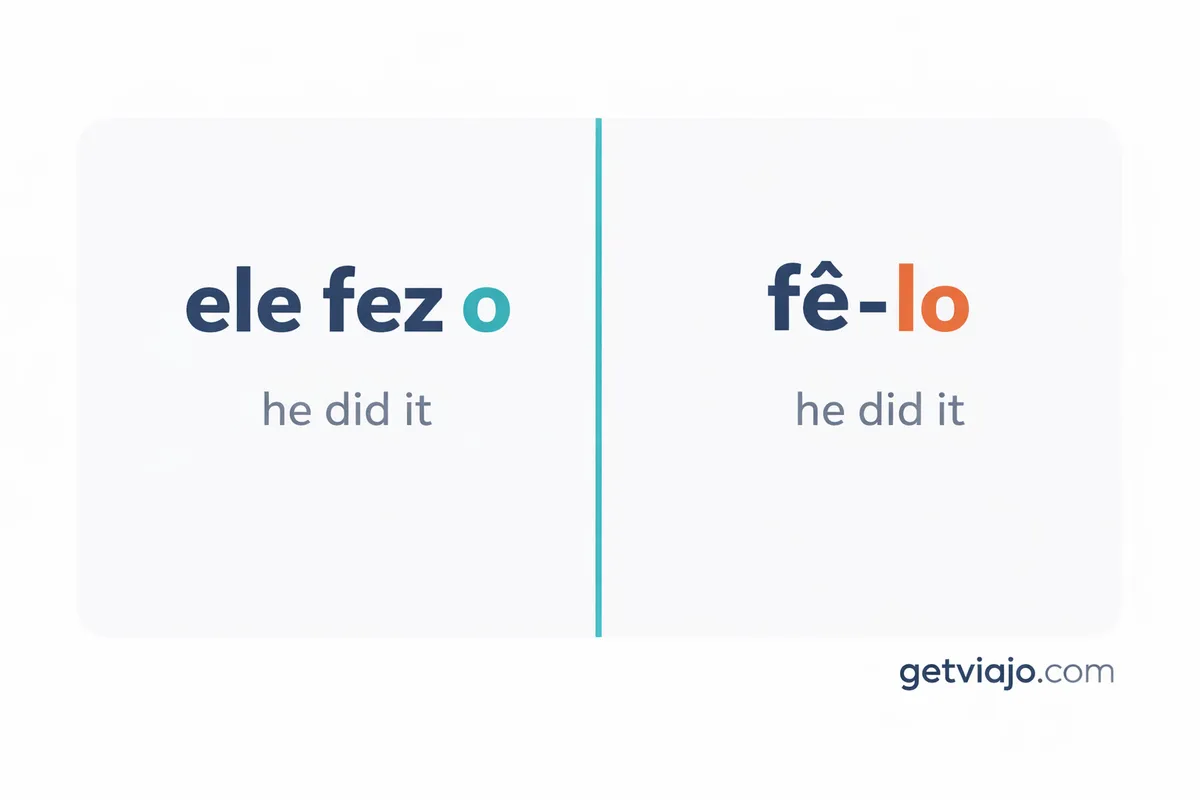 Both sides mean exactly the same thing. The right side is just easier to say out loud.
The Problem of Choppy Sounds
European Portuguese hates choppy sounds. It is obsessed with mouth flow.
Normally, if you want to say “I see it” referring to a masculine object like o filme, you would theoretically say vejo o. That flows fine. Try it: form your lips and say it out loud slowly.
What happens when the verb ends in a consonant like R, S, or Z? Or a nasal sound like M?
Try saying fez o quickly. It comes out clunky, like “phase-oo.”
The language forces a rule change to make the words glide. It cuts the harsh consonants and adds an L or an N to bridge the gap.
The Rule for Verbs Ending in R, S, or Z
This is the most common mutation you will see.
Whenever a direct object pronoun like o, a, os, or as comes after a verb ending in -r, -s, or -z, two things happen.
- Drop the letter. The -r, -s, or -z disappears.
- Add an L. The pronoun becomes
-lo,-la,-los, or-las.
[!tip] Watch out for the accents
When the -r gets cut, the vowel left behind usually needs an accent to keep the stress strong.
- -ar verbs get an acute accent (á). Example: lavar becomes
lavá-la.- -er verbs get a circumflex accent (ê). Example: fazer becomes
fazê-la.- -ir verbs usually get no accent. Example: pedir becomes
pedi-lo.
(In the example we’ve been using, fez is just the third-person past tense of fazer, meaning “he/she/it did.”)
The Mechanics in Action
Here is how the transformation looks step-by-step.
| Verb Ending | Transformation |
|---|---|
| -R | vou trocar + a → drop R, add L → vou trocá-la |
| -S | nós vemos + o → drop S, add L → vemo-lo |
| -Z | ele fez + o → drop Z, add L → fê-lo |
 Think of the L as the replacement part for the letters you threw away.
The Nasal Rule for M, ÃO, and ÕE Endings
This group is easier to spot because nothing gets cut from the verb. You just stick an “n” onto the front of the pronoun.
If the verb form ends in a nasal sound (-m, -ão, or -õe), the pronoun becomes -no, -na, -nos, or -nas.
The logic is purely about sound. Going from a nasal “M” straight into an open “O” vowel is awkward. The “N” smooths it over.
The Nasal Bridge
| Verb Ending | Transformation |
|---|---|
| -M | eles fazem + as → add N → fazem-nas |
| -ÃO | eles dão + o → add N → dão-no |
| -ÕE | ela põe + os → add N → põe-nos |
[!warning] A Critical Exception: The Magnet Rule There is one situation where you do not perform this surgery. Certain words in Portuguese act like magnets that pull the pronoun to the front of the verb.
If the sentence is negative (contains não, nunca, etc.) or starts with a question word (like como, que, ainda, or já), the magnet wins. The normal pronoun goes before the verb, and nothing gets cut.
- Standard: Vou
fazê-lo. (I’m going to do it.)- Negative: Não
o voufazer. (I’m not going to do it.) → No surgery needed.
This focus on flow is similar to how the small connecting words shift around in a sentence, which I cover in my guide to Portuguese prepositions.
Audio lessons and PDF study guides to accompany every lesson
Get In on the Ground Floor!
This is a new website!
As such, I'm starting the price for premium at just $2.99/mo, increasing to $11.99/mo after my first 100 members.
Top Verbs That Use These Endings
You don’t need to memorize every verb in the dictionary. In my experience, this rule shows up most often on a handful of high-frequency verbs.
These are the ones worth recognizing instantly.
| Verb (Infinitive) | Example and Transformation |
|---|---|
| Fazer (To do/make) | Vou fazer a cama → Vou fazê-la (drop R, add L) |
| Ver (To see) | Nós vemos a Sara → Nós vemo-la (drop S, add L) |
| Trazer (To bring) | Ele traz a mala → Ele trá-la (drop Z, add L) |
| Dar (To give) | Eles dão o documento → Eles dão-no (keep ÃO, add N) |
| Pôr (To put) | Ela põe os livros → Ela põe-nos (keep ÕE, add N) |
[!tip] The “Isso” Hack If your brain freezes mid-conversation and you can’t remember whether to drop an R or add an L, there is a cheat code.
Instead of using the specific pronoun (o/a), you can often just swap the object for isso (that).
- The textbook way: Vou
comê-lo. (I’m going to eat it.)- The lazy way: Vou comer isso. (I’m going to eat that.)
It is not always elegant, but it will get you through the moment when you’re staring at a server and your brain is empty.
 You will run into these five verbs in this form pretty often.
3 Practice Drills to Build Muscle Memory
The only way to stop staring at these words blankly is to build the mechanical habit. Here are three drills based on standard workbook exercises.
Drill 1: The R, S, Z Drop
Rewrite the sentence, replacing the bold part with a pronoun.
| Question | Answer |
|---|---|
| O João pôs a mesa na sala. | O João pô-la na sala. |
| Tu partes a louça. | Tu parte-la. |
| Ontem eu fiz os exercícios todos. | Ontem eu fi-los todos. |
Drill 2: The Nasal Add-On
Rewrite the sentence, replacing the bold part with a pronoun.
| Question | Answer |
|---|---|
| Ela põe as canetas na mala. | Ela põe-nas na mala. |
| Eles dão os papéis ao Paulo. | Eles dão-nos ao Paulo. |
| Elas veem o filme. | Elas veem-no. |
Drill 3: The Infinitive Challenge
These are common “going to do” structures.
| Question | Answer |
|---|---|
| Ele vai comprar as maçãs. | Ele vai comprá-las. |
| Ela está a lavar as mãos. | Ela está a lavá-las. |
| Ele vai fazer a cama. | Ele vai fazê-la. |
Don’t worry if you forget the accent mark sometimes or mix up -no and -lo at first. The goal right now is to recognize the verb hiding inside the strange-looking word so you don’t get lost in the middle of a sentence.
Frequently Asked Questions
[!faq]- Do Brazilians use these forms? Generally, no. Brazilian Portuguese tends to put the pronoun at the start of the verb phrase (Me dá) or use ele/ela as a direct object (Eu vi ele), which is considered incorrect in European Portuguese. If you want to sound like you are speaking the Portugal variety, the -lo and -no forms are part of the package.
[!faq]- Is this formal or casual? It is standard. Some casual speech drops the object pronoun entirely, but
fê-loordão-nois not “fancy” or “aristocratic.” It is simply how the language is written and spoken correctly in Portugal. You will hear it in shops, cafes, on the news, and so on.
[!faq]- Why doesn’t ‘tens’ become ‘ten-lo’? The rule applies to direct object pronouns. Ter (to have) is transitive, but in everyday speech we don’t usually say “I have it” the way we say “I see it.” That said, following the S-drop rule, tu tens + o would technically follow the pattern. Focus on the high-frequency verbs above first.
[!faq]- How do I pronounce the accents like á and ê? The acute accent (á) opens the vowel, like the “a” in “father.” The circumflex (ê) closes the sound, making it deeper, somewhere between the “a” in “about” and the “e” in “hey” without the glide. The distinction matters because it keeps the stress on that final syllable after the R drops away.
