


You can memorize hundreds of Portuguese nouns and verbs, but your sentences will still fall apart without the small words that hold them together. Those small words are prepositions.
Using the right one is often what makes a sentence sound Portuguese rather than translated. Words like em, a, de, and por show up constantly, and they are the building blocks of clear sentences. This guide walks through the most common ones, how they work, and the spots where they tend to trip up English speakers.
What Are Prepositions?
Simply put, prepositions are connector words. They show the relationship between a noun (or pronoun) and the rest of a sentence, marking things like location, time, and direction.
In English, “I left the book on the table for you” needs those two small words, ‘on’ and ‘for’ to make the sentence make sense. Portuguese works the same way. The trick is less about learning a list and more about knowing which one fits which situation.
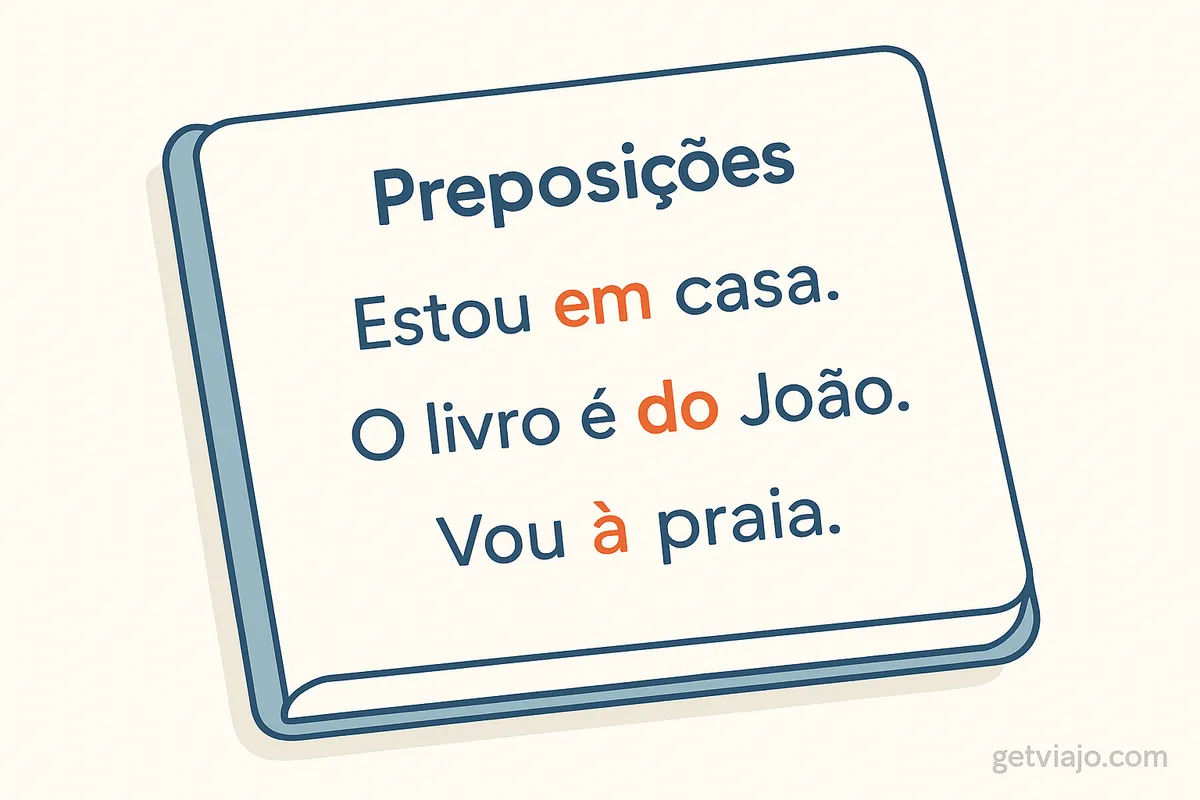 A Portuguese textbook showing a few essential prepositions for language learners
Common Portuguese Prepositions
A small handful of prepositions do most of the work in everyday Portuguese. The rest of this section covers those. There’s also a full list of Portuguese prepositions if you want to see the wider set.
Em
This preposition generally means “in” or “on.” It almost always contracts with the definite article that follows it, depending on the gender of the noun.
- em + o = no (masculine)
- em + a = na (feminine)
So, you would say someone is no jardim (in the garden) or that your keys are na mesa (on the table).
De
De is incredibly versatile. It’s used to show possession (o carro de Paulo = Paulo’s car), origin (vinho de Portugal = wine from Portugal), or what something is made of (uma casa de madeira = a wooden house).
It also contracts with articles: de + o = do, de + a = da. For example, a porta da casa = the door of the house, and o telhado do prédio = the roof of the building.
Para
Use para to indicate a destination or a purpose. It’s about where you’re going or the reason you’re doing something. For example, Vou para o trabalho means “I’m going to work” (destination) and “Comprei flores para a minha mãe” means “I bought flowers for my mom” (the purpose).
[!tip] Quick Tip for Texting You’ll often see para o and para a abbreviated as pro and pra in texting and other informal communication.
Com
This one is straightforward. Com means “with.” You use it for accompaniment, like in the classic café com leite (coffee with milk).
Sem
The opposite of ‘com’, sem simply means “without.” It’s what you need to order um café sem açúcar (a coffee without sugar).
Por
Por can indicate a cause, a means of travel, or a duration. It’s the “why” or “how.” For example:
- “Estive fora por duas semanas” = I was away for two weeks
- “Obrigado pela ajuda” = Thanks for the help. Here, pela is a contraction of por + a because ajuda is a feminine noun.
- “Obrigado pelo livro” = Thanks for the book. Here, it’s pelo because livro is a masculine noun.
Here are the example sentences side by side, with the contractions noted in the prose below.
Common Prepositions in Context
| English | Portuguese |
|---|---|
| The book is on the table. | O livro está na mesa. |
| I like the new car. | Gosto do carro novo. |
| We are going to the cinema. | Nós vamos ao cinema. |
| We walked along the beach. | Andámos pela praia. |
| Do you want a coffee with milk? | Queres um café com leite? |
A quick reference on the contractions you just saw: em gives you no / na / nos / nas, de gives you do / da / dos / das, a gives you ao / à / aos / às, and por gives you pelo / pela / pelos / pelas. Com doesn’t contract.
Prepositions of Movement
Movement prepositions are one of the spots where Portuguese splits paths with English. The language uses different small words depending on whether a trip is short or long, temporary or permanent.
For a deeper outside take on this, here is a helpful guide to movement prepositions.
A vs. Para
In European Portuguese, the general rule is about intention and duration.
Use a for short, temporary movements where you don’t intend to stay long. It implies a round trip.
- “Vou a Lisboa amanhã.” — “I’m going to Lisbon tomorrow.” (short trip, coming back)
- “Fui ao café esta manhã.” — “I went to the café this morning.” (brief visit)
- “Fui ao supermercado.” — “I went to the supermarket.”
[!tip] Explaining “ao” Ao is the contraction of a + o.
One ‘a’ = “to”
One ‘o’ = “the” (masculine)
You can’t say “Eu vou a o supermercado” with both words separate, so they’re combined into ao.
Thus… “Eu vou ao supermercado”.
Also…
- “Eu vou à praia.” = I am going to the beach.
[!tip] Explaining “à” À (with the accent on top) is the contraction of a + a.
One ‘a’ = “to”
Two ‘a’s’ = “to the” (feminine)
But you can’t just say “Eu vou a a praia” with two a’s, so they shorten it to à.
Thus… “eu vou à praia”. Make sense?
Meanwhile, use para for more permanent or long-duration moves, or when the destination is the final goal of the journey.
- “Vou para Lisboa uns dias.” — “I’m going to Lisbon for a few days.” (Keeping it vague with uns dias actually strengthens the sense of a longer, more definite stay.)
- “Eles mudaram-se para o Porto.” — “They moved to Porto.”
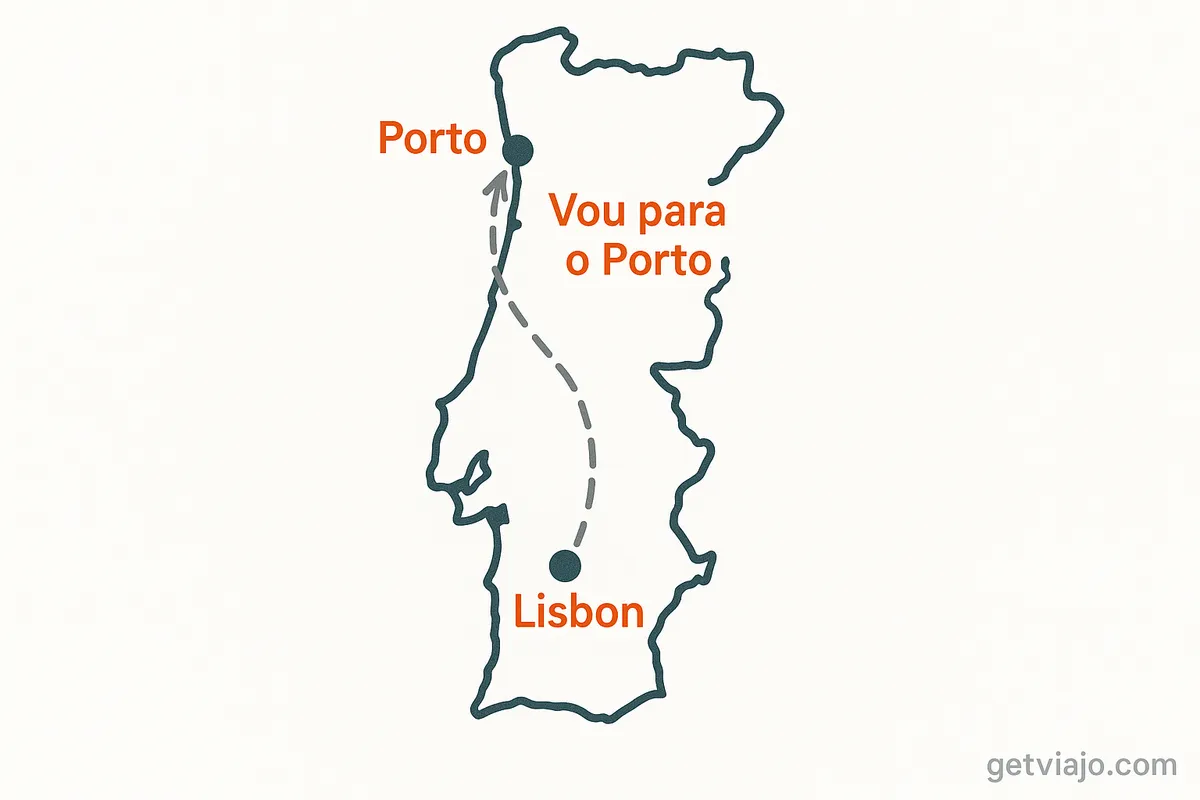 Using ‘para’ is common for showing clear movement and direction between two points, like traveling from Lisbon to Porto.
Think of it this way:
In Lisbon, you might say, “Vou ao Rossio tomar um café,” (I’m going to Rossio to have a coffee) implying a quick, temporary trip.
…But you would say, “Mudei-me para Alfama no ano passado,” (I moved to Alfama in the last year) for a permanent move. Here, the verb mudar-se (to move oneself) itself implies a longer-term stay, which is why para is the natural choice.
Chegar a vs. Chegar em
A clear example of the difference between European and Brazilian Portuguese shows up with the verb chegar (to arrive). The form used in Portugal is chegar a.
-
In European Portuguese, the grammatically correct and universally used form is ‘chegar a’.
- Eu cheguei a casa. (I arrived home.)
- O avião chegou a Lisboa. (The plane arrived in Lisbon.)
-
In Brazilian Portuguese, it is standard to use chegar em.
- Eu cheguei em casa.
- O avião chegou em São Paulo.
[!warning] This is Specific to Chegar! Using “chegar em” in Portugal is one of the more recognizable markers of Brazilian Portuguese. It’s understood without any trouble, but it’s not the form you’ll hear from speakers here. Switching to ‘chegar a’ is a small adjustment that tends to fit in better.
Audio lessons and PDF study guides to accompany every lesson
Get In on the Ground Floor!
This is a new website!
As such, I'm starting the price for premium at just $2.99/mo, increasing to $11.99/mo after my first 100 members.
Prepositions of Time
Just like with movement, talking about when something happens in Portuguese requires a specific set of prepositions that don’t always align with English.
This is a brief overview of the most important concepts, which we will explore more deeply in a future article.
One of the most useful distinctions is how you talk about days of the week. The preposition you choose changes the meaning from a one-time event to a recurring habit.
- For a single action, use em + article (no/na). “Na terça-feira, fui ao cinema.” (On Tuesday, I went to the cinema.) This implies it happened on that specific Tuesday and not necessarily any other.
- For a habitual action, use a + article (ao/à). “Às terças-feiras, vou ao cinema.” (On Tuesdays, I go to the cinema.) This implies it’s a routine that happens every Tuesday (notice the day of the week also becomes plural: terça-feira becomes terças-feiras).
This same logic applies to parts of the day. Notice the different prepositions for morning, afternoon, and night:
- De manhã, bebo café. (In the morning, I drink coffee.)
- À tarde, gosto de passear. (In the afternoon, I like to walk.)
- À noite, leio um livro. (At night, I read a book.)
Finally, the way you talk about duration can add a subtle layer of meaning.
- Em suggests completion: “Corri a maratona em 2 horas.” (I ran the marathon in 2 hours - meaning, I finished it).
- Durante suggests the process: “Corri durante 2 horas.” (I ran for 2 hours - that was the duration of my activity, with no mention of finishing a race).
 Learning the days of the week and months is a fundamental foundation
Contractions with Prepositions
Portuguese is full of contractions. Prepositions merge with the articles (o, a, os, as) and pronouns that follow them, and this merging is a mandatory rule of the language.
You don’t say “em a” casa; you say “na” casa. A good way to think about it is to extend the “mmm” sound from em straight into the ‘o’ or ‘a’ that follows: ‘em-o’ becomes ‘no’, ‘em-a’ becomes ‘na’.
Here are a few more examples:
- “Estou no carro.” = I’m in the car. (em + o → no)
- “Ela mora na cidade.” = She lives in the city. (em + a → na)
- “As chaves estão nos bolsos.” = The keys are in the pockets. (em + os → nos)
- “As toalhas estão nas gavetas.” = The towels are in the drawers. (em + as → nas)
Challenges and Tips
Prepositions are tricky because they don’t map perfectly from English to Portuguese. A single English word like “for” could be por or para depending on the context.
On top of that, some Portuguese verbs require a preposition where English doesn’t. A common example is gostar (to like), which must be followed by 'de'.
- English: “I like the movie.”
- Portuguese: Eu gosto do filme. (de + o filme)
[!warning] Another Common Trap: Assistir
You might know that assistir means “to watch” or “to attend,” but did you know it requires the preposition a? To watch the game? You translate it to say you watch to the game.
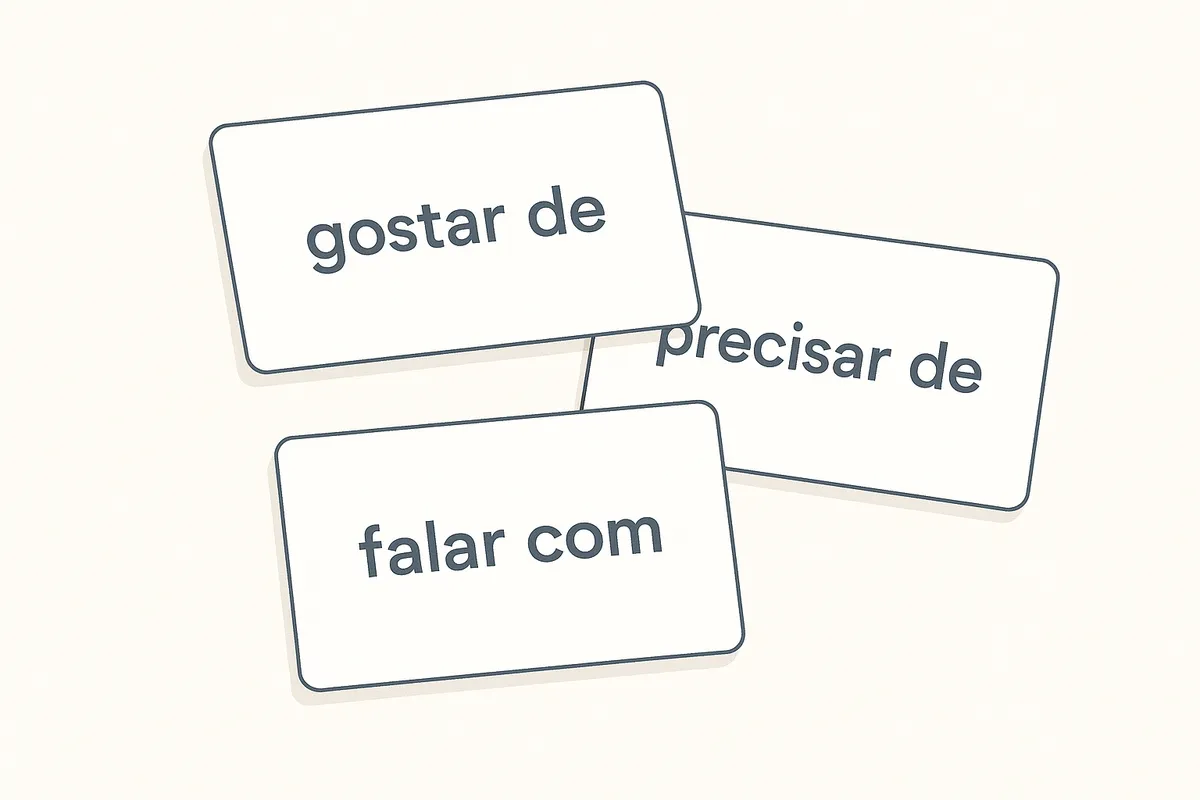 Flashcards are a great way to memorize verbs that require a specific preposition, like ‘gostar de’ (to like).
A few things that help.
Write full sentences rather than memorizing lists, and pay attention to which prepositions show up when you’re reading or listening to Portuguese.
When you learn a new verb, learn the preposition that goes with it. Treat gostar de (to like), precisar de (to need), and falar com (to speak with) as single units.
Listen for how speakers connect words. The contractions and patterns become familiar with time.
You will get prepositions wrong. Everyone does. The useful move is to notice the mistake, check the correct form, and try again the next time.
Conclusion
Prepositions take time. The patterns settle in slowly, mostly through exposure, and you will get them wrong along the way. That’s normal.
If you want to see how prepositions fit into the wider shape of a sentence, my guide on Portuguese sentence structure is a good next step.
Keep at it. You’ll get there.
Frequently Asked Questions
[!faq]- What is the main difference between ‘por’ and ‘para’? It’s one of the trickiest distinctions. Generally, para indicates a destination, a recipient, or a purpose (the “end goal”). Por indicates a cause, a means, a duration, or an exchange. For example: “Vou para casa” = I’m going home vs. “Vou pela rua”= I’m going through the street.
[!faq]- As an example, how do I say “on Monday” in Portuguese? It depends on the context. If you are talking about a single event, you say “Na segunda-feira” (e.g., Na segunda-feira, tenho uma reunião). If you are talking about a recurring, habitual action, you say “Às segundas-feiras” (e.g., Às segundas-feiras, vou ao ginásio).
[!faq]- Do I always have to use contractions like ‘no’ and ‘da’? Yes, in almost all cases. When a preposition like em or de is followed by a definite article (o, a, os, as), the contraction is mandatory in standard spoken and written Portuguese. Saying em o or de a sounds very unnatural.
[!faq]- Why do some verbs need a preposition in Portuguese but not in English? This is a feature of many languages called “verb government” or “complementation.” Certain verbs require a specific preposition to connect to their object. There’s often no direct logical reason that translates to English; it’s simply a grammatical rule you have to memorize. Think about how in English you “listen to” music, but you just “hear” a noise with no preposition—it’s just convention. Portuguese is the same with verbs like gostar de (to like) or precisar de (to need).
[!faq]- Are there big differences in prepositions between European and Brazilian Portuguese? For the most part, the core prepositions are the same. However, there are differences in usage, especially with verbs of motion. For example, the use of em with chegar is common in Brazilian Portuguese (cheguei em casa) whereas European Portuguese requires a (cheguei a casa). The examples in this article are for European Portuguese.
