


When you tell a story in Portuguese, you need a clean way to say that one past action happened before another past action.
Example: You arrived at the station… but the train had already left.
Exemplo: Tu chegaste à estação… mas o comboio já tinha partido.
In European Portuguese, you don’t solve this by stacking simple past verbs. You use a specific tense:
Pretérito Mais-Que-Perfeito Composto
(also called the Pluperfect Compound)
It’s the tool that gives you “had done” / “had already done”, or “had happened” / “had already happened.”
Picture a timeline. The pluperfect is a flag you plant further back in the past.
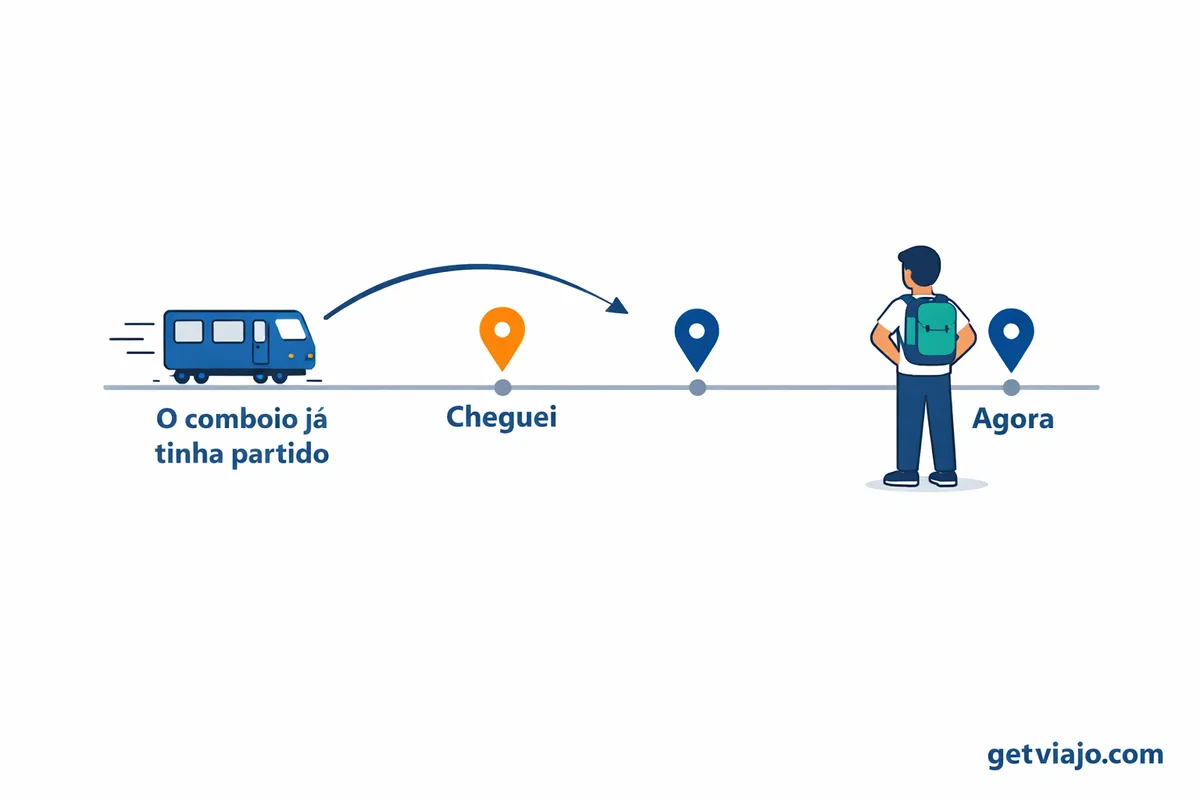 Timeline: The train had already left before I arrived (agora means ‘now’)
The Have vs. Had Trap
English has two phrases that look similar:
- “I have eaten”
- “I had eaten”
If you translate them directly, you’ll get the wrong meaning in Portugal.
The Direct Translation
The literal translation of “I have eaten” from English is Tenho comido. Comido is the past participle (particípio) of the verb comer (to eat).
What It Actually Means in Portugal
In Portugal, tenho + particípio usually signals repetition, ongoing habit, or “lately”:
| Portuguese | English |
|---|---|
| Tenho comido muito peixe. | I’ve been eating a lot of fish (lately / repeatedly). |
Think of this structure as a calendar, not a single moment.
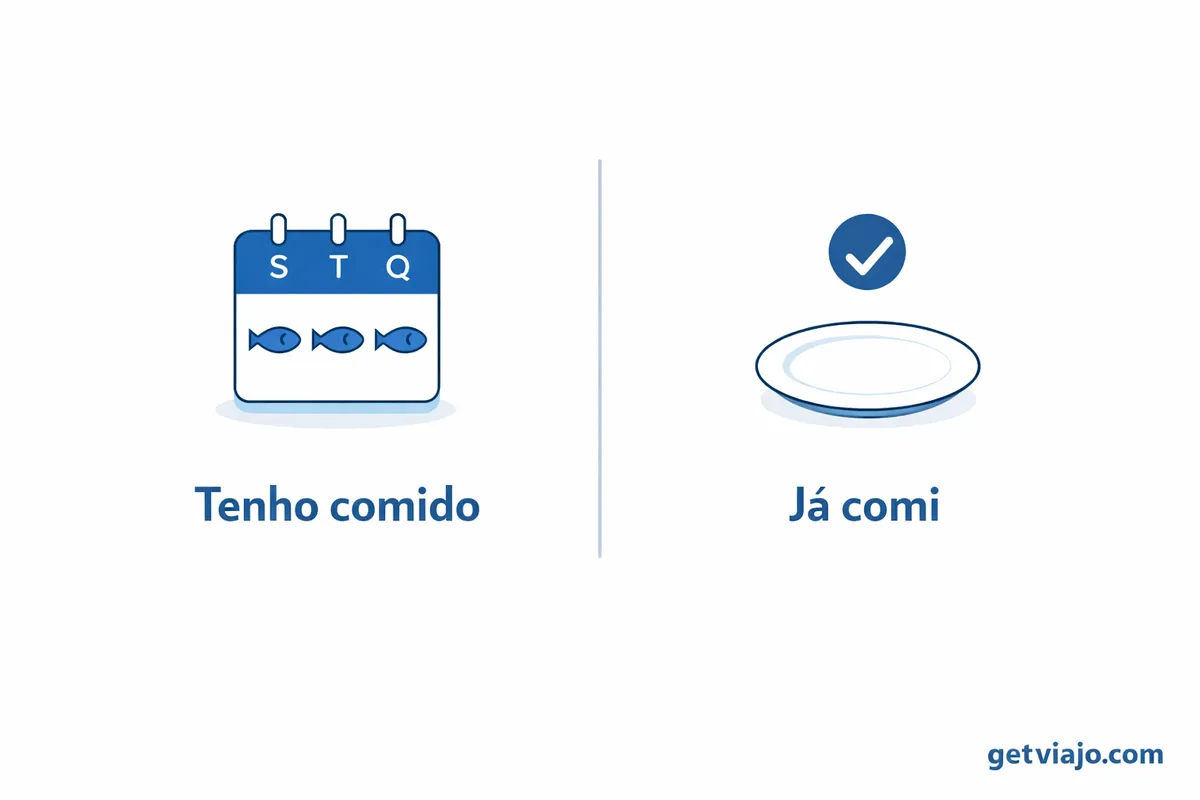 Don’t confuse the habit (Tenho comido / I have been eating) with the finished event (Já comi / I already ate).
Tenho comido does not mean “I ate (one time) and I’m done.”
How to Say “I Have Eaten” for One Completed Action
In European Portuguese, you’d normally say:
| Portuguese | English |
|---|---|
| Já comi. | I’ve eaten (already). / I already ate. |
| Comi. | I ate. (Often used where English would say “I’ve eaten.”) |
This keeps your Portuguese natural and avoids the “I’ve been eating lately” meaning when you didn’t intend it.
The Lately Rule
Two structures, same helper verb, very different meanings:
| Structure | Meaning (with example) |
|---|---|
| Ter (present) + particípio | Repeated / ongoing (“lately”). Tenho falado com ele. = I’ve been talking to him (lately). |
| Ter (imperfect) + particípio | ”Had done” (before another past moment). Já tinha falado com ele. = I had already spoken with him (before something else). |
[!tip] The “Andar a” Alternative
You’ll also hear andar a + infinitive to mean “lately.”
- “Ando a comer muito peixe.” = I’ve been eating a lot of fish (lately).
- “Andas a trabalhar muito?” = Have you been working a lot?
- “Andamos a aprender português.” = We’ve been learning Portuguese.
It means almost the same thing as tenho comido. Both point to ongoing habits, not a single finished event.
Building the Had Done Flashback
To say someone “had done” something, or something “had happened,” the structure is always the same:
- Ter in the imperfect past
- Past participle of the main verb
| Portuguese | English |
|---|---|
| Nunca tinha provado antes. | I had never tasted this before. |
| Tu já tinhas estado em Portugal? | Had you been to Portugal before? |
| Eles já tinham saído quando cheguei. | They had already left when I arrived. |
If you’re shaky on participles (falado, comido, partido, feito, visto…), the mechanics live in mastering Portuguese past participles.
The Helper Verb Cheat Sheet
Memorize this. It’s the entire engine.
| Subject | Imperfect Ter (with example) |
|---|---|
| Eu | tinha. Tinha chegado. (I had arrived.) |
| Tu | tinhas. Tinhas chegado. (You had arrived.) |
| Ele/Ela / o senhor / a senhora | tinha. Ele tinha chegado. (He had arrived.) |
| Nós | tínhamos. Tínhamos chegado. (We had arrived.) |
| Eles/Elas | tinham. Eles tinham chegado. (They had arrived.) |
[!tip] Pro Tip In European Portuguese, você is often avoided. You’ll hear o senhor / a senhora for politeness, while você shows up much more in Brazilian Portuguese.
Pronouns (eu, tu, nós) also get dropped constantly because the verb already tells you who the subject is.
Real Life Scenarios
You use this tense to show sequence:
- Event B happened first (earlier past), tinha + particípio
- Event A happened later (later past), normal past
Missing the Train
| Portuguese | English (with logic) |
|---|---|
| O comboio já tinha partido… | The train had already left… (Event B, earlier past) |
| …quando chegámos. | …when we arrived. (Event A, later past) |
Notice the accent in chegámos.
That feather accent (´) on the á marks past tense, “we arrived.” Without the accent it becomes the present tense “we arrive.”
More Examples
| Situation | Portuguese / English |
|---|---|
| Dinner | Quando cheguei, ele já tinha feito o jantar. / When I arrived, he had already made dinner. |
| Movie | Quando chegámos ao cinema, já tínhamos visto o filme. / When we got to the cinema, we had already seen the movie. |
| Leaving | Quando telefonaste, já tinha saído. / When you called, I had already left. |
 Use the pluperfect when the dinner was waiting for you (it happened first).
[!tip] The power of já
This tense often appears with já in Portugal:
“Já tinha feito isso.” = I had already done it. It signals “completed before that moment.”
Two Mini-Dialogues
1. Late, and the train already left
- You: Desculpa… cheguei tarde. O comboio já tinha partido? (Sorry… I arrived late. Had the train already left?)
- Local: Pois. Acontece. (Yup. It did.)
2. “I’ve eaten already”
- Friend: Queres café? (Do you want a coffee?)
- You: Não, obrigado, já bebi. (No thanks, I already drank one.)
That second one is exactly where English speakers misuse tenho comido, because it lines up with how we’d phrase it in English, but the Portuguese meaning is different.
Audio lessons and PDF study guides to accompany every lesson
Get In on the Ground Floor!
This is a new website!
As such, I'm starting the price for premium at just $2.99/mo, increasing to $11.99/mo after my first 100 members.
Navigating Irregular Verbs
This tense forces you to use participles constantly. Regular ones are simple:
| Verb ending | Participle ending (with example) |
|---|---|
| -AR | -ado. falar → falado |
| -ER | -ido. comer → comido |
| -IR | -ido. partir → partido |
Many of the most common verbs have irregular participles. Getting these wrong stands out immediately.
| Verb | Participle |
|---|---|
| fazer | feito (not fazido) |
| ver | visto (not vido) |
| escrever | escrito |
| pôr | posto |
| dizer | dito |
For a tight reference list, see 40 irregular participles for daily life.
Why This Unlocks Fluency
Beginners speak in flat sequences:
- “I went. I saw. I ate.”
Intermediate speakers control time:
- what happened first,
- what happened later,
- what was already true when something else happened.
The “imperfect ter” + particípio structure is one of the first tools that lets you tell stories like a normal person in Portugal.
To see where it fits in the bigger picture, take a look at the essential verb tenses for Portuguese conversation.
Boa sorte!
Frequently Asked Questions
[!faq]- Can I use havia instead of tinha? Kind of. Havia feito is grammatically correct, but it sounds more formal or literary. In everyday spoken European Portuguese, tinha feito is the common choice. Learn tinha first if your goal is natural speech in Portugal.
[!faq]- Does this tense exist in a simple form without ter? Yes. It’s called the Pretérito Mais-Que-Perfeito Simples (e.g., ele fizera, eu partira). You’ll see it in literature and some formal writing, but it’s rare in modern everyday speech in Portugal. You don’t need it for conversation. Just recognize it when reading.
[!faq]- What if I just use the simple past twice? If you say “O comboio partiu quando eu cheguei,” it suggests the events were simultaneous, or that your arrival triggered the departure.
The pluperfect (o comboio já tinha partido) makes it clear the train was already gone before you arrived.
[!faq]- Do I use ser or estar with this? No. For the “had done” meaning in modern European Portuguese, the standard structure is ter in the imperfect (tinha) + past participle.
Haver (havia) is also possible but more formal.
You don’t build this “had done” structure with ser or estar (both mean “to be,” so it wouldn’t translate cleanly to English anyway).
