


English uses “so” for almost everything: “I’m so tired,” “There’s so much traffic.” Portuguese splits that into two words, tão and tanto. Getting the split right is one of the fastest ways to make your sentences sound less like you just memorized something from Google Translate.
Tão means “so” and pairs with qualities. Tanto means “so much” or “so many” and pairs with quantities.
Each one behaves differently from there.
Tão for Qualities
Tão describes how something is. It sits before an adjective or an adverb, and it never changes form, no matter what comes after it. Masculine, feminine, singular, plural… doesn’t matter. It’s always tão.
| English | Portuguese |
|---|---|
| The day is so beautiful. | O dia está tão bonito. |
| He speaks so fast. | Ele fala tão rápido. |
| We are so happy for you. | Estamos tão felizes por ti. |
In each one, tão is adding weight to a quality: bonito, rápido, feliz. The word itself stays put.
 Use
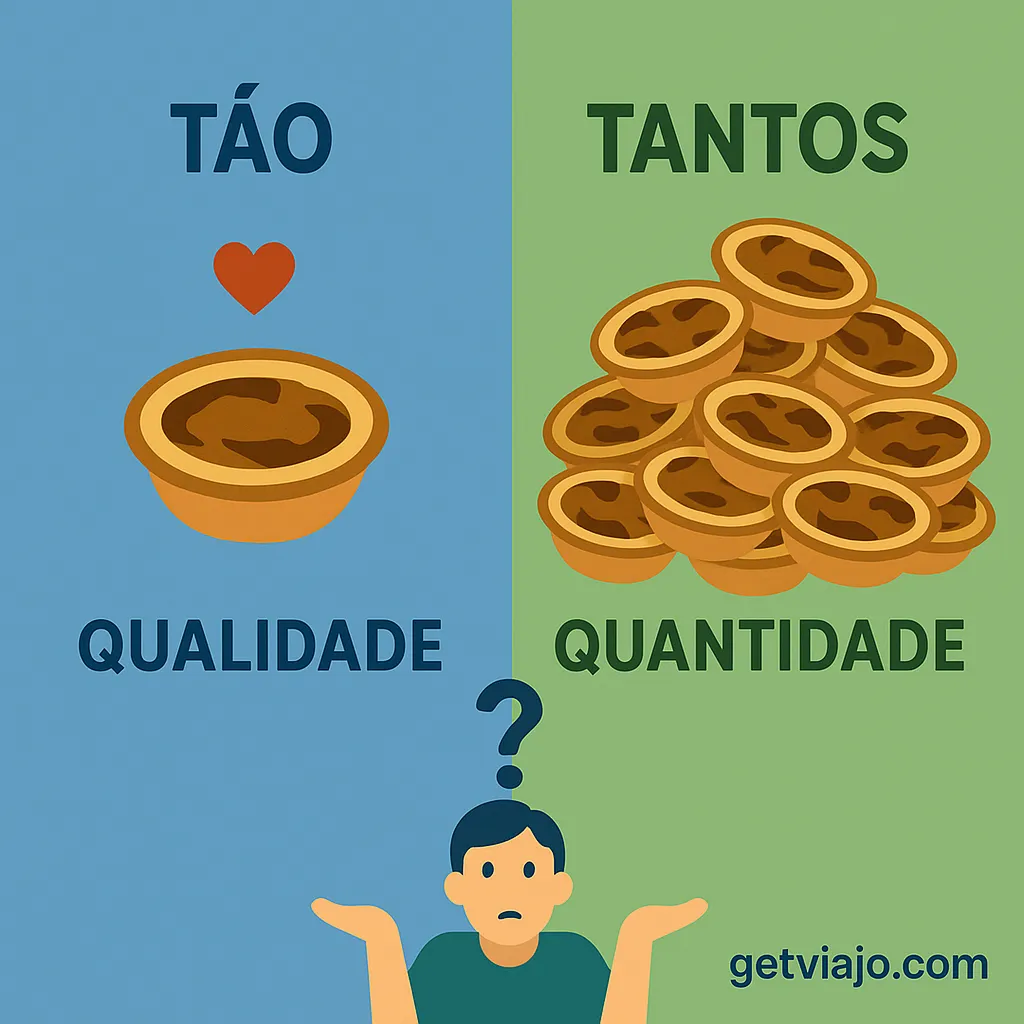
Use tão to describe the quality of one thing, and tanto to describe the quantity of many things.
Audio lessons and PDF study guides to accompany every lesson
Get In on the Ground Floor!
This is a new website!
As such, I'm starting the price for premium at just $2.99/mo, increasing to $11.99/mo after my first 100 members.
Tanto for Quantities
Think of tanto as the word for how much or how many. It pairs with nouns (things) and adds intensity to verbs (actions).
Tanto with Nouns
When tanto sits before a noun, it has to agree with that noun’s gender and number. That is where most of the slip-ups happen.
| English | Portuguese |
|---|---|
| so much noise (masc. sing.) | tanto barulho |
| so much rain (fem. sing.) | tanta chuva |
| so many cars (masc. pl.) | tantos carros |
| so many people (fem. pl.) | tantas pessoas |
Tanto with Verbs
Tanto also pairs with verbs to mean “so much.” It sits after the verb, and here it stays fixed. No gender, no number, just tanto.
| English | Portuguese |
|---|---|
| She talks so much! | Ela fala tanto! |
| I worked so much this week. | Trabalhei tanto esta semana. |
| He ate so much at lunch. | Ele comeu tanto ao almoço. |
 Use ‘tanto’ after a verb to emphasize how much you did something.
The English Translation Trap
This is where English speakers can have a difficult time, and it has nothing to do with the gender rule. Say, for example, you want to say “I’m so hungry,” the instinct is to translate word for word: “Estou tão fome.”
That sentence is broken Portuguese. The fix is not really about tão versus tanto, but rather just the way Portuguese people say “I’m hungry” in the first place. They don’t say Estou fome (the literal translation), but rather Estou *com* fome. (I’m with hunger), or Tenho fome (I have hunger).
In Portuguese fome is a noun (a thing you have), thus… the quantity rule kicks in, making tanto the right choice here, and because fome is feminine, it becomes tanta.
The natural sentence is Estou com **tanta** fome. Literally, “I am with so much hunger.”
The same pattern carries to other states you “have” in Portuguese.
| English | Portuguese |
|---|---|
| I’m so cold. | Estou com tanto frio. |
| I’m so thirsty. | Estou com tanta sede. |
| He’s so sleepy. | Ele está com tanto sono. |
Basically, just remember that in English you “are” a temporary state (hot, cold, hungry, thirsty), but in Portuguese you are “with” it instead.
…And the thing you’re with? That’s a noun, so we need to use tanto or tanta, depending on the noun’s gender.
 Think “I have so much hunger,” not “I am so hungry.”
Final Takeaway
This is a small grammar point with an outsized payoff. Once tão for qualities (tão bom) and tanto for quantities (tanta gente, trabalhar tanto) starts to feel automatic, your Portuguese stops sounding translated.
The whole thing comes down to one question. If you are describing a quality, reach for tão. If you are describing a quantity, a noun, or how much something is happening, use tanto, and adjust the ending appropriately.
You will likely still slip up, especially on the gender agreement, and that is fine. The ear takes time to catch the wrong versions before they leaves your mouth. Keep talking through the mistakes. People will get it, maybe correct you, and you’ll know better for next time.
For the bigger picture of how connecting words like this hold sentences together, my guide to sentence structure is a natural next step. Or, for another pair that often gets tangled, this breakdown of ainda vs. já is also worth a look.
Boa sorte! 🇵🇹
Frequently Asked Questions
[!faq]- What about “so many”? Does that follow a different rule than “so much”? It is the same rule, just in the plural.
Tantoscovers masculine plural nouns andtantascovers feminine plural nouns. For example:Há *tantos* carros na rua(There are so many cars on the street) andComprei *tantas* coisas(I bought so many things).
[!faq]- Can I just use
muitoinstead oftãoortanto? Technically yes, but you’d be saying “very” or “a lot” rather than “so” or “so much”.Tãoandtantosignify a stronger intensity.Ele está muito cansadomeans “He is very tired.”Ele está *tão* cansadomeans “He is so tired.”
[!faq]- I’ve heard people say
tão pouco. How does that work? The logic mirrors English. Just as you can say “so little,” you can saytão pouco. Here,tãois modifyingpoucoto describe the quality of that smallness.Dormi *tão* pouco esta noitemeans “I slept so little last night.” You are describing how little you slept.
[!faq]- Does
tantoalways have to come before the noun? When it means “so much/many,” yes, it comes before the noun (tanta chuva). When it modifies a verb, however, it follows (trabalhar tanto). It can also stand alone as an emphatic reply. For example,Comeste muito?(Did you eat a lot?),**Tanto**!(So much!).
[!faq]- What’s the difference between
tantoandtanto que? Addingqueaftertantoturns it into a cause-and-effect link.Tanto quemeans “so much that…” It ties an action to its result. For example,Choveu *tanto que* as ruas inundaram(It rained so much that the streets flooded). It takes the simple statement (Choveu tanto) and attaches a clear consequence.
