


Most of the future tense conjugations you find in a textbook will sit on the shelf gathering dust. They look impressive on the page, but they almost never come out of a real Portuguese mouth.
It is technically correct to say eu farei isso (I will do that), but almost nobody says that in everyday conversation. You might catch it in an old film or read it in the Bible, but not at the dinner table or in a chat with a friend.
This guide is about the future tense people actually use. We will cover the one form you should lean on for daily life, the formal version you only need to recognize, and a small shortcut that lets you skip conjugation entirely.
The Going-To Future
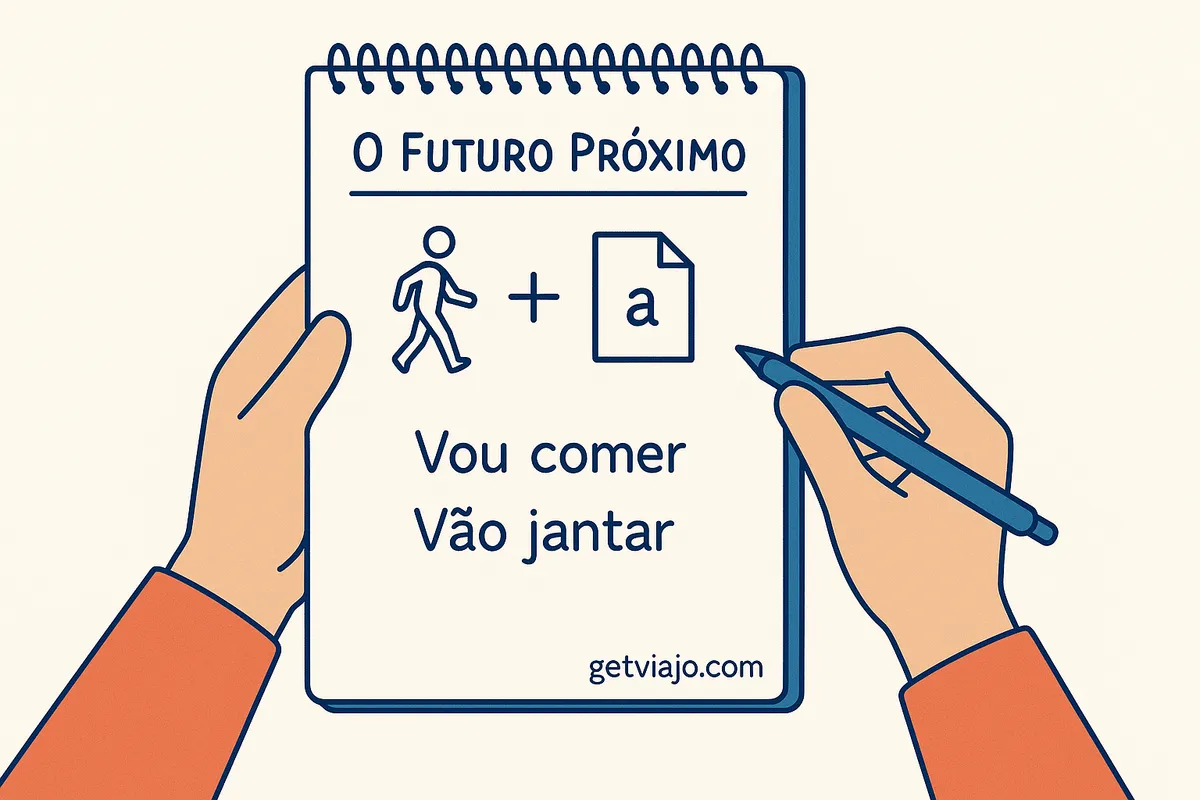 This simple formula is your key to a natural-sounding future tense.
The future tense worth mastering for daily life is the futuro próximo. It is the Portuguese version of “I’m going to,” “you are going to,” and so on. It is the one I hear most often in conversation.
It is also easy to build. Conjugate ir (to go) in the present tense, then add any verb you want in its infinitive form.
Here is the present-tense conjugation of ir:
| English | Portuguese |
|---|---|
| I am going | Eu vou |
| You are going | Tu vais |
| He/She is going | Ele/Ela vai |
| We are going | Nós vamos |
| They are going | Eles/Elas vão |
[!tip] A note on “Nós vamos” In some formal settings, you may hear vamos used when addressing a single person. It works a bit like a formal “you” or the “royal we.” You do not need to use it that way, but it helps to recognize it.
Add a verb like comer (to eat), and you are set.
If a friend calls and asks what you are up to: Vou comer agora. (I’m going to eat now.)
Or with a group deciding on plans: Vamos comer? (Shall we eat?)
[!tip] Shouldn’t I say “Eu vou comer” or “Nós vamos comer”? You can, but you usually do not need to. Each Portuguese verb form is distinct enough that the ending itself tells you who is doing the action. Since vou can only mean “I go” and vamos can only mean “we go,” the pronouns (eu, nós) are often dropped. Skipping them tends to sound more natural.
When to Use Futuro Próximo
This is the form to lean on for immediate plans, intentions, and even a quick weather guess.
| Situation | Portuguese (English) |
|---|---|
| Planning your morning | Vou tomar um duche. (I’m going to take a shower.) |
| Confirming plans with a friend | Vais à festa? (Are you going to the party?) |
| Asking about leftovers | Vai comer isso? (Are you going to eat that?) |
| Getting ready for a night out | Vamos jantar fora. (We’re going out for dinner.) |
| Looking at a grey sky | Vai chover. (It’s going to rain.) |
[!tip] A false-friend hack for future plans One handy verb for talking about plans is the Portuguese word that looks like “pretend” but actually means “to intend” or “to aim for.”
The verb is pretender (to intend). It is useful for describing your future intentions without wading into more complex grammar.
 In everyday life, the futuro próximo is the simplest way to talk about the weather.
The simplicity is the whole point. You get to focus on what you are saying instead of which ending goes where.
The Museum Tense, Futuro Simples
This is the formal future tense. It shows up in older texts (literature, poetry, religious writing, and the occasional period piece). In modern conversation, even in professional or academic settings, it rarely comes up.
The form attaches specific endings to the infinitive. Falar (to speak) becomes falarei (I will speak).
[!warning] A small warning Recognizing futuro simples in a book is useful. Using it in casual conversation makes you sound oddly formal, like reaching for “m’lady” in English. Stick with futuro próximo for daily life.
There are three common irregular verbs in this tense:
- dizer (to say)
- fazer (to do)
- trazer (to bring)
Here is how they shift, in case you run into them.
dizer → direi (I will say)
| Subject | Conjugation (Translation) |
|---|---|
| Eu | direi (I will say) |
| Tu | dirás (You will say) |
| Ele/Ela | dirá (He/She will say) |
| Nós | diremos (We will say) |
| Eles/Elas | dirão (They will say) |
fazer → farei (I will do)
| Subject | Conjugation (Translation) |
|---|---|
| Eu | farei (I will do) |
| Tu | farás (You will do) |
| Ele/Ela | fará (He/She will do) |
| Nós | faremos (We will do) |
| Eles/Elas | farão (They will do) |
trazer → trarei (I will bring)
| Subject | Conjugation (Translation) |
|---|---|
| Eu | trarei (I will bring) |
| Tu | trarás (You will bring) |
| Ele/Ela | trará (He/She will bring) |
| Nós | traremos (We will bring) |
| Eles/Elas | trarão (They will bring) |
I would save memorizing these for much later, unless a Shakespeare-in-Portuguese role is on the horizon. 🧑⚖️
The Present Tense Shortcut
 Using the present tense for future plans is a common shortcut you’ll hear often.
Portuguese speakers often use the present tense to talk about future plans, especially when a time marker like “tomorrow” or “next week” makes the timing clear.
It frames the event as a sure thing. English does the same thing when we say “I’m leaving at six” instead of “I will leave at six.”
A few examples:
| English | Portuguese |
|---|---|
| Tomorrow I have an appointment. | Amanhã tenho uma consulta. |
| I’m leaving at six. | Saio às seis. |
| I’m getting there at eight. | Chego lá às oito. |
| I start the new job on Monday. | Na segunda começo o trabalho novo. |
This is a simple, natural way to talk about the future without conjugating anything new. For a wider view of how these forms fit together, see my master guide on Portuguese verb tenses.
Audio lessons and PDF study guides to accompany every lesson
Get In on the Ground Floor!
This is a new website!
As such, I'm starting the price for premium at just $2.99/mo, increasing to $11.99/mo after my first 100 members.
Frequently Asked Questions
[!faq]- Does futuro próximo work for all verbs? Yes. Unlike tenses with many irregular forms, futuro próximo stays consistent. You only conjugate ir (to go), and the second verb always stays in its infinitive form (fazer, comer, ter). It is one of the most reliable patterns in the language.
[!faq]- When is it actually important to recognize futuro simples? Think of futuro simples as something you read more than something you say. It shows up in classic literature and historical texts. One form does sneak into daily speech, though. The verb ser (to be) is often used to express wonder or doubt. You might hear someone glance at the sky and say Será que vai chover amanhã? (I wonder if it will rain tomorrow?). That será is from the futuro simples, and it sounds completely natural in that fixed expression.
[!faq]- How can I practice using the future tense more? The best practice is real conversation. Next time you are talking with a friend or a neighbor, try describing your weekend plans with futuro próximo, or use the present-tense shortcut with a time marker. Mistakes are part of the process, so do not let them stop you.
