


If you have been traumatized by the unpredictable nightmare that is the Simple Past (Pretérito Perfeito), I have good news for you.
The Imperfect (Pretérito Imperfeito) is the Portuguese language’s way of apologizing for being so difficult. Its verb conjugations are hands down the easiest tense to learn—they are incredibly regular, forgiving, and consistent.
This page is your “No-Fluff” reference guide. I’ve stripped out the deep-dive explanations so you can just bookmark this and find the chart you need in seconds.
[!tip] Usage vs. Conjugation This guide focuses strictly on the mechanics (the verb endings). If you are looking for the logic of when to use this tense versus the Simple Past, check out our master guide on The Imperfect Storytelling Tense.
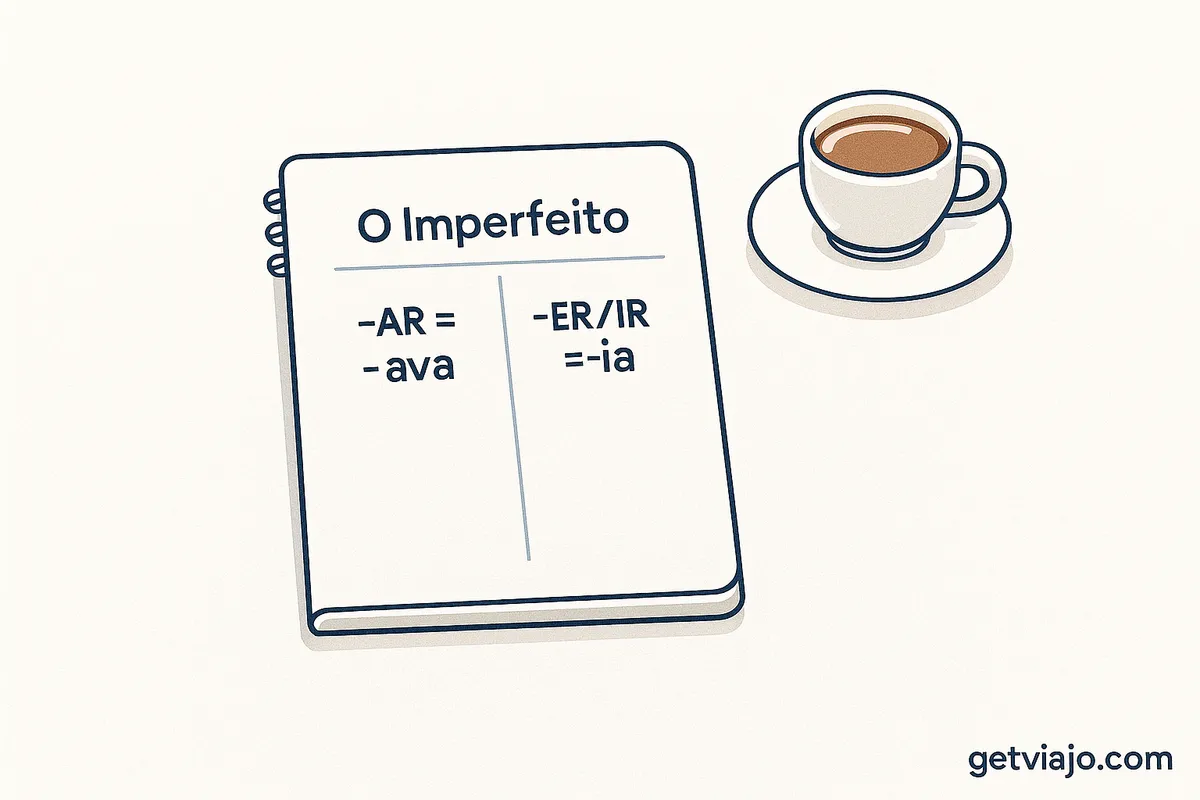 One cheat sheet to rule them all
The Two Meanings You’ll Actually Use
Before you memorize the charts, you need to understand how we actually use this tense in the real world. Portuguese takes a few English concepts and rolls them into one word:
- Habit: “I used to speak…” (Antigamente, eu falava…)
- Description: “I spoke…” (Used for ongoing states, e.g., Eu falava bem quando era criança…)
[!warning] Avoid This: The “M’lady” Trap Technically, a grammar book will tell you that Falava can also mean “I was speaking.” However, in modern Portugal, using the simple imperfect for an action in progress makes you sound like a 19th-century poet. It is the linguistic equivalent of tipping a fedora and saying “m’lady.” People will understand you, but you’ll sound like a weirdo. Stick to the shortcut below.
[!tip] The “Was-Ing” Shortcut In modern spoken Portuguese—even in professional settings or on the news—when we want to say we were doing something right then, we use the structure: Estava a + (Infinitive).
| English | Portuguese |
|---|---|
| I was speaking with my neighbor | Eu estava a falar com o meu vizinho |
| We were eating dinner | Nós estávamos a comer o jantar |
Context: If a friend asks why you didn’t answer the phone, you’d say: “Desculpa, não atendi porque estava a falar com o meu vizinho.”
The “Polite Shortcut”
In Portugal, the Imperfect is frequently used to make requests sound more sophisticated and polite in present-day situations, like at a cafe or shop.
| English Concept | Portuguese Imperfect |
|---|---|
| I would like a coffee | Queria um café |
| Could you tell me the time? | Podia dizer-me as horas? |
| I would like to try on this coat | Gostava de experimentar este casaco |
Context: When you walk into your local pastelaria, instead of a blunt “I want,” use the polite imperfect: “Bom dia! Queria um café e um pastel de nata, por favor.”
The Regular Verbs
Here is a mental shortcut that saved my sanity: -ER verbs and -IR verbs have the exact same endings. You literally only need to memorize two patterns: the -ava pattern (for -AR verbs) and the -ia pattern (for everything else).
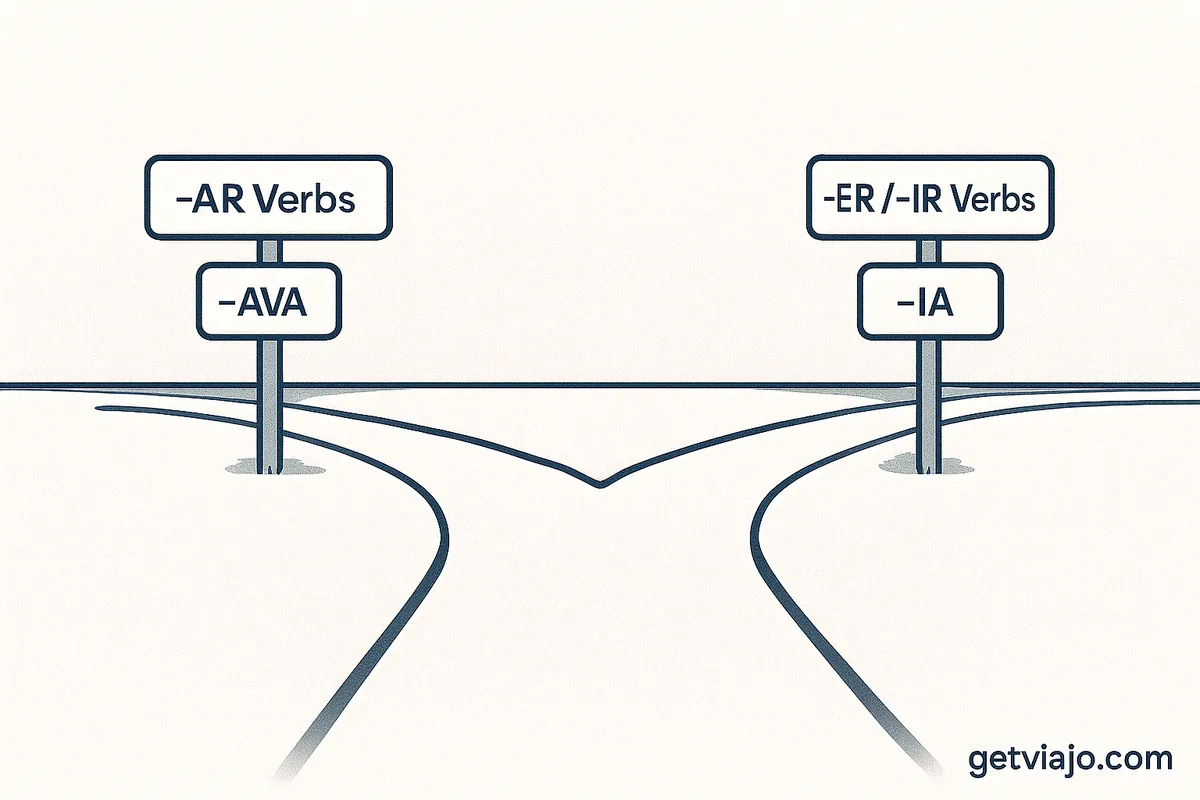 Two paths cover every regular verb in the language.
-AR Verbs: Falar (To Speak)
The “Ava” Pattern
| Person | Conjugation |
|---|---|
| Eu (I) | Falava |
| Tu (You) | Falavas |
| Ele/Ela/Você (He/She/You) | Falava |
| Nós (We) | Falávamos |
| Eles/Elas/Vocês (They/You Pl.) | Falavam |
-ER Verbs: Comer (To Eat)
The “Ia” Pattern
| Person | Conjugation |
|---|---|
| Eu (I) | Comia |
| Tu (You) | Comias |
| Ele/Ela/Você (He/She/You) | Comia |
| Nós (We) | Comíamos |
| Eles/Elas/Vocês (They/You Pl.) | Comiam |
-IR Verbs: Partir (To Leave/Depart)
Notice: These are 100% identical to the -ER verbs above.
| Person | Conjugation |
|---|---|
| Eu (I) | Partia |
| Tu (You) | Partias |
| Ele/Ela/Você (He/She/You) | Partia |
| Nós (We) | Partíamos |
| Eles/Elas/Vocês (They/You Pl.) | Partiam |
Seeing the Rhythm in Real Sentences
| English | Portuguese |
|---|---|
| In the old days, I used to speak English | Antigamente, eu falava inglês |
| They always left early | Eles partiam sempre cedo |
| She was eating when he arrived | Ela estava a comer quando ele chegou |
Context: Discussing past habits with a local: “Antigamente, eu falava inglês com toda a gente em Lisboa, mas agora tento falar português.”
Audio lessons and PDF study guides to accompany every lesson
Get In on the Ground Floor!
This is a new website!
As such, I'm starting the price for premium at just $2.99/mo, increasing to $11.99/mo after my first 100 members.
The “Big 4” Irregulars
There are remarkably few irregular verbs in this tense. These are the only four you strictly need to memorize to survive daily life:
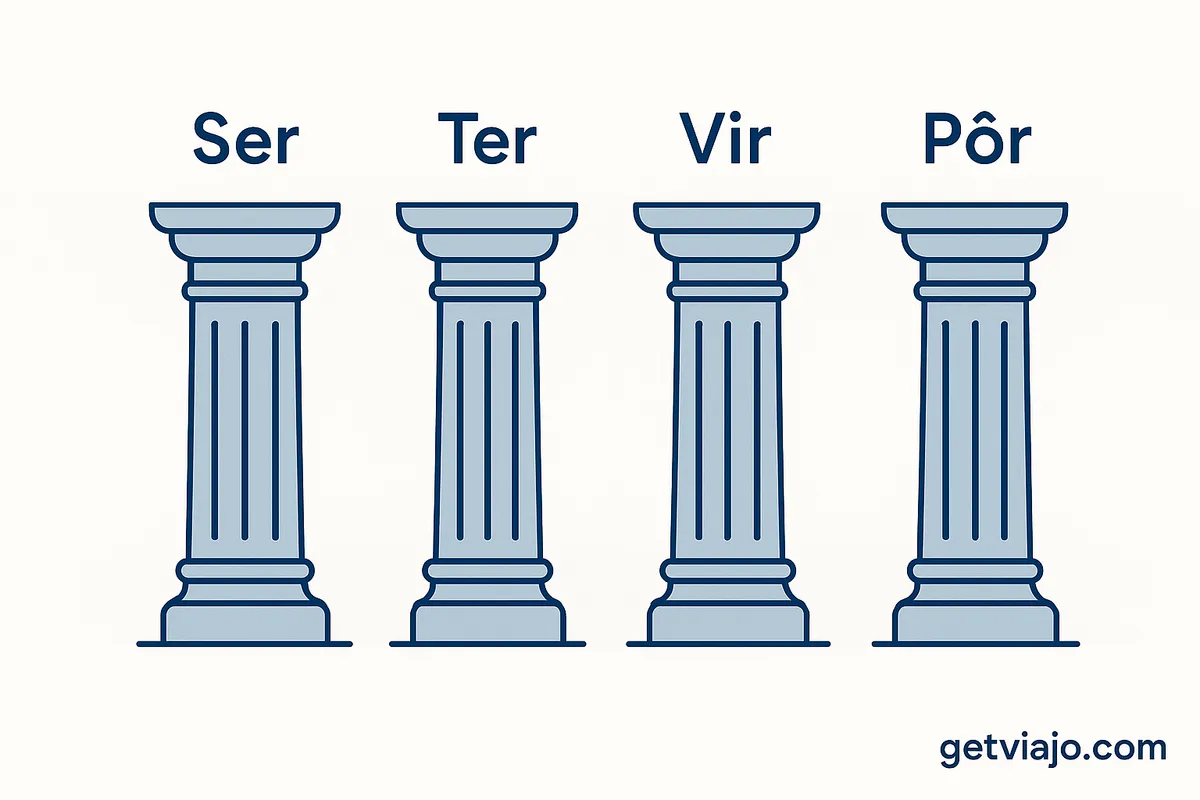 Memorize these four, and you are set.
1. Ser (To be)
Used for permanent descriptions (“The house was big”).
| Person | Conjugation |
|---|---|
| Eu (I) | Era |
| Tu (You) | Eras |
| Ele/Ela/Você (He/She/You) | Era |
| Nós (We) | Éramos |
| Eles/Elas/Vocês (They/You Pl.) | Eram |
2. Ter (To have)
Used for descriptions (“I had a car”) and age (“I was 10 years old”).
| Person | Conjugation |
|---|---|
| Eu (I) | Tinha |
| Tu (You) | Tinhas |
| Ele/Ela/Você (He/She/You) | Tinha |
| Nós (We) | Tínhamos |
| Eles/Elas/Vocês (They/You Pl.) | Tinham |
3. Vir (To come)
Used for routine movement (“He came every day”).
| Person | Conjugation |
|---|---|
| Eu (I) | Vinha |
| Tu (You) | Vinhas |
| Ele/Ela/Você (He/She/You) | Vinha |
| Nós (We) | Vínhamos |
| Eles/Elas/Vocês (They/You Pl.) | Vinham |
4. Pôr (To put)
Use this for setting tables, putting on clothes, etc.
| Person | Conjugation |
|---|---|
| Eu (I) | Punha |
| Tu (You) | Punhas |
| Ele/Ela/Você (He/She/You) | Punha |
| Nós (We) | Púnhamos |
| Eles/Elas/Vocês (They/You Pl.) | Punham |
[!tip] Pro Tip: The Meaning Shifters Choosing the Imperfect over the Simple Past doesn’t just change the “vibe” for these two verbs—it completely changes the meaning.
| Verb | Imperfect (State) | Simple Past (Event) |
|---|---|---|
| Saber | Sabia: I knew (I was aware) | Soube: I found out (moment I learned) |
| Conhecer | Conhecia: I knew (already acquainted) | Conheci: I met (first time introduced) |
Example: You say “Eu conhecia o João” to mean you’ve known him for years. If you say “Eu conheci o João”, you mean you met him for the first time just now.
Pronunciation Tip: The Nasal “-AM”
When you see the -am ending in the Imperfect (Falavam, Comiam), it is unstressed. Don’t emphasize the end; keep the stress on the middle syllable: “Fa-LA-vam.”
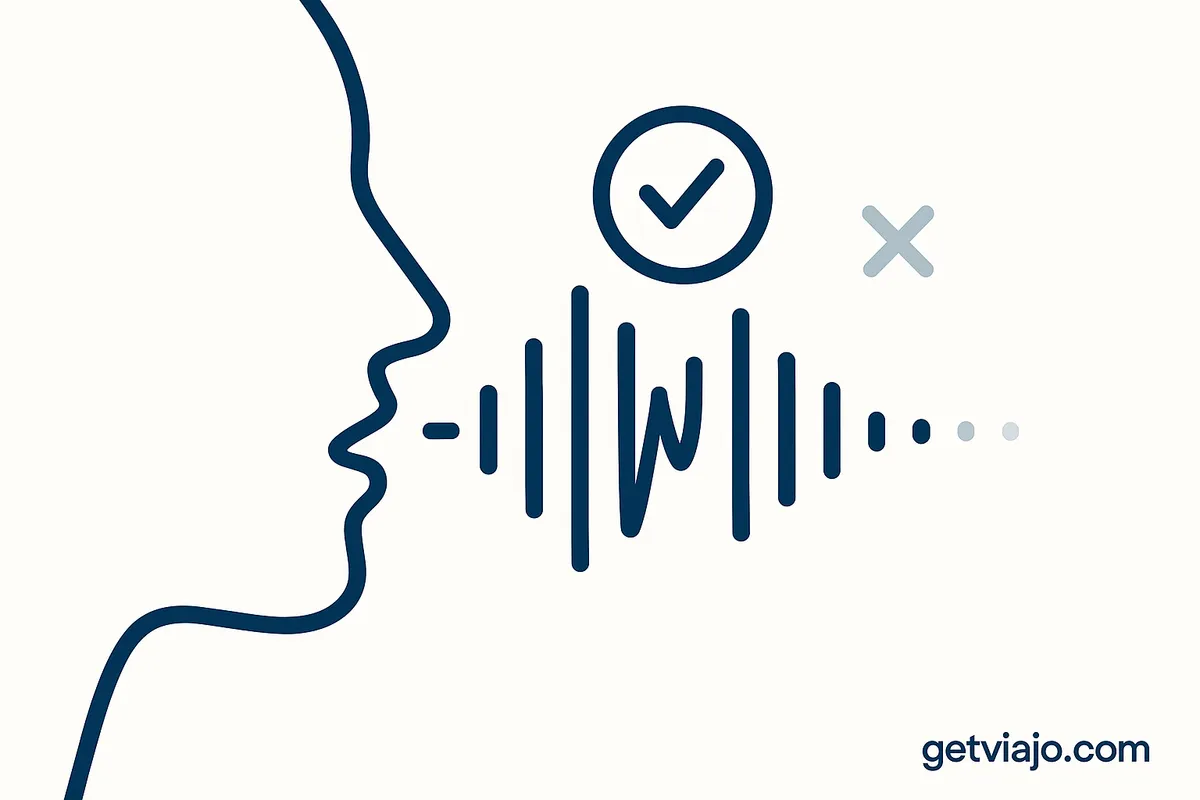 Keep the stress in the middle, not the end.
The “-am” acts like a phantom “M.” Your lips shouldn’t actually touch; it should sound like a closed, nasal hum fading away at the end of the word.
Frequently Asked Questions
[!faq]- Why do “Eu” and “Ele/Ela” have the same conjugation? This is a feature, not a bug! In the Imperfect tense, the first person (Eu) and third person (Ele/Ela/Você) are identical. If the context isn’t clear, you just add the pronoun before the verb to clarify.
[!faq]- Can I use this tense to say “I was doing something”? No. While technically possible, it sounds extremely literary and formal. Even in professional business meetings, locals prefer Estar a + Infinitive (Eu estava a comer). If you use the simple imperfect for this, you’ll sound like you’re reading from a 100-year-old novel.
[!faq]- What is the deal with the accent marks on “Nós”? You absolutely must pronounce the accent mark on the Nós forms (Falávamos, Comíamos). It shifts the stress back to that syllable; if you miss it, you sound like you are saying a different word entirely.
[!faq]- Is “Tu” really necessary? Yes. In Portugal, Tu is the default for peers and anyone you aren’t being strictly formal with. It’s the baseline for daily life. Using Você with a shopkeeper in a casual neighborhood can actually make you sound like a stiff foreigner or a Brazilian.
[!tip] How to be Polite without “Você” If you need to be polite but don’t want to sound stiff, just use the third-person conjugation and omit the word “você” entirely. Instead of saying “Pode ajudar-me?”, you create a natural, polite distance without the “textbook” trap.
