


The Simple Past gives you the skeleton of a story. This happened, then that happened. The Imperfect (Pretérito Imperfeito) adds the flesh and blood. It builds the atmosphere.
It’s the difference between listing facts for a police report and telling a story to a friend over uma cerveja.
This tense tripped me up for ages. English doesn’t have a clean equivalent. Sometimes it translates to “I used to,” sometimes “I was doing,” and sometimes just “was.” It felt slippery for a long time.
If you are specifically stuck on the Era vs. Foi confusion, start with my guide to Era, Foi, Estava, and Esteve before diving in here.
Think of this page as a field guide for the feel of the Imperfect. I’ll cover the vibe of the tense here, then point you to the deep dives for the specific mechanics.
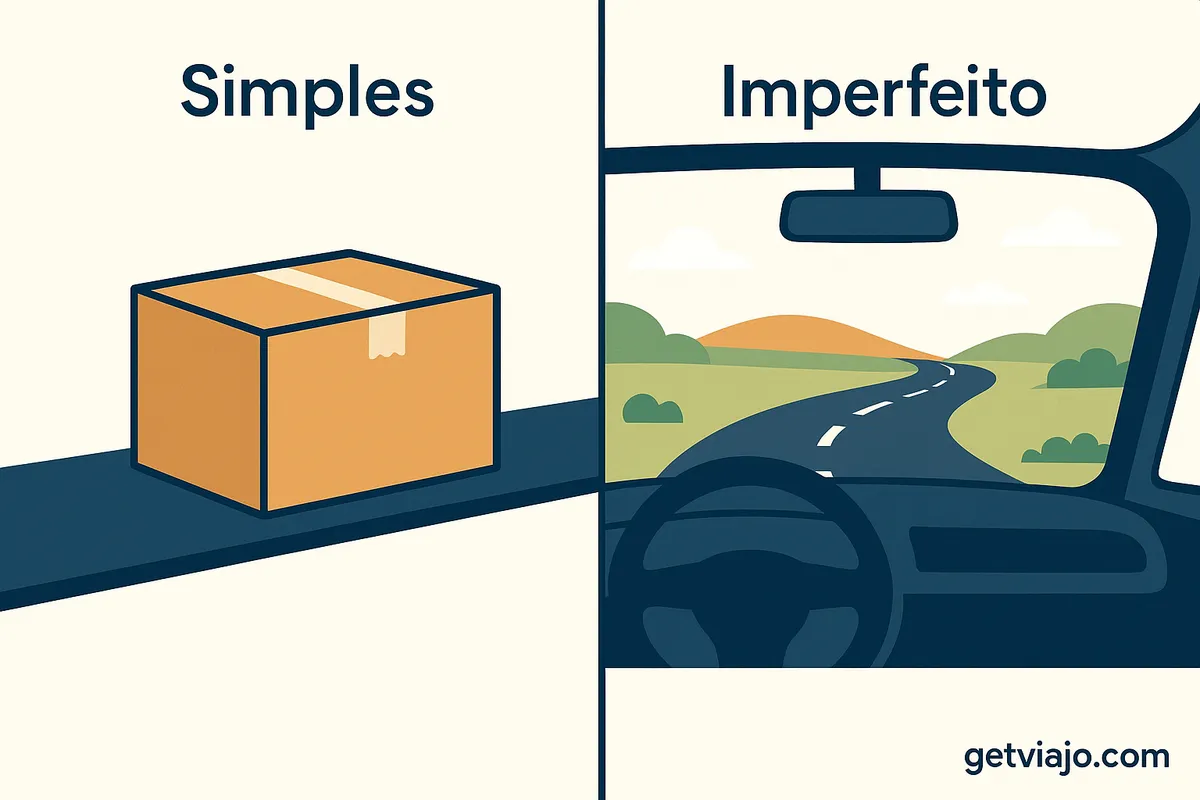 One creates a closed chapter, the other invites you along for the ride.
The Box and the Open Road
Before looking at verb endings, I needed a mental shift that finally made this click. I stopped thinking about grammar rules and started visualizing a Box versus an Open Road. Some teachers refer to this distinction as the “Limit of Time.”
The Simple Past Is a Closed Box
The Simple Past (Pretérito Perfeito) has a clear Limit of Time. You put the action in a box, tape it shut, and put it on a shelf. It started, it finished, it’s done.
- Example: “Eu vivi em Lisboa.” (I lived in Lisbon.)
- The Vibe: I lived there for a specific stretch and now I don’t. The chapter is closed.
The Imperfect Is an Open Road
The Imperfect (Pretérito Imperfeito) has No Limit of Time. It drops you in the middle of the action. You aren’t looking at the beginning or the end. You’re driving down the road looking at the scenery.
- Example: “Eu vivia em Lisboa…” (Back when I was living in Lisbon…)
- The Vibe: You’re setting the stage. You’re taking the listener back in time to walk the streets with you. We don’t care exactly when you started or stopped. We care about what was happening while you were there.
| English | Portuguese |
|---|---|
| It rained yesterday (done, finished). | Ontem, choveu. |
| Yesterday, it was raining (setting a scene). | Ontem, estava a chover… |
[!tip] The Dream Logic Trick Here is a shortcut that works for me. Think about dreams.
When you tell someone about a dream, you almost always reach for the Imperfect. A dream isn’t a tidy list of completed facts. It’s a state of being you were inside of.
- Natural: “Sonhei que estava a voar sobre o mar.” (I dreamed I was flying over the sea.)
- Unnatural: “Sonhei que estive a voar” or “Sonhei que voei.” (These sound like you clocked in, flew for a set time, then clocked out.)
 Dreams drop you in the middle of the action, just like the Imperfect.
Five Uses of the Imperfect
The Imperfect covers a lot of ground. Rather than memorizing a textbook definition, I find it easier to break it into five specific situations.
Here’s the roadmap. Each one links out to its own deep dive.
Rule 1: Habits and Nostalgia (Used To)
This is the one I reach for most often. For things you “used to do” repeatedly (playing soccer after school, visiting your grandmother on Sundays), you use the Imperfect. It’s the tense of antigamente (in the old days).
Example: Talking to a Portuguese friend about your life before moving here.
| English | Portuguese |
|---|---|
| Before, I used to work in an office. | Dantes, eu trabalhava num escritório. |
| And did you like it? | E gostavas? |
Mini-Dialogue:
- Tu: Quando era criança, eu comia gelados todos os dias. (When I was a kid, I used to eat ice cream every day.)
- Amigo: Pois, a vida era mais fácil antigamente! (Yeah, life was easier in the old days!)
👉 Deep Dive: How to Say "Used To" in Portuguese
Rule 2: The Movie Scene (Simultaneous Actions)
The Imperfect works like the background action in a movie scene (it was raining, the band was playing) that gets interrupted by the main action. It’s also what you use when two things happen at the same time, usually with Enquanto (“while”).
Example: Explaining why you didn’t answer the phone.
| English | Portuguese |
|---|---|
| I didn’t hear the phone because I was cooking. | Não ouvi o telemóvel porque estava a cozinhar. |
Mini-Dialogue:
- Tu: Eu estava a tomar banho quando tu ligaste. (I was taking a shower when you called.)
- Amigo: Ah, ok! Eu só queria saber se vens jantar. (Ah, okay! I just wanted to know if you’re coming to dinner.)
👉 Deep Dive: When to Use the Simple Past and the Imperfect
 Set the scene with the Imperfect before the main action interrupts.
Audio lessons and PDF study guides to accompany every lesson
Get In on the Ground Floor!
This is a new website!
As such, I'm starting the price for premium at just $2.99/mo, increasing to $11.99/mo after my first 100 members.
Rule 3: Descriptions (People, Places, Time)
When you describe what someone looked like, their age, the time, or the weather, you use the Imperfect. You’re painting a picture rather than listing a completed event.
Example: Describing a party you went to.
| English | Portuguese |
|---|---|
| The party was lively and there was a lot of food. | A festa estava animada e havia muita comida. |
Mini-Dialogue:
- Tu: Ontem fui ao LX Factory. O sol estava incrível. (Yesterday I went to LX Factory. The sun was incredible.)
- Amigo: E estava muita gente lá? (And were there a lot of people there?)
👉 Deep Dive: Era or Estava? The Stage vs. Actor Rule
Rule 4: Polite Requests
This one matters for daily life. The Imperfect form is used to order coffee, ask for help, or soften any request. Technically, the Imperfect form is acting as a Conditional here. It shifts a demanding “I want” into a gentle “I wanted” (meaning “I would like”).
Example: Ordering at the counter (o balcão).
| English | Portuguese |
|---|---|
| Harsh: I want a coffee. | Eu quero um café. |
| Polite: I’d like a coffee. | Queria um café. |
Mini-Dialogue:
- Empregado: O que vai ser? (What will it be?)
- Tu: Queria um café e um pastel de nata, por favor. (I’d like a coffee and a pastel de nata, please.)
[!warning] Go easy on Eu Quero “Eu quero” (I want) can come across as blunt in Portugal. Queria is the safer default at a counter or a table.
👉 Deep Dive: How to Make Polite Requests in Portuguese
Rule 5: Hypothetical Wishes (The Conditional Shortcut)
The Imperfect also covers things you would do, if you could. Textbooks teach the formal Conditional (compraria), but in everyday spoken Portuguese, the Imperfect (comprava) usually takes its place. It works for dreams, excuses, and hypotheticals.
Example: Explaining why you can’t buy something expensive.
| English | Portuguese |
|---|---|
| Textbook (formal, rare in speech) | Eu compraria… |
| Everyday spoken | Eu comprava… |
Mini-Dialogue:
- Tu: Gostas deste carro? (Do you like this car?)
- Amigo: Adoro! Eu comprava o carro amanhã, mas não tenho dinheiro. (I love it! I’d buy the car tomorrow, but I don’t have the money.)
👉 Deep Dive: See the "Gostava de" section in the Polite Requests guide
The Mechanics (Conjugations and Irregulars)
You’ve got the feel. Now you need to know how to form it. The good news. The Imperfect is the most regular, easy-to-learn tense in the language. Only four verbs are truly irregular (Ser, Ter, Vir, and Pôr).
👉 Deep Dive: The Complete Portuguese Imperfect Conjugation Guide
Frequently Asked Questions
[!faq]- How do I choose when telling a story? Use the Imperfect (or
estava a + infinitive) for the background, and the Simple Past for the main action. Example: “Eu estava a andar na rua (background)… quando vi um amigo (main action).”
[!faq]- Is the Imperfect always about a long-ago habit? Not always. It can also describe a state at a specific past moment. Example: “Ontem, às dez da noite, as ruas estavam vazias.” (Yesterday at 10 PM, the streets were empty.)
[!faq]- Is
estava a comerthe same asestava comendo? The meaning is the same, but the sound is regional.Estava comendois Brazilian Portuguese. In Portugal, the structure isestava a comer. Using this form is one of the quickest ways to make your Portuguese sound local.
