


One of the most frustrating phases of learning Portuguese is when you know you have a head full of vocabulary but still sound like a caveman when you open your mouth.
You spend weeks memorizing the difference between frigorífico (fridge) and frigideira (frying pan), and then the logic falls apart when you try to put together a simple sentence.
“Eu… ir… loja.”
You have the bricks (the vocabulary), but you are missing the mortar (the connectors). Without mortar, the house falls down. I spent my first months in Lisbon feeling stuck because I could not string three words together, even after a lot of time in vocabulary apps.
The problem was the small, boring words that actually glue the language together.
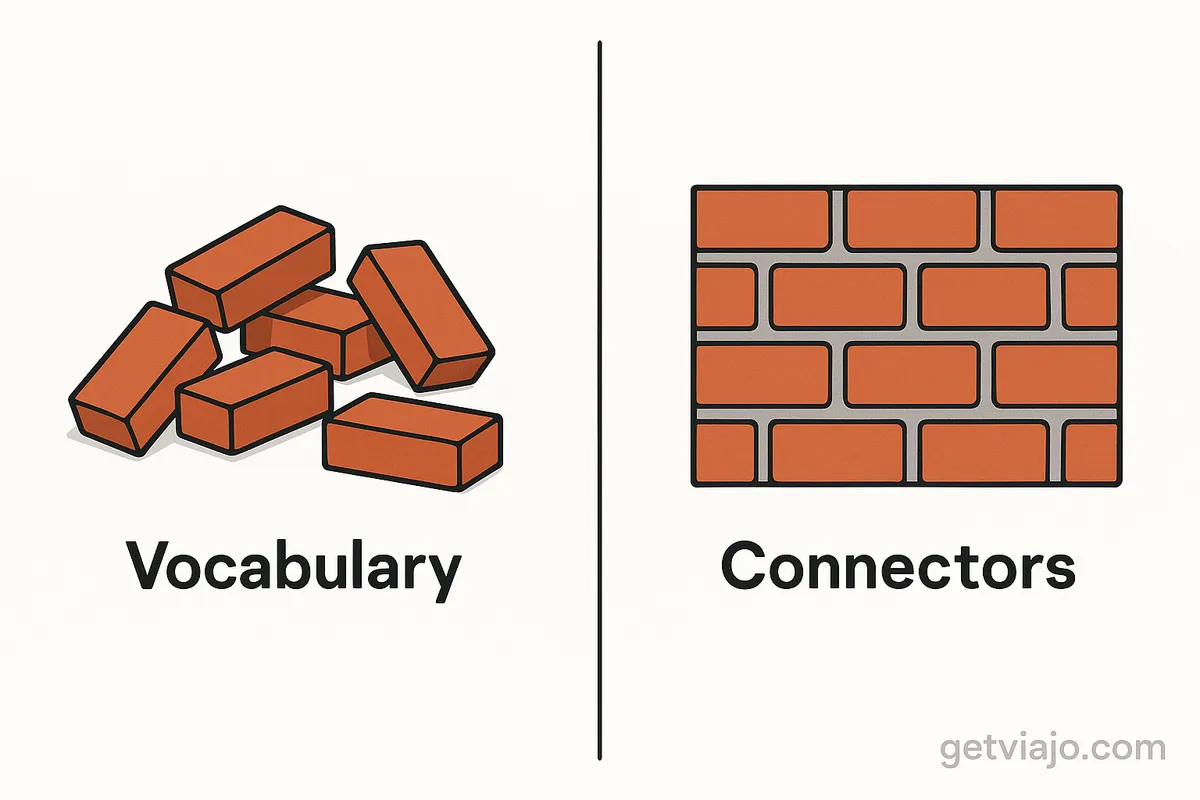 Vocabulary is the raw material. Structure builds the house.
Here is the glue that turns a list of words into a real sentence.
Prepositions
Prepositions point a sentence in a direction. English often gets by with “to” and “at” for a lot of things. Portuguese prepositions change based on whether you are moving or staying put.
The mix-up between para (movement towards a destination) and em (location at) is one of the quickest ways to sound like a non-native speaker.
| English | Portuguese |
|---|---|
| I am at home | Eu estou em casa |
| I am going home | Eu vou para casa |
This kind of thing that can come up when giving directions.
| English | Portuguese |
|---|---|
| I am at the cafe | Estou no café |
| I am going to Lisbon (longer stay) | Vou para Lisboa |
| I am going to Lisbon (short visit) | Vou a Lisboa |
| I am going home (for the day) | Vou para casa |
| I am going home (real quick) | Vou a casa |
[!tip] Para vs. A
“Vou para casa” suggests you are going home to stay, like at the end of the day.
If you are popping home quickly to grab a coat and heading back out, you would say “vou a casa”. Same idea for a weekend trip: you go a Lisboa, not para Lisboa.
When the place carries an article, a fuses with it the way “a + the article”. So o Porto becomes vou ao Porto, and o Algarve becomes vou ao Algarve. Heading somewhere feminine like a Madeira? The two a’s merge into one written with an accent: vou à Madeira.
The word de does a lot of heavy lifting too. It handles possession, origin, and material descriptions, and it shows up almost everywhere. I’ve written an article all about it called Portuguese verbs that always need "de" that you might find useful. Or if you need a “big picture” overview, there’s also my guide on Portuguese prepositions.
Dropping the Subject
In English, verbs are simple. “I go,” “you go,” “we go”… the verb barely shifts. So we have to say “I” or “you” otherwise no one knows who is doing what.
In Portuguese, verbs are dynamic. They change for every person (eu vou, tu vais, ele/ela/você vai, nos vamos, eles/vocês vão).
The verb chosen already identifies who it is directed at (“he/she speaks” = “fala”), so the pronoun eu, tu, etc becomes redundant. Many speakers just drop it entirely, or only use it for emphasis.
Repeating the subject in Portuguese is a bit like saying “Justin went to Justin’s house because Justin was tired” in English. It technically works, but it sounds weird.
| English | Portuguese |
|---|---|
| I go to the beach (awkward) | Eu vou para a praia |
| I go to the beach (natural) | Vou à praia |
| I speak English (awkward) | Eu falo inglês |
| I speak English (natural) | Falo inglês |
Saying “Vou” instead of “Eu vou” signals a higher level of comfort with the language. Keep eu only when you want to stress that you (and not someone else) are doing it.
Almost like, if clearing up confusion and you need to point to your chest and say “no, it’s me. I am the one doing this.”
[!tip] À praia
The table above uses à praia. Since the beach is usually a temporary day trip, à (a + a) tends to fit better. Para a praia (without the accent) reads more like “I’ve given up on society and have decided to begin living in the sand.”
Spoken… no one can tell if you pronounced the accent mark. It’s just in writing.
Reflexive Verbs
Once you start dropping the subject, the next puzzle shows up. What happens when the subject is reflexive in nature, like… someone does something to themselves, etc.
In English we say “I get dressed.” Portuguese is more literal: “I dress myself” (visto-me). These are reflexive verbs, because the action reflects back onto the doer.
You build them by attaching a pronoun like -me or -se to the verb.
| English | Portuguese (with reason) |
|---|---|
| I cut myself | Cortei-me (action reflects back to you) |
| I feel good | Sinto-me bem (internal state, back to you) |
| I get dressed | Visto-me (you perform it on yourself) |
A quick example:
Friend: “Estás pronto?” (Are you ready?) You: “Ainda não, estou a vestir-me.” (Not yet, I’m getting dressed.)
[!warning] The magnet trap In European Portuguese, the pronoun usually goes after the verb (visto-me), there’s a handful of words that act like a magnet and pull the pronoun forward, dropping the hyphen.
The easiest example of one of these is “não”.
- Positive: Visto-me agora. (I’m getting dressed now)
- Negative: Não me visto agora. (I’m not getting dressed right now)
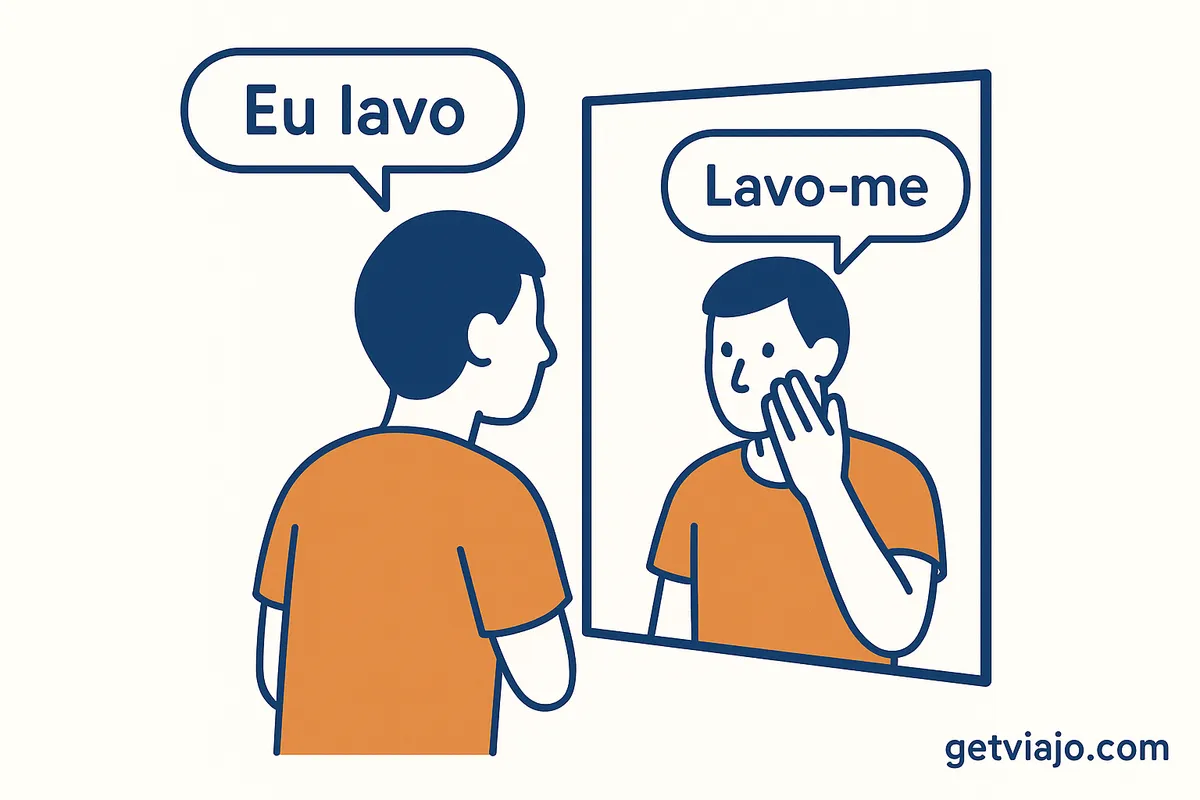 Reflexive verbs reflect the action back onto you.
Comparisons and Timing
This is the layer that separates robotic sentences from human ones. It (often) comes down to two pairs of words.
Tão vs. Tanto
In English, we use “so” or “so much” to express intensity. “It’s SO windy today”, “this curry is SO spicy!”, “I have SO MUCH to do today”, etc.
Tão and tanto are how you express the same things in Portuguese.
I’m simplifying a bit, but Tão goes with adjectives and means “so”, while Tanto goes with nouns and means “so much.”
| English | Portuguese |
|---|---|
| She is so tall | Ela é tão alta |
| The wind is so strong! | O vento está tão forte! |
| There is so much food | Há tanta comida |
| There are so many people on the metro. | Há tanta gente no metro. |
Want to deep dive on this further? 👉 A Practical Guide to Tão vs. Tanto
Timing the Action
A couple of very common, very useful words in Portuguese are *“Ainda” *and “Já”, and they both work like timestamps. They tell the listener where you are in the process.
Ainda means each “still” and “yet”
Já is a little trickier to translate, but it can be either “already” or express a general sense of immediacy.
| English | Portuguese |
|---|---|
| I’m still on the bus | Ainda estou no autocarro |
| The bill hasn’t come yet | A conta ainda não chegou |
| We’ve already ordered | Já pedímos |
| I’ll be right back | Volto já |
Here’s THAT deep dive 👉 The Ainda vs. Já Guide
Audio lessons and PDF study guides to accompany every lesson
Get In on the Ground Floor!
This is a new website!
As such, I'm starting the price for premium at just $2.99/mo, increasing to $11.99/mo after my first 100 members.
Conversational Fillers
Sometimes a Portuguese learner’s grammar is technically fine, but the silence between sentences feels stiff.
Here’s two easy words that can be very helpful in everyday situations.
”Pois” and “Pois é”
Pois on its own means “indeed,” but pois é sounds warmer. Think of it like the difference between “indeed” and “indeed, that’s true.” The latter sounds more obviously in agreement and couldn’t possibly be mistaken for indifference.
For example: if a neighbor says “Faz tanto calor hoje, não se aguenta.” (It’s so hot today, it’s unbearable.) A good response would be for you to nod and say “Pois é…"
"Pá”
Pá is short for rapaz (boy) and works like “man,” “dude,” or “mate.” It sprinkles into casual speech as a kind of verbal punctuation, and you hear people say it all the time.
Example: “Então, pá! Tudo bem?” (“hey dude, how’s it going?”)
Also, stacking them together is common:
Friend: “O trânsito na ponte hoje estava horrível.” (Traffic on the bridge was terrible today.)
You: “Eh pá, pois é, estava mesmo!” (“Man, you’re right, it really was!”)
[!tip] This is slang
This is hopefully obvious, but just to be safe… pá is fine with friends, neighbors, colleagues you’re relaxed with, but you’d drop it when speaking to, say, an older stranger, your landlord on first meeting, or anyone in a formal setting, the same way you wouldn’t pepper “dude” through a job interview.
Four Structural Habits
To stop thinking in English and start thinking in Portuguese, these four observations/lessons made the biggest difference for me, personally.
Adjectives Go After
In English we say “the red car.” In Portuguese, the noun is the hero and the adjective is decoration, so it steps to the back.
| English | Portuguese |
|---|---|
| The red car | O carro vermelho |
| A difficult day | Um dia difícil |
[!tip] There are a few exceptions, however…
You should be aware that there’s a small group of common adjectives that break this pattern and come before the noun.
Short, judgement words like bom, mau, grande, and ordinals like primeiro, último, próximo.
| English | Portuguese |
|---|---|
| Good morning | Bom dia |
| A bad sign | Um mau sinal |
| The first time | A primeira vez |
A handful of these can actually go on either side, but the meaning shifts: um amigo velho is an elderly friend, while um velho amigo is an old friend in the sense of a long-standing one. Front the adjective and it turns figurative rather than literal.
My advice is to not worry about obsessing over these exceptions. Just pay attention to what you hear other people say and eventually you’ll absorb what sounds right vs. what sounds wrong.
Articles in Front of Possessives
English speakers tend to skip articles. We say “I like coffee” or “Where is my car?”
In Portugal, the article (o or a) usually goes in front of possessives. Without it, the sentence sounds bare.
The rule: “O meu carro” (literally “the my car”).
- Foreigner: “Onde está meu telemóvel?”
- Local: “Onde está o meu telemóvel?”
[!warning] General vs. specific
The article goes in when you are talking about a specific thing. For a general concept, drop it.
- General: “Gosto de café.” (I like coffee, the concept.)
- Specific: “O meu café está frio.” (My specific cup of coffee is cold.)
Que and “É que”
Que shows up everywhere as the universal connector. English often drops “that” (as in “I think he is nice” vs “I think THAT he is nice” ). Portuguese always keeps “that”: “Acho que ele é simpático.”
Then there is the extended version, “é que”. It pops up frequently and always confuses not just me but I think most native English speakers.
It translates roughly to “is it that,” but it does not change the meaning. It just adds extra words, and doesn’t seem to have a real point… maybe emphasis?
But regardless, people DO say it all the time so it’s best to learn now so you’re not surprised when you come across it.
- Plain: “Onde vives?” (Where do you live?)
- Natural: “Onde é que vives?” (Where is it that you live?)
A short exchange:
Local: “O que é que estás a fazer?” (“What is it THAT you are doing?”) You: “Acho que vou almoçar.” (I think THAT I’m going to have lunch)
Estar a + Infinitive
If you learned Portuguese on Duolingo or a lot of other more common tools, you might say “Estou comendo.” to imply “I am eating.” In Portugal, that -endo/-ando ending structure is called “The Gerund” and is more commonly associated with Brazilian Portuguese.
In European Portuguese, ongoing actions usually skip the -ndo ending. The structure is estar + a + infinitive.
| English | Brazilian vs. European |
|---|---|
| I am eating | Brazilian: Estou comendo / European: Estou a comer |
| She is driving | Brazilian: Ela está conduzindo / European: Ela está a conduzir |
 If a sentence feels disjointed, a missing “que” is often the culprit.
Start Gluing It Together
Sentence structure does not click overnight. I still accidentally drop the o before meu carro and occasionally reach for a Brazilian -ndo endings. That is fine. People still get what I’m trying to say and communication is the most important part.
The goal is not poetry (yet, at least). It is just to stop sounding like a caveman.
Focusing on these connector words in this lesson is a great way to level up. Pick one habit (maybe estar a or dropping the eu, te, ele/ela, nos etc) and stick with it until it feels normal. Then move on to the next.
You have the bricks. Now take your time with the mortar.
Frequently Asked Questions
[!faq]- Can I really drop the subject every time? Almost always, yes. If the conjugation is clear (falo is clearly “I speak”), adding eu is unnecessary and can sound emphatic. Keep the pronoun when the conjugation is ambiguous, like fala, which could be he, she, or formal you.
[!faq]- Why do I sometimes hear adjectives before the noun? Some adjectives shift meaning depending on position. Grande pessoa means a great person in character. Pessoa grande means a physically big person. As a beginner, putting the adjective after the noun is the safer default.
[!faq]- Is Brazilian Portuguese sentence structure different? Yes, in a few noticeable ways. Brazilian Portuguese tends to put pronouns before the verb (me dá), while European Portuguese puts them after (dá-me). Brazilians use the gerund (fazendo) where European Portuguese uses a fazer. Brazilians say te amo for “I love you,” while in Portugal it is amo-te. Small differences add up.
[!faq]- Do I use “tu” or “você” for sentence structure? The structure is largely the same, but the conjugation changes. Tu is for friends and family. With strangers, use the você conjugation (third person) but drop the word você itself. Saying você out loud in Portugal can come across as blunt.
- Less natural: “Você quer ajuda?”
- Better: “Quer ajuda?”
