


In English, the word “was” does a tremendous amount of work. We use it for everything: “He was tall,” “She was tired,” “It was 3 PM.”
In Portuguese, you have to choose between two very different verbs: Era (from Ser) and Estava (from Estar).
[!tip] The Spanish Shortcut If you took Spanish in high school or grew up around it, you can breathe a sigh of relief. This distinction is almost identical to ser vs. estar in Spanish. If you’ve got that down, you’re 90% of the way there.
Getting this choice right is the secret to setting scenes and describing backgrounds. If you swap them, you change the entire reality of what you are saying. You might accidentally say a hotel “used to be nice” (but is now a dump) when you really meant it “was nice” (during your stay).
If you are still fuzzy on how the background relates to the main action of a story, I’d recommend checking out my guide on understanding the conflict between background and action first.
The Stage vs. The Actor
Here is the core idea that helped me finally get over the “A2 Hump”: Think about a theater stage.
- Era (from Ser) is the Stage. It describes the permanent, unchanging scenery. The walls, the location, the definition of the place.
- Estava (from Estar) is the Actor. It describes the temporary actions, feelings, or conditions of the people (or things) on that stage.
[!tip] The Theater Trick Imagine you are describing a memory of a café in Chiado.
The Scenery (Era): The café was small (O café era pequeno). The walls were yellow (As paredes eram amarelas). These are the permanent facts of the set design.
The Actors (Estava): I was drinking coffee (Eu estava a beber café). My friend was tired (O meu amigo estava cansado). These are the temporary things happening inside that scene.
| English | Portuguese |
|---|---|
| The café was small. | O café era pequeno. |
| I was drinking coffee. | Eu estava a beber café. |
In the wild: “Como era o café?” (What was the café like?) “Era muito bonito, mas estava cheio de gente!” (It was very beautiful, but it was full of people!)
 Think of Era as the painted scenery and Estava as the moving actor.
Rule #1: Age & Time (The English Trap)
This is the number one trap we fall into as English speakers because we are so used to using “was” for everything. Portuguese is much more specific.
The Time (Scenery)
When you tell the time in the past, it is part of the “Scenery.” It is a fundamental fact of the universe at that moment. Therefore, we always use Ser (Era/Eram).
- “Eram três da tarde.” (It was 3 PM.)
- “Era meia-noite.” (It was midnight.)
Note: Use Era for singular times (1:00, Noon, Midnight) and Eram for plural times (2:00 onwards).
The Age (Possession)
CRITICAL WARNING: You never, ever say “Eu era 15.”
In Portuguese, you don’t “be” an age; you “have” an age. Even in the past. We use the Imperfect of Ter (to have), which is Tinha.
- The Mistake: “Quando eu era 15…” (This sounds like “When I existed as the number 15…”)
- The Fix: “Quando eu tinha 15 anos…” (When I had 15 years…)
[!tip] Memory Hook Memorize this simple binary to save yourself a headache: When talking about Time, use Era. When talking about Age, use Tinha.
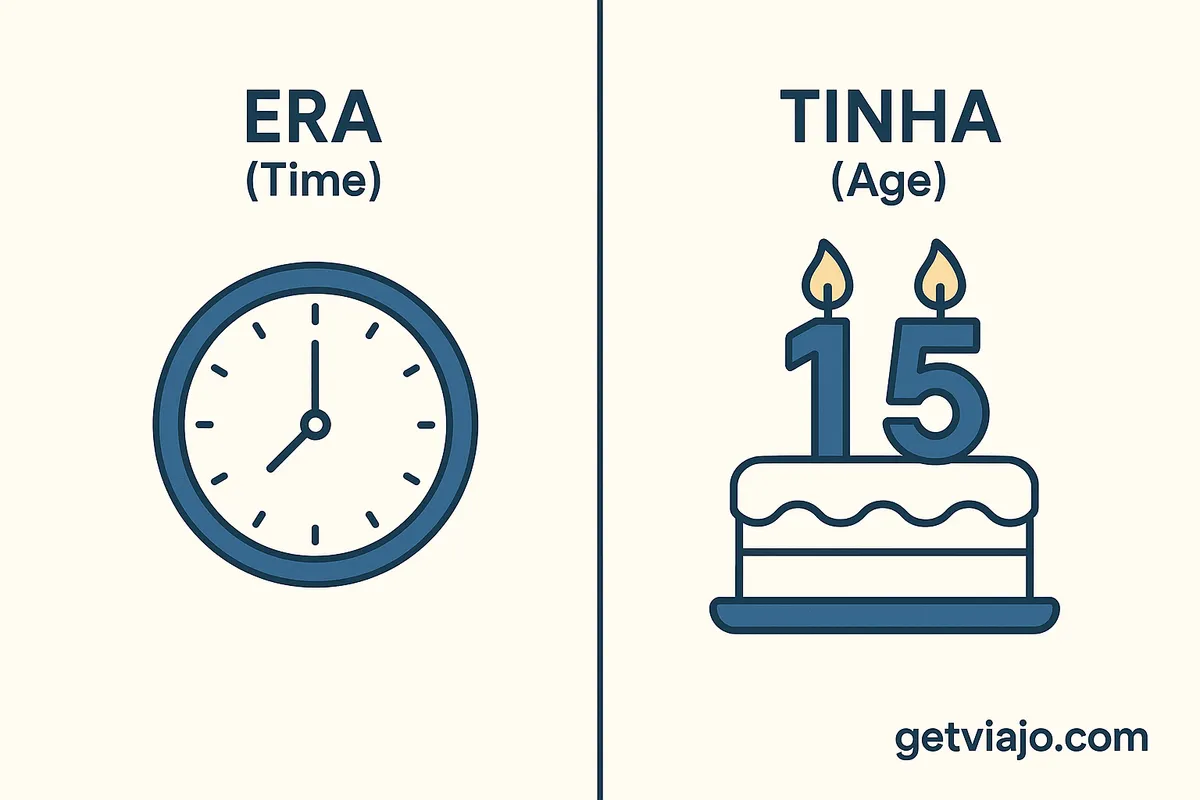 Remember: Time is scenery (Era), but age is a possession (Tinha).
Rule #2: Descriptions vs. Conditions
This is where the “Stage vs. Actor” rule really shines. You can often describe the exact same object using Era or Estava, but the meaning changes completely.
The Description Rule: Whenever you are describing what something was like in general (its personality or definition), use Era.
The Condition Rule: Whenever you are describing how something was at that specific moment (its mood or state), use Estava.
The “Compliment Test”
This is my favorite way to explain it. Imagine you see a friend at a party.
- “Ela é bonita.” (She is pretty.) This describes her as a person. It’s her “scenery.”
- “Ela está bonita.” (She looks pretty.) This describes her state right now—maybe because of her dress or hair.
At the party: “Estás tão bonita hoje!” (You look so pretty today!) “Obrigada! Este vestido era da minha mãe.” (Thanks! This dress was/used to be my mom’s.)
Other Examples
The Hotel
- “O hotel era bom.” (The hotel was nice.) - It was a nice place in general. (Stage)
- “O hotel estava cheio.” (The hotel was full.) - At that specific moment, it had no rooms. (Actor/Condition)
The Ocean
- “O mar era perigoso.” (The ocean was dangerous.) - That coast is defined as a dangerous place.
- “O mar estava calmo.” (The ocean was calm.) - On that specific day, the water happened to be flat.
The Food Dilemma: “Foi bom” vs. “Estava bom”
When you finish a meal at a tasca, how do you say “It was good”? This is where we need to distinguish between the Event and the Experience.
- “O jantar foi bom.” (The dinner was good.)
- Use Foi (Simple Past of Ser) to rate the dinner as a completed Event. You’re home now, and you’re judging the whole night—the company, the wine, the ambiance.
- “O peixe estava bom.” (The fish was good.)
- Use Estava (Imperfect of Estar) to describe the Experience of the food while you were eating it. It refers to the flavor and state of the meal at that specific moment.
The Shortcut: Use Foi to rate the event (the night out). Use Estava to rate the flavor (the food itself).
A quick check-in: “Como correu o jantar ontem?” (How did the dinner go yesterday?) “Foi ótimo! A comida estava deliciosa.” (It was great! The food was delicious.)
[!tip] Pro Tip
If you find yourself getting confused specifically about the difference between Foi and Esteve (the simple past forms), check out my dedicated breakdown on Foi vs. Esteve
How to Form the Verbs
Understanding the difference is 90% of the battle. But if you need a refresher on how to actually conjugate Ser and Estar in the past (without having to Google it every time), I’ve got you covered in the next guide.
👉 Deep Dive: The "No-Stress" Guide to Imperfect Conjugations
Frequently Asked Questions
[!faq]- Can’t I just use the simple past tense instead? You can, but your stories will sound like a list of bullet points. The distinction between the simple past vs the imperfect past is all about context. The simple past is for completed actions: “I opened the door,” “She ate the apple.” The imperfect (era/estava) is for the description surrounding those actions: “It was raining when I opened the door,” “She was hungry when she ate the apple.” You need both to sound fluent.
[!faq]- What’s a common mistake learners make confusing era and estava? The most common mistake I hear (and still make sometimes tbh) is using era for temporary feelings or locations. For example, saying “Eu era em casa” instead of the correct “Eu estava em casa” (I was at home). Remember: if it’s a temporary location or condition, it’s almost always estar.
[!faq]- Does this apply to other forms, like “éramos” vs “estávamos”? Absolutely. The logic is exactly the same for all the different conjugations. Nós éramos amigos (We were friends - an ongoing state/identity). Nós estávamos no supermercado (We were at the supermarket - a temporary location). The “scenery vs. action” rule applies across the board.
[!faq]- What about the verb ‘ter’? I hear ‘tinha’ used for ‘was’ or ‘were’. Great question. This is a special case. For talking about age in the past, Portuguese uses the imperfect of ter (to have). So, “I was ten years old” becomes Eu tinha dez anos (literally, “I had ten years”). It’s just one of those set phrases you have to memorize, but it always uses tinha, not era or estava.
[!faq]- What’s a good way to practice this? Try this exercise: Think of a memory from your childhood home. First, write three sentences describing the house itself using era. (e.g., “My room was blue.”) Then, write three sentences about what you were doing in that house using estava. (e.g., “I was playing with my toys.”) This helps solidify the difference. Also, listening to natural conversation is huge. I’d also, of course, recommend checking out my portuguese flashcards tool as well!
