


Trying to say something simple in Portuguese like “I got up” or “I forgot” and then realizing there’s supposed to be a little me or se sitting in the middle of the sentence can feel… random? Strange? Why do they do it this way?
Reflexive verbs, as they’re called, were one of the trickier parts of my A1 Portuguese courses, personally.
In English we only reach for “myself” or “yourself” in a narrow set of cases. So when Portuguese requires you to say these for seemingly everything, like just to say you “got out of bed”, it feels awkward and unintuitive.
The trick is to recognize the typical situations and set patterns of where they show up. Once you can spot those patterns, the whole thing begins to settle down.
I’ll walk you through it the way it was explained to me.
The Contrast With English
English reserves “myself” or “yourself” for emphasis or when the doer is also the receiver. Portuguese handles these the exact same way, they just use “myself” and “yourself” much more often, basically.
This is the rule of thumb:
- Verb (conjugated) + hyphen + “me” = myself
- Verb (conjugated) + hyphen + “se” = himself/herself/themselves
- Verb (conjugated) + hyphen + “nos” = ourselves
Here’s some familiar cases first:
| English | Portuguese |
|---|---|
| I cut myself | Cortei-me |
| I hurt myself | Magoei-me |
| She introduced herself | Ela apresentou-se |
| He prepared himself | Ele preparou-se |
| We blame ourselves | Culpamo-nos |
Intuitive, right?
The tricky thing is that Portuguese keeps using this pattern even in places where English would never naturally use “myself”, “yourself”, “themselves”, or “ourselves”
| English | Portuguese |
|---|---|
| I got up at 7 | Levantei-me às 7 |
| I feel good | Sinto-me bem |
| I remember | Lembro-me |
| We’ll see each other tomorrow | Vemo-nos amanhã |
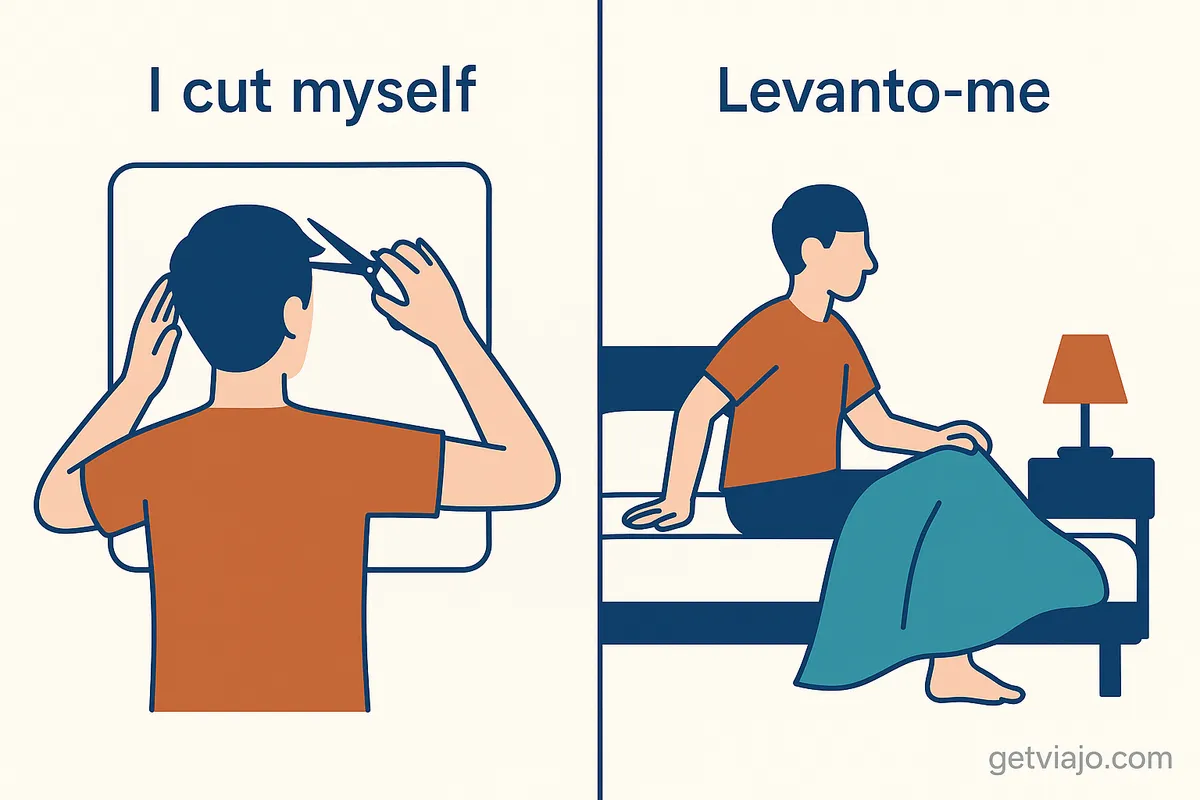 In English, we use “myself” for actions on ourselves. In Portuguese, it’s also used for everyday actions like getting up or remembering, feeling, etc.
Daily Routines
This is the first big pattern that’s different from English. Daily routines rely heavily on reflexive verbs. Try to think of these as a mirror list of actions you do to yourself.
The idea being that, for example, when getting up out of bed… your legs physically stand you up, thus, you’re doing it to yourself.
Or to comb your hair, that requires your arms working to do something to your hair, thus, you’re doing it to yourself.
It’s a little tricky, but if you think of it as “your brain telling one body part to do something physically”, then that’s likely to be reflexive.
| English | Portuguese |
|---|---|
| I get up at 7 | Levanto-me às 7 |
| I go to bed late | Deito-me tarde |
| I get dressed | Visto-me |
| I comb my hair | Penteio-me |
Morning Routine Dialogue
Here’s how this often sounds in a real conversation:
A: A que horas te levantas? — What time do you get up? B: Normalmente levanto-me às 7, mas hoje não me apetece. — Normally I get up at 7, but today I don’t feel like it. A: Pois, também me deito sempre tarde. — Yeah, I also always go to bed late.
Identifying Reflexive Verbs
Conversation generally moves too quickly for mental grammar checks. Mid conversation, you won’t have 10 seconds to think, “is this reflexive?” before opening your mouth. Like a baby learning their native language, you’ll learn these patterns through exposure.
My advice is to try focusing on using these verbs in the contexts where they are likely to occur.
Common Situations
Here’s a handful of common situations where you’d use a reflexive verb. Remember, it’s when “doing something to yourself”.
| Context | Examples |
|---|---|
| Daily routine actions | Getting up, getting dressed, lying down |
| Feelings and states | Feeling good, feeling tired, feeling stressed |
| Your brain “doing something to itself” | To remind, to remember something |
| Reciprocal actions | Things where you do something “to each other” |
These patterns eventually become familiar. Sometimes it’s hard to contextualize how, for example, “I remember” is technically doing something to yourself, and thus “Eu lembro-me”, but over time, you’ll see this more and more. It’s just how you say “I remember.”
Do you want to say “I forgot”? That’s “Esqueci-me”, because, once agian, your brain was the one doing the action.
Here are some others:
Daily Routine Actions
| English | Portuguese |
|---|---|
| I sit down | Sento-me |
| He lies down | Ele deita-se |
| We got dressed quickly | Vestimo-nos depressa |
Emotional Feelings and States
| English | Portuguese |
|---|---|
| I feel good | Sinto-me bem |
| I feel bad | Sinto-me mal |
| She feels nervous | Ela sente-se nervosa |
[!tip] A Note on “Sentir” The verb
sentircan be used non-reflexively to mean “to smell” (as insinto o cheiro, “I smell the scent”). When you’re describing your own emotional or physical state, just remember to use the reflexive formsentir-se.
Ex:
A: Como te sentes hoje? — How do you feel today? B: Sinto-me muito cansado. — I feel really tired. A: Também me sinto assim às segundas-feiras. — I feel the same way on Mondays.
[!warning] Trigger Words
Notice how the “me” comes before the verb “sinto” in that last example (“Também me sinto assim”)?
While normally the verb gets a hyphen and the pronoun (-me, -te, -se, -nos) comes after, there are a handful of “exception” words which pull the pronoun in front and removes that hyphen.
Também is one of them. Others are “já” and “não”, which is why “I don’t remember” becomes “Não me lembro”, and so on.
More on this further down the article 👇
Audio lessons and PDF study guides to accompany every lesson
Get In on the Ground Floor!
This is a new website!
As such, I'm starting the price for premium at just $2.99/mo, increasing to $11.99/mo after my first 100 members.
A Few More Examples
| English | Portuguese |
|---|---|
| I remember you | Lembro-me de ti |
| I forgot | Esqueci-me |
| He left (went away) | Ele foi-se embora |
Ex:
A: Trouxeste as chaves? — Did you bring the keys? B: Esqueci-me! — I forgot! A: Outra vez? Tens de pôr lembretes no telemóvel. — Again? You need to set reminders on your phone.
[!tip] Mental Health Advice I know at first this all feels a bit overwhelming, but honestly… don’t worry about the grammatical terms. Just consider this exposure and awareness.
No one in real life is going to quiz you on whether something is “reflexive” or not. Try to focus on which expressions go with which situations. That’s how locals learned it. No one sat down a baby and said “this is a reflexive verb”, they just… heard things being used that way, and now it feels right.
Pronoun Placement
So, once you understand how to tell if a verb is reflexive or not, how are you supposed to internalize this whole “hyphen + pronoun” business?
I briefly mentioned this above, but the basic rule is that the pronoun usually attaches to the end of the verb after a hyphen.
HOWEVER, if there’s a “puller word” before the verb (like já, também, não, nunca, or a “question word”), the pronoun gets pulled to the front.
| English | Portuguese |
|---|---|
| I get up at 7 | Levanto-me às 7 |
| I don’t get up late | Não me levanto tarde |
| Did you get up at 7? | Levantas-te às 7? |
| What time do you get up? | A que horas te levantas? |
These puller words show up all over everyday speech. They act like little magnets that drag the pronoun in front of the verb.
There’s more than this that exist, but here’s some of the most common “puller words”:
| Type | Examples |
|---|---|
| Negatives | não, nunca, ninguém |
| Question words | quando, onde, porque, como, a que horas |
| Connecting words | também (also), já (already), que (that), porque (because), se (if) |
A few examples of puller words in action (where the pronoun comes before, and doesn’t use a hyphen):
| Portuguese | English |
|---|---|
| Não me apetece sair hoje. | I don’t feel like going out today. |
| Quando te vais deitar? | When are you going to bed? |
| Ele disse que se sentia doente. | He said that he felt sick. |
Puller Word Pronoun Placement Dialogue
— A: Deitas-te cedo? > Did you go to bed early? (no puller word = hyphen gets used and pronoun comes after the verb)
— B: Não, nunca me deito antes da meia-noite. > No, I never go to bed before midnight. (yes puller word = no hyphen, pronoun comes before the verb)
Reflexive Verbs vs Regular “Object Pronouns”
This part trips a lot of people up. A hyphen plus a pronoun serves multiple purposes beyond signaling whether something is a reflexive verb.
In European Portuguese specifically (Brazilian Portuguese has it much easier), the hyphen attaches any short pronoun to a verb, even when it’s not reflexive.
Remember, reflexive is when you do something to yourself. But what if you’re talking to someone else? Well, pronouns still get used, but they’re not “classified as reflexive” anymore, but instead just "object pronouns".
| English | Portuguese |
|---|---|
| Sit down! | Senta-te! |
| Help me | Ajuda-me |
| We’ll see each other tomorrow | Vemo-nos amanhã |
| Tell me | Diga-me |
| Don’t tell me! | Não me diga! |
Dialogue: — A: Senta-te aqui ao pé de mim.> Sit down here next to me. — B: Espera, ajuda-me primeiro com esta mala. > Wait, help me with this suitcase first.
[!tip]
This is why I preach “don’t get hung up on whether something is considered reflexive or not”. Just remember the rules of pronouns first and foremost. Hyphen + pronoun after unless it includes a triggering puller word, and then the pronoun comes first, sans hyphen.
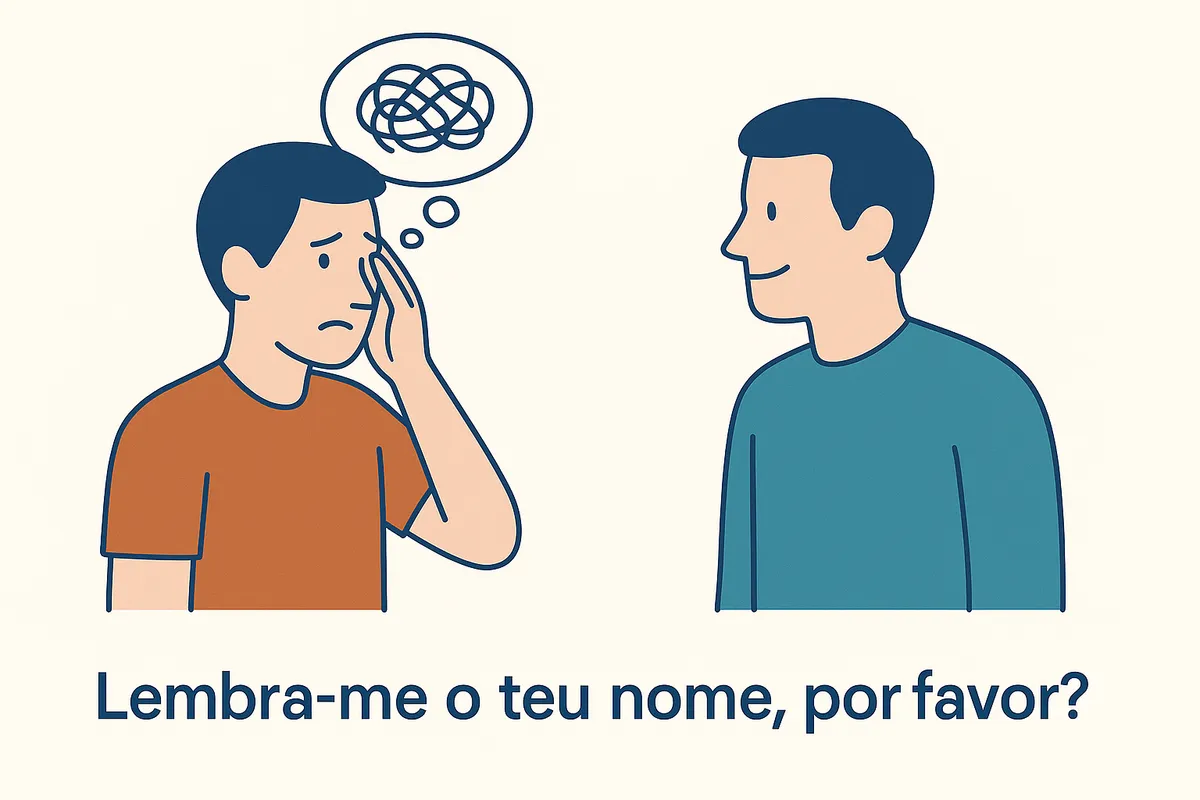 Forgot a name? Just say “Esqueci-me!” It happens to everyone.
These are all reflexive. Are you able to tell the difference?
| English | Portuguese |
|---|---|
| I remember you (informal) | Lembro-me de ti |
| Remind me your name? | Lembra-me o teu nome? |
| I’m going to bed early today | Vou-me deitar cedo hoje. |
Good luck with learning all this! I know it’s a lot at first but I promise it gets easier the more you see it, hear it, and read it. Exposure is everything when language learning.
As always don’t hesitate to ask me to clear anything up if you’re having trouble. I’d be happy to hear from you!
