


Choosing between era, foi, estava, and esteve is one of those moments that makes English speakers freeze mid-sentence. English gives you one word for the job, and Portuguese gives you four.
The good news is that there’s a clear logic underneath, and a two-step process gets you to the right choice every time. Getting comfortable with this is a big step past the basics of Portuguese present and past tenses and toward sounding more natural in everyday conversation.
The Four Options
English mostly gives you was and were. Portuguese gives you four common ways to say “was”:
- era
- foi
- estava
- esteve
That looks like a lot, but you get there with two questions:
- Step 1: Is it ser (a core quality) or estar (a temporary state)?
- Step 2: Is it a background description (imperfect) or a completed event (preterite)?
Answer those two and you have your verb.
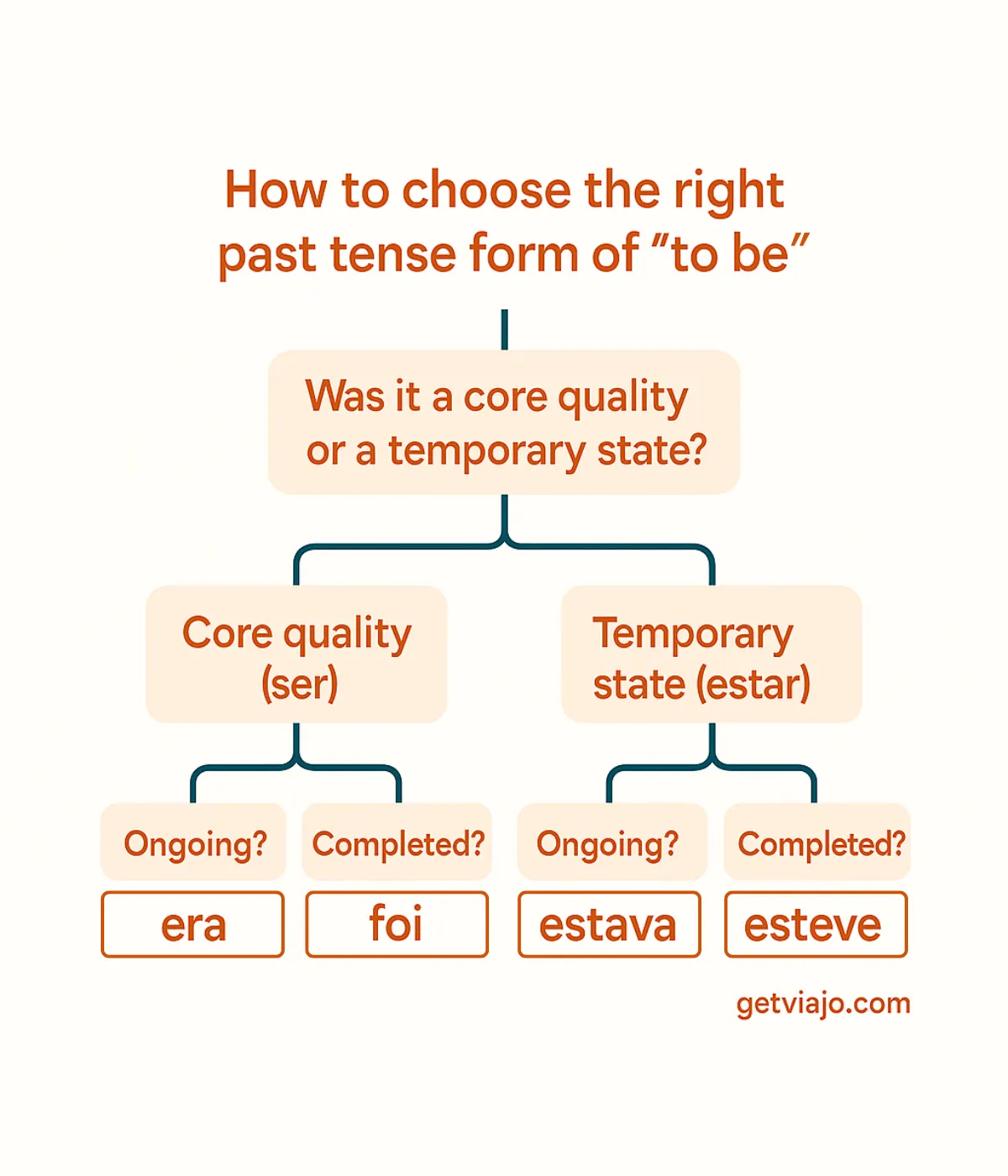 First choose between ser and estar, then decide if it’s a background description or a completed event, and you’ve got your answer.
Step 1: Ser or Estar
This is the classic core quality (ser) versus temporary state (estar) decision. If you’ve studied Spanish, this will feel familiar. It’s the biggest choice you’ll make, and it cuts your options in half right away.
[!tip]Pro Tip Don’t worry yet about why you see both era and foi in the examples below. The goal here is just to train your brain to pick the right verb family, ser (foi, era) for core qualities and estar (esteve, estava) for temporary states. You’ll pick the exact form in Step 2.
Core Qualities = Ser
Ser describes the DNA of a person, object, or event. You’re talking about what something was. These are traits, roles, or facts that define it.
Use ser for identity or characteristics, profession, relationships, origin, and the time or date of an event.
| English | Portuguese |
|---|---|
| He was a nice man. (identity) | Ele era um homem simpático. |
| My mother was a teacher. (profession) | A minha mãe era professora. |
| We were good friends. (relationship) | Nós éramos bons amigos. |
| My grandfather was from Viseu. (origin) | O meu avô era de Viseu. |
| The party was on Saturday. (time of event) | A festa foi no sábado. |
In the wild:
A: Como era o teu avô?
B: Ele era uma pessoa impecável e era padeiro em Viseu.
Temporary States = Estar
Estar describes a snapshot in time. You’re talking about how something was at a particular moment. Conditions, moods, locations, weather, anything not permanent by nature.
Use estar for location, mood or feelings, physical condition, and weather.
| English | Portuguese |
|---|---|
| She was in Lisbon last year. (location) | Ela estava em Lisboa no ano passado. |
| In that moment, I was very happy. (mood) | Naquele momento, eu estava muito feliz. |
| After the run, they were tired. (physical condition) | Depois da corrida, eles estavam cansados. |
| On Sunday, the weather was awful. (weather) | No domingo, o tempo estava horrível. |
In the wild:
A: Como estava o tempo ontem?
B: Estava um frio de rachar! Eu estava cheio de pressa para chegar a casa.
The What vs. How Test
The most reliable shortcut for English speakers is to ask whether you’re describing what something was or how it was.
- What it was (its essence, identity, a defining trait) points to ser.
- How it was (its condition, location, a passing feeling) points to estar.
What about long-term happiness? Feelings aren’t always estar. If you’re describing a whole chapter of your life, you can say “Naquela altura, eu era muito feliz” (At that time, I was very happy). Being happy here wasn’t a fleeting mood, it was the core quality of that phase of your life.
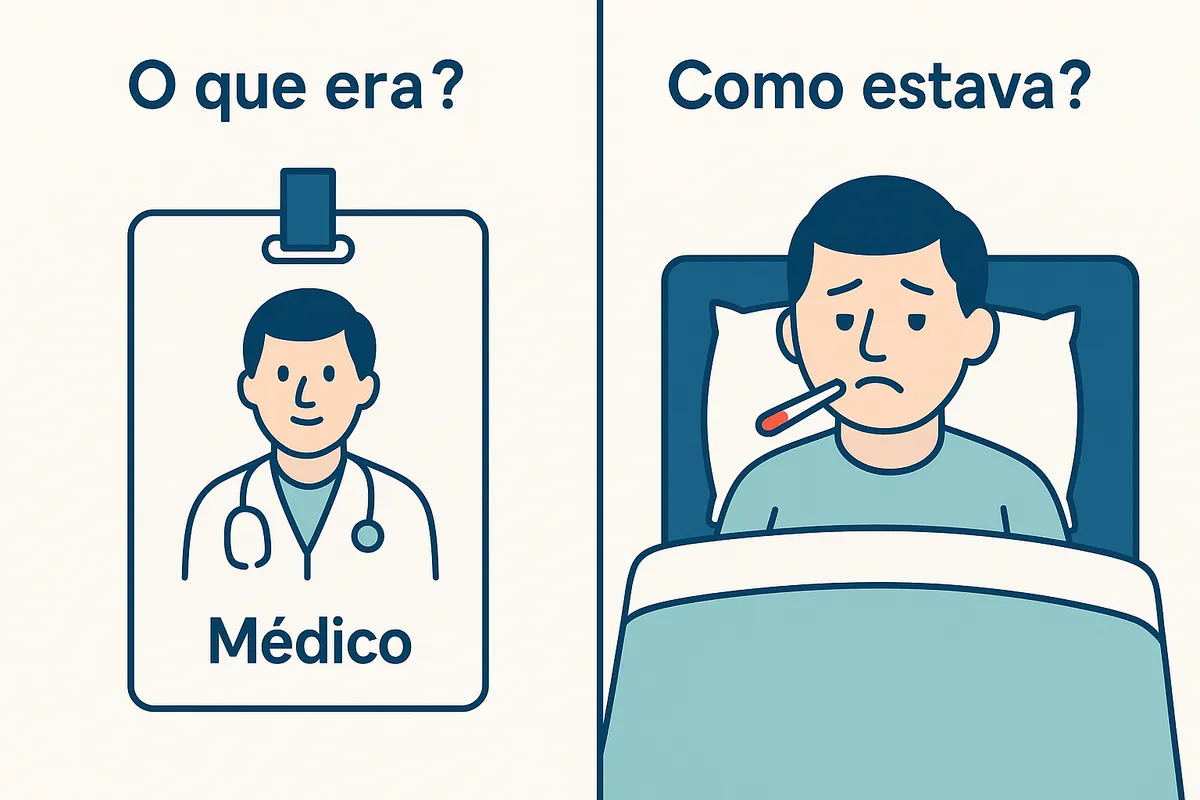 Asking ‘what it was’ (ser) versus ‘how it was’ (estar) is the key to your first decision.
Step 2: Background Description or Completed Event
You’ve decided between core quality (ser) and temporary state (estar). Now the second question, are you painting a background scene or describing a specific, finished event? That’s the split between the imperfect tense (background) and the preterite tense (completed).
Background Description (Imperfect)
The imperfect paints the backdrop of a story. If you picked ser, you’ll use era. If you picked estar, you’ll use estava. This tense describes ongoing conditions, sets the scene, and covers habitual actions in the past. No clear start or end.
[!tip] Master the Background Vibe
The imperfect tense is the secret to storytelling in Portuguese. For more on the feel of era and estava, check out my full guide on The Imperfect Storytelling Tense.
In English, this often comes out as “used to be” or “was/were ___ing.”
- Quando eu era criança, brincava muito na rua. (When I was a child, I used to play in the street a lot.) (ser → era)
- Estava a chover quando saí de casa. (It was raining when I left the house.) (estar → estava)
Completed Event (Preterite)
The preterite is for actions or states that are finished. If you picked ser, you’ll use foi. If you picked estar, you’ll use esteve. This tense is for things that happened at a specific point in the past and are now over.
- O filme foi ontem. (The movie was yesterday.) (ser → foi)
- Ele esteve em Portugal durante duas semanas. (He was in Portugal for two weeks.) (estar → esteve)
Trigger Words as Clues
Some words give you a strong hint about which tense fits. Treat them as signals about whether the sentence is setting a scene or describing something finished.
Words that often signal a background description (imperfect):
| English | Portuguese |
|---|---|
| always | sempre |
| normally | normalmente |
| every day | todos os dias |
| many times | muitas vezes |
| while | enquanto |
Words that often signal a completed event (preterite):
| English | Portuguese |
|---|---|
| yesterday | ontem |
| last week | na semana passada |
| in (year/month) | em (year/month) |
| suddenly | de repente |
| one time | uma vez |
The Four Choices in Action
Era
Use era to set the scene with a core quality (ser for background description).
- A casa era antiga. (The house was old.)
Foi
Use foi for the core quality of a specific, finished event (ser for a completed event).
- A reunião foi uma seca. (The meeting was a bore.)
Estava
Use estava for a temporary state that was in progress (estar for a background condition).
- Eu estava cansado, por isso não fui. (I was tired, so I didn’t go.)
Esteve
Use esteve for a temporary state across a specific, finished period (estar for a completed state).
- Ele esteve doente no Natal. (He was sick at Christmas.)
Common Pitfalls for English Speakers
Foi Bom vs. Estava Bom
You’ve just finished a meal. What do you say? This is where a lot of learners stumble.
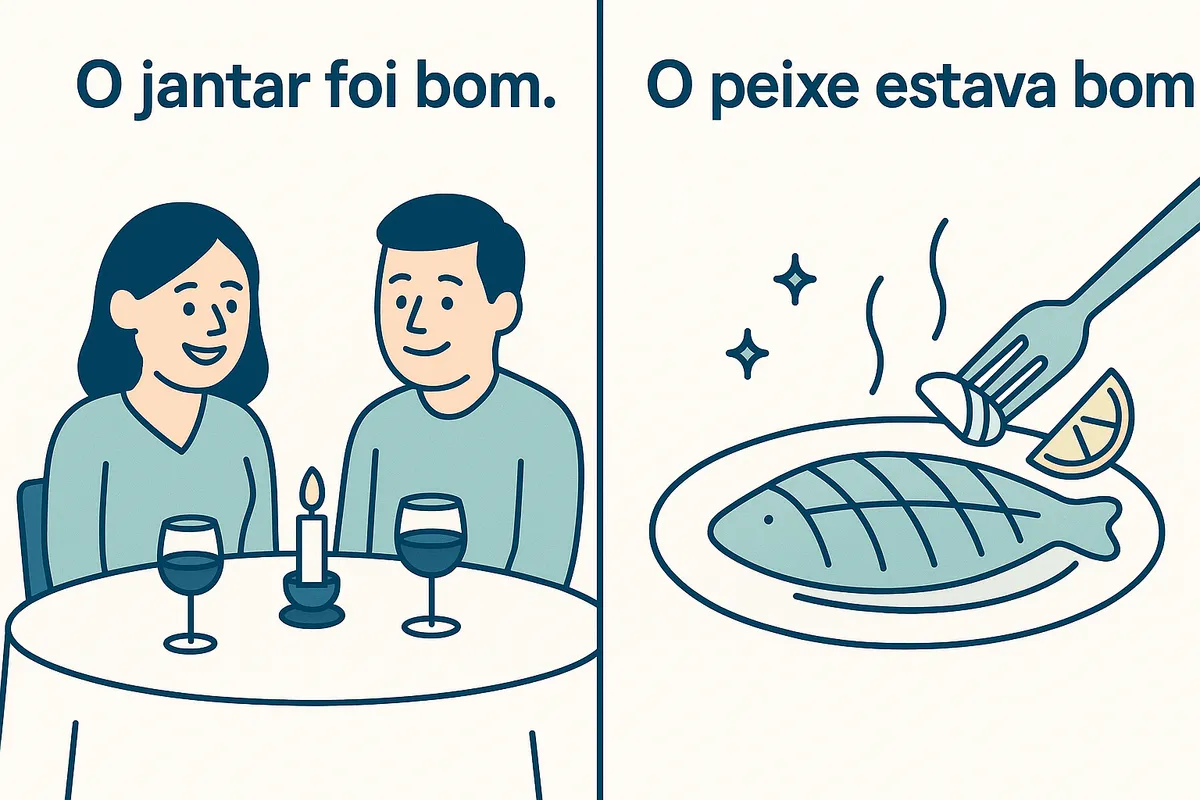 Use foi to describe the whole event, and estava to describe the state of the food itself.
In Portugal, o jantar or o almoço can refer to the food itself, not only the gathering.
- O jantar estava ótimo! (The dinner/food was great!) Use this almost any time you’re commenting on how the food tasted.
- O jantar foi bom. (The dinner was good.) Use this when you’re judging the event, the company, the atmosphere, the whole night.
- Avoid: “A comida foi boa.” It sounds off. Go with estava.
Street Tip: To sound a bit more local, use o comer (the food) as a noun.
A: Quando é que fica pronto o comer? (When is the food ready?)
B: Já está! O comer estava muito bom, não estava? (The food was really good, wasn’t it?)
Estava Feliz vs. Fiquei Feliz
Estava describes a state of being, but Portuguese often uses ficar (to become) to express a change in emotion.
- Estava feliz naquele dia. (I was happy that day.) Background feeling.
- Fiquei feliz com o presente. (I was/became happy with the gift.) A reaction to something.
You’ve Got This
It looks like a lot, but it isn’t guesswork.
- First: core quality (ser) or temporary state (estar)?
- Then: background scene (imperfect) or completed event (preterite)?
To see how these past tenses fit into the bigger timeline, check out my master guide on Portuguese verb tenses.
Frequently Asked Questions
[!faq]- What’s the real difference between “O meu avô era padeiro” and “O meu avô foi padeiro”? Both are common, but the focus shifts. Ele era padeiro sets a scene, you’re probably about to tell a story about his life. Ele foi padeiro states it as a completed fact, a chapter that is now closed. You’d use foi when listing things he did: “He was a baker, then he was a driver.”
[!faq]- Can I say “A comida foi boa”? It sounds odd. To compliment the food itself, use estava. To compliment the whole night out, use foi for the jantar (the event).
[!faq]- Why do people say “Ele esteve em Lisboa” but “Ele era de Lisboa”? Being in a place is a snapshot (estar), but being from a place is part of your DNA (ser). He esteve (was temporarily) in Lisbon, but he era (was inherently) from Lisbon.
