


English lets you get away with one past tense for almost everything. “I walked” can mean a single hike last Tuesday or a commute you repeated for ten years. The listener fills in the rest from context.
Portuguese does not give you that shortcut. You have to pick. Did you walk once (andei), or were you in the process of walking (andava)?
That choice is the difference between stating a fact for the record and setting a scene for a friend.
If the general feel of these tenses is still shaky, start with my guide on the storytelling vibe of the Imperfect.
For me, this finally clicked when I stopped memorizing rules and started thinking like a film director. The framing is sometimes called the Movie Scene method.
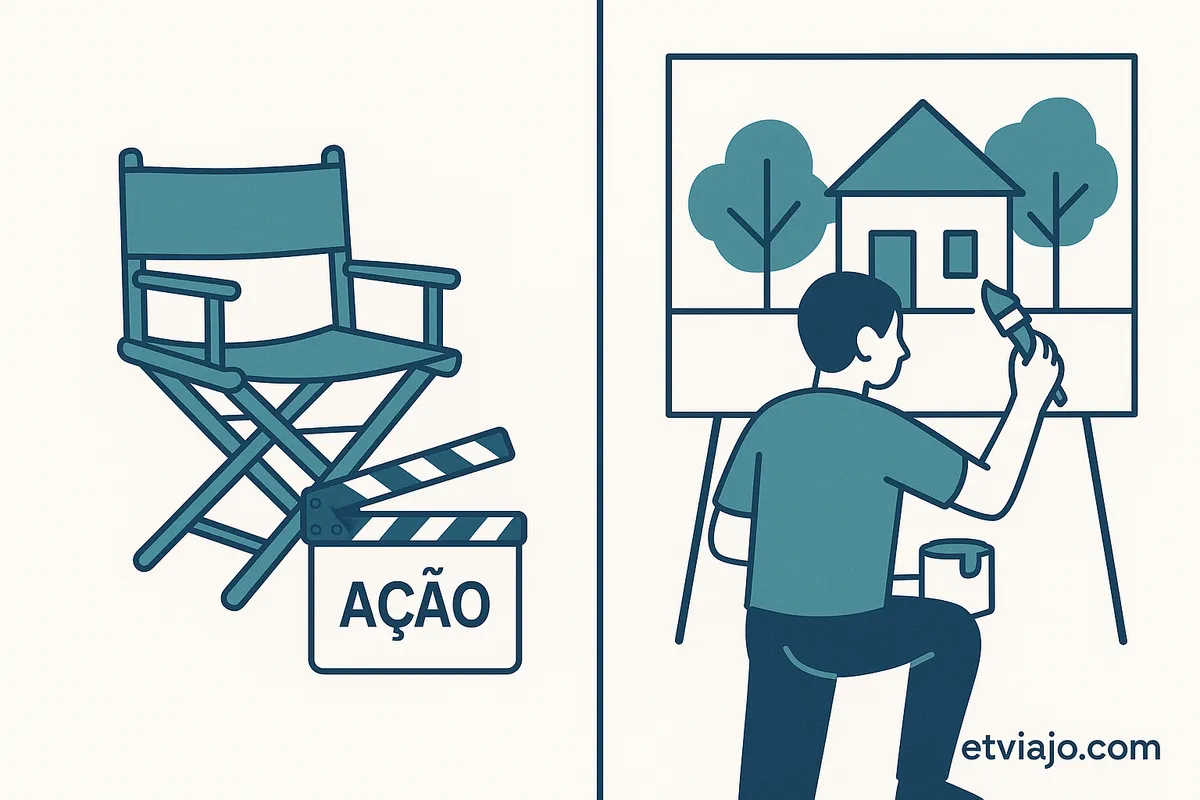 Think of your verb tenses like a film set. One controls the action, the other paints the background.
The Simple Past Handles the Action
The Simple Past (Pretérito Perfeito) is your “Action!” moment. These are events that started and finished at a specific time. They are done.
Think of them as the plot points of your movie. The camera focuses, the action happens, the scene moves on.
| English | Portuguese |
|---|---|
| I ate a pastel de nata | Eu comi um pastel de nata |
| She opened the door | Ela abriu a porta |
| They spoke with the boss | Eles falaram com o chefe |
The Imperfect Handles the Set Design
While the Simple Past pushes the action forward, the Imperfect (Pretérito Imperfeito) builds the set.
It freezes the timeline to paint the picture. It covers context, weather, feelings, or habits. It shows what the world looked like while the plot was waiting for the main action to start.
| English | Portuguese |
|---|---|
| The house was big | A casa era grande |
| I used to ride my bike | Eu costumava andar de bicicleta |
[!tip] Showing Habit The verb costumar (costumava) is a clear way to emphasize that something was a regular, repeating habit in your past life.
Here is how this works in a real conversation. Describing a childhood home to a Portuguese friend:
“A minha casa era perto da praia, por isso eu nadava todos os dias.” (My house was near the beach, so I used to swim every day.)
 The Imperfect paints the background before the main character enters the scene.
Scenario 1: The Interruption
This is the most common pairing in daily conversation. You set the scene with the background (Imperfect), and then something interrupts it (Simple Past).
In spoken European Portuguese, the continuous structure Estava a + Verb (was ___-ing) tends to handle the background action.
The formula is background (Estava a ___) plus interruption (Simple Past).
| English | Portuguese |
|---|---|
| I was talking on the phone when you arrived | Eu estava a falar ao telefone quando tu chegaste |
| I was reading when the phone rang | Eu estava a ler quando o telefone tocou |
Picture it: the camera pans across the room where you are reading (background), and the phone rings (action).
In context: “O que é que estavas a fazer quando o telefone tocou?” (What were you doing when the phone rang?) “Eu estava a tomar banho!” (I was taking a shower!)
[!warning] Is “Chovia” Too Dramatic?
Textbooks often teach “It was raining” as Chovia. It is correct, but in casual conversation it can sound a bit literary. The continuous form Estava a chover is more common day to day.
If you want to emphasize how intense the weather was, the simple Imperfect can land harder: “Pá, chovia que era uma coisa doida!” (Man, it was raining like crazy!)
Audio lessons and PDF study guides to accompany every lesson
Get In on the Ground Floor!
This is a new website!
As such, I'm starting the price for premium at just $2.99/mo, increasing to $11.99/mo after my first 100 members.
Scenario 2: The Split Screen
Sometimes nothing gets interrupted. Two things are simply happening in the background at the same time. The keyword here is Enquanto (While).
When two background actions run side by side, both belong to the “set design.”
In this split-screen case, the simple Imperfect form often feels more natural than repeating estava a twice.
| English | Portuguese |
|---|---|
| While Luísa was sunbathing, João was drinking a juice | Enquanto a Luísa apanhava sol, o João bebia um sumo |
| I was cooking while you were reading | Eu cozinhava enquanto tu lias |
A real example, describing a quiet Sunday morning: “Ontem de manhã foi muito calmo. Enquanto eu fazia o pequeno-almoço, o meu marido lia o jornal.” (Yesterday morning was very calm. While I was making breakfast, my husband was reading the newspaper.)
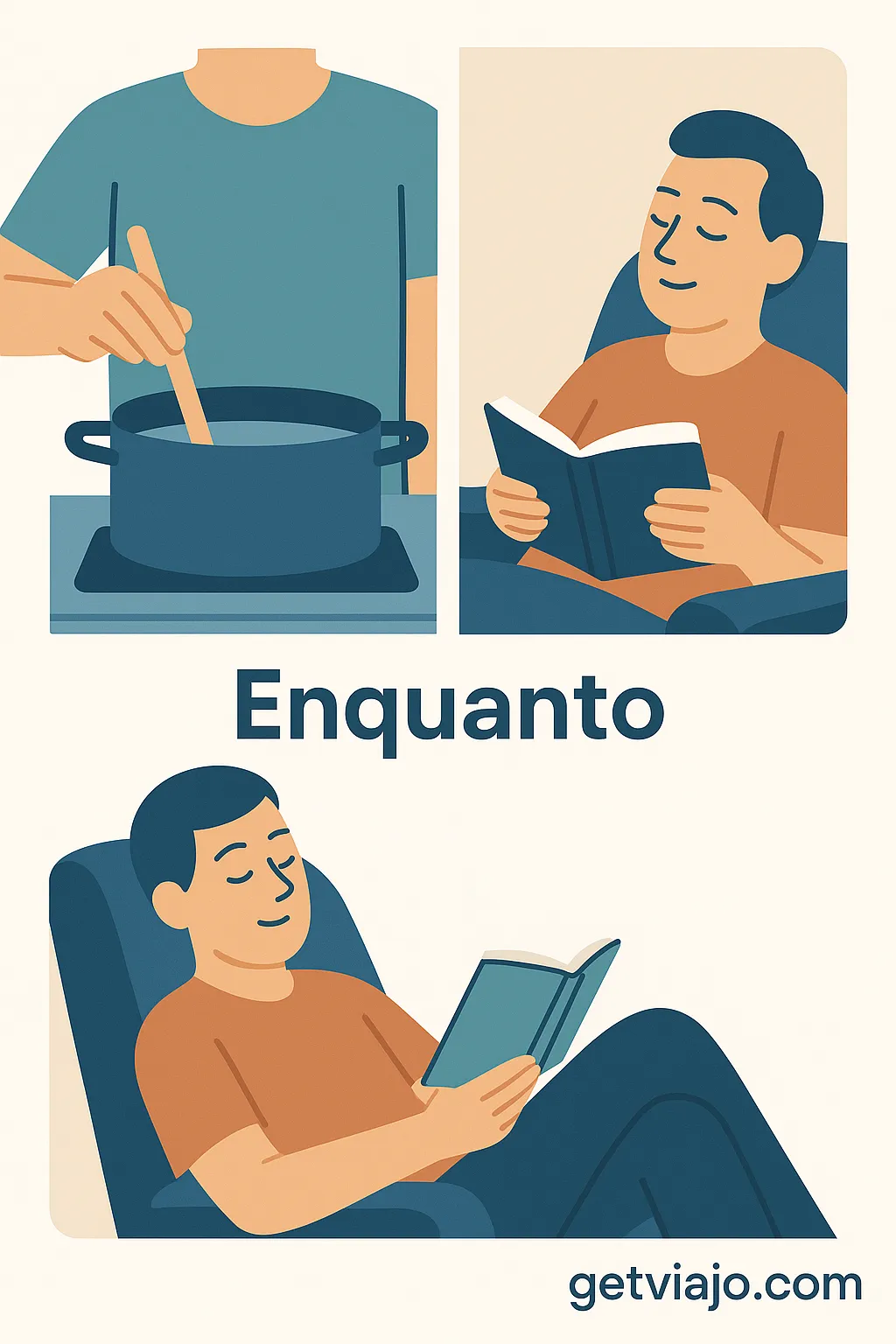 When two things happen at once without interruption, both stay in the Imperfect.
Scenario 3: The ‘Que’ Cheat Code
When you report what someone said or thought in the past using que (that), the verb that follows is almost always Imperfect.
The reason is simple. You are describing the reality that existed in their head at that moment. It was their background scenery.
| English | Portuguese |
|---|---|
| He said that it was late | Ele disse que era tarde |
| I thought that you had the ticket | Eu pensei que tinhas o bilhete |
| She thought that the bank was open | Ela achava que o banco estava aberto |
Showing up to a café and finding it closed: “Fogo, eu achava que estava aberto!” (Damn, I thought it was open!) “Pois, mas o empregado disse que era feriado.” (Yeah, but the employee said it was a holiday.)
The Movie Director mindset carries over to most of the other tenses too. For the full timeline, see my master guide on Portuguese Verb Tenses.
A Note on Era vs Estava
You may have noticed Era in one example (“era tarde”) and Estava in another (“estava aberto”). Both translate as “was,” but they describe different kinds of states (permanent vs. temporary).
If you are unsure why a house era big but the bank estava open, the answer sits inside the Ser vs. Estar split. I broke that down in my guide on the difference between Era and Estava.
How to Form the Verbs
The focus here is the method, because the “Movie Scene” logic is usually the harder part for English speakers.
The good news is that the Imperfect is probably the most regular, stress-free tense in the language.
👉 Deep Dive: The "No-Stress" Guide to Imperfect Conjugations
Frequently Asked Questions
[!faq]- Can I use ‘Costumava’ to say ‘I used to’? Yes, and it is very common. The simple Imperfect (ia, comia) can show a past habit on its own, but costumava makes the repetition explicit. It is a natural way to say “I used to [verb] regularly.” More on this in my guide on How to Say "Used To" in Portuguese.
[!faq]- Is ‘Fui’ the Simple Past or the Imperfect? Fui is the Simple Past (Pretérito Perfeito) of two different verbs, Ser (to be) and Ir (to go). It is never the Imperfect. The Imperfect of Ser is Era. The Imperfect of Ir is Ia.
[!faq]- Are there specific keywords that trigger one tense over the other? Time markers help a lot. Pinpoint words like ontem (yesterday) or na semana passada (last week) usually pull the Simple Past. Vaguer markers like antigamente (in the old days) or todos os dias (every day) usually pull the Imperfect.
[!faq]- What if I just use the Simple Past for everything? You will be understood, but you will sound flat. The Imperfect carries the texture and feeling of a story. Skipping it tends to make you sound like you are reading a list of facts rather than sharing a memory.
